
| From | Nazgol Ghandnoosh <[email protected]> |
| Subject | Felony Murder - An On-Ramp for Extreme Sentencing |
| Date | July 14, 2026 3:42 PM |
Links have been removed from this email. Learn more in the FAQ.
Links have been removed from this email. Learn more in the FAQ.
[link removed] [[link removed]]
Dear John,
Imagine being sentenced to life in prison for a murder you didn't commit, didn't intend, and didn't directly cause. Under felony murder laws in the United States, this is a devastating reality.
Today, we released an update to our groundbreaking report with Fair and Just Prosecution, " Felony Murder: An On-Ramp for Extreme Sentencing [[link removed]] ," exposing how these outdated laws have become a major, yet often overlooked, driver of mass incarceration and racial inequity in the American legal system.
The crime of "felony murder" is charged when a death occurs when a person participates in a felony. These laws compel harsh decades-long – or even death by incarceration – sentences even when the individual charged did not directly cause or intend the loss of life.
Our research reveals a deeply broken system that punishes disproportionately and excessively. Key findings from this report include:
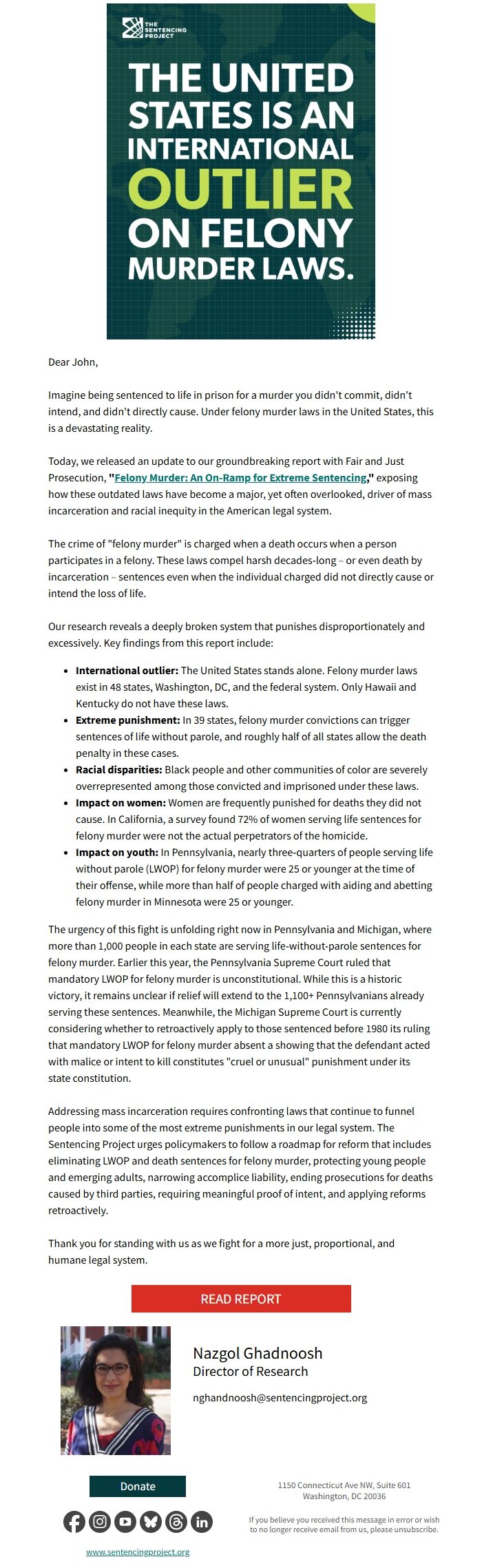
* International outlier: The United States stands alone. Felony murder laws exist in 48 states, Washington, DC, and the federal system. Only Hawaii and Kentucky do not have these laws.
* Extreme punishment: In 39 states, felony murder convictions can trigger sentences of life without parole, and roughly half of all states allow the death penalty in these cases.
* Racial disparities: Black people and other communities of color are severely overrepresented among those convicted and imprisoned under these laws.
* Impact on women: Women are frequently punished for deaths they did not cause. In California, a survey found 72% of women serving life sentences for felony murder were not the actual perpetrators of the homicide.
* Impact on youth: In Pennsylvania, nearly three-quarters of people serving life without parole (LWOP) for felony murder were 25 or younger at the time of their offense, while more than half of people charged with aiding and abetting felony murder in Minnesota were 25 or younger.
The urgency of this fight is unfolding right now in Pennsylvania and Michigan, where more than 1,000 people in each state are serving life-without-parole sentences for felony murder. Earlier this year, the Pennsylvania Supreme Court ruled that mandatory LWOP for felony murder is unconstitutional. While this is a historic victory, it remains unclear if relief will extend to the 1,100+ Pennsylvanians already serving these sentences. Meanwhile, the Michigan Supreme Court is currently considering whether to retroactively apply to those sentenced before 1980 its ruling that mandatory LWOP for felony murder absent a showing that the defendant acted with malice or intent to kill constitutes "cruel or unusual" punishment under its state constitution.
Addressing mass incarceration requires confronting laws that continue to funnel people into some of the most extreme punishments in our legal system. The Sentencing Project urges policymakers to follow a roadmap for reform that includes eliminating LWOP and death sentences for felony murder, protecting young people and emerging adults, narrowing accomplice liability, ending prosecutions for deaths caused by third parties, requiring meaningful proof of intent, and applying reforms retroactively.
Thank you for standing with us as we fight for a more just, proportional, and humane legal system.
READ REPORT [[link removed]]
Photo of Kristen M. Budd, Ph.D. [[link removed]] Nazgol Ghadnoosh
Director of Research
[email protected]
Donate [[link removed]]
[link removed] [[link removed]] [link removed] [[link removed]] [link removed] [[link removed]] [link removed] [[link removed]] [link removed] [[link removed]] [link removed] [[link removed]] 1150 Connecticut Ave NW, Suite 601
www.sentencingproject.org [[link removed]] Washington, DC 20036
If you believe you received this message in error or wish to no longer receive email from us, please unsubscribe: [link removed] .
Dear John,
Imagine being sentenced to life in prison for a murder you didn't commit, didn't intend, and didn't directly cause. Under felony murder laws in the United States, this is a devastating reality.
Today, we released an update to our groundbreaking report with Fair and Just Prosecution, " Felony Murder: An On-Ramp for Extreme Sentencing [[link removed]] ," exposing how these outdated laws have become a major, yet often overlooked, driver of mass incarceration and racial inequity in the American legal system.
The crime of "felony murder" is charged when a death occurs when a person participates in a felony. These laws compel harsh decades-long – or even death by incarceration – sentences even when the individual charged did not directly cause or intend the loss of life.
Our research reveals a deeply broken system that punishes disproportionately and excessively. Key findings from this report include:
* International outlier: The United States stands alone. Felony murder laws exist in 48 states, Washington, DC, and the federal system. Only Hawaii and Kentucky do not have these laws.
* Extreme punishment: In 39 states, felony murder convictions can trigger sentences of life without parole, and roughly half of all states allow the death penalty in these cases.
* Racial disparities: Black people and other communities of color are severely overrepresented among those convicted and imprisoned under these laws.
* Impact on women: Women are frequently punished for deaths they did not cause. In California, a survey found 72% of women serving life sentences for felony murder were not the actual perpetrators of the homicide.
* Impact on youth: In Pennsylvania, nearly three-quarters of people serving life without parole (LWOP) for felony murder were 25 or younger at the time of their offense, while more than half of people charged with aiding and abetting felony murder in Minnesota were 25 or younger.
The urgency of this fight is unfolding right now in Pennsylvania and Michigan, where more than 1,000 people in each state are serving life-without-parole sentences for felony murder. Earlier this year, the Pennsylvania Supreme Court ruled that mandatory LWOP for felony murder is unconstitutional. While this is a historic victory, it remains unclear if relief will extend to the 1,100+ Pennsylvanians already serving these sentences. Meanwhile, the Michigan Supreme Court is currently considering whether to retroactively apply to those sentenced before 1980 its ruling that mandatory LWOP for felony murder absent a showing that the defendant acted with malice or intent to kill constitutes "cruel or unusual" punishment under its state constitution.
Addressing mass incarceration requires confronting laws that continue to funnel people into some of the most extreme punishments in our legal system. The Sentencing Project urges policymakers to follow a roadmap for reform that includes eliminating LWOP and death sentences for felony murder, protecting young people and emerging adults, narrowing accomplice liability, ending prosecutions for deaths caused by third parties, requiring meaningful proof of intent, and applying reforms retroactively.
Thank you for standing with us as we fight for a more just, proportional, and humane legal system.
READ REPORT [[link removed]]
Photo of Kristen M. Budd, Ph.D. [[link removed]] Nazgol Ghadnoosh
Director of Research
[email protected]
Donate [[link removed]]
[link removed] [[link removed]] [link removed] [[link removed]] [link removed] [[link removed]] [link removed] [[link removed]] [link removed] [[link removed]] [link removed] [[link removed]] 1150 Connecticut Ave NW, Suite 601
www.sentencingproject.org [[link removed]] Washington, DC 20036
If you believe you received this message in error or wish to no longer receive email from us, please unsubscribe: [link removed] .
Message Analysis
- Sender profile: Sentencing Project
- Political Party: n/a
- Country: United States
- State/Locality: n/a
- Office: n/a
-
Email Providers:
- EveryAction