
|
 |


Kitty Thompson is the Head of Policy and Campaigns at Create Streets
If you go down to the woods today, you’d better go in disguise. If you are planning a trip to the National Trust’s Ashridge Estate, I’d specifically recommend going disguised as a stag beetle.
That’s one of the features the 1,276-hectare Chiltern Beechwoods Special Area of Conservation (SAC) was designated to protect. Found on the Hertfordshire-Buckinghamshire border, this SAC constitutes a beautiful part of the country, comprising ancient beech forests and species-rich chalk grasslands. The National Trust is the majority landowner; the jewel in the SAC’s crown is its Ashridge Estate. As with so much of our natural environment, this site is under threat and in need of some serious remedial work to conserve and protect its integrity.
Rather than pointing the finger at familiar culprits, like climate change and biodiversity loss, according to surveying from 2021, we need to point the finger at ourselves. The problem is not that people don’t love Ashridge enough. With around 1.7 million visitors a year, it’s that they love it too much.
The ecological problems are real enough: widespread erosion, exposed tree roots, dog fouling, campfires, verge parking, and removal of deadwood for den building. While the National Trust has already been taking steps to address these issues, including path management, ranger presence, and educational signage, more needs to be done to meet the scale of the challenge.
Because of the area’s legal designation as an SAC, and therefore its tie to the perverse and precautionary world of the EU-derived Habitats Regulations, the four local councils, as the relevant Competent Authorities, have a legal duty “to ensure that all the activities they regulate have no adverse effect on the integrity” of the Chiltern Beechwoods SAC.
The resulting solution proceeds with almost admirable simplicity. Surveyors found that 97 per cent of visitors had travelled from home, that 75 per cent lived within 12.6km of Ashridge, and that roughly half had come to walk their dog. People live in houses. More houses could mean more visitors. Councils cannot regulate the number of dog walkers visiting the site. Councils can regulate housing. So they are. By process of regulatory elimination, a challenge of managing a much-loved landscape has become a challenge of managing future neighbours living in the 32,049 planned homes within the Zone of Influence.
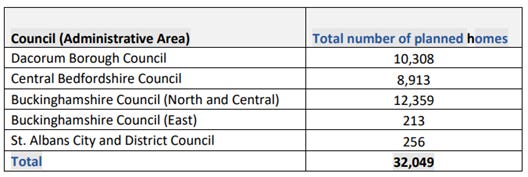 |
Planned housing growth within the Zone of Influence (page 54)
With the two Sites of Special Scientific Interest (SSSI) at its centre, a 500-metre ‘Avoidance Zone’ immediately around them was drawn with an explicit presumption against development within it to ensure “no increase in the number of dwellings there.” An accompanying 12.6km ‘Zone of Influence’ was drawn around that with developers having to adhere to the mitigation strategy devised by the local authorities in consultation with Natural England. Unsurprisingly, for the best part of the year that it took to put the strategy in place, there was an effective ban on housebuilding.
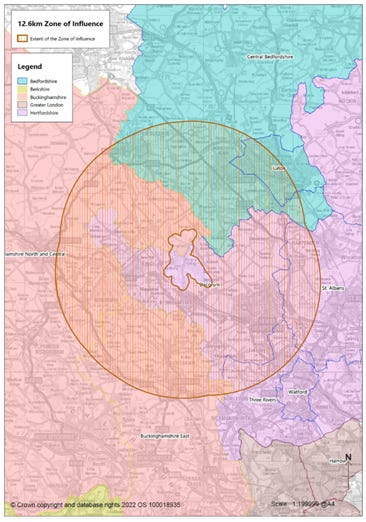 |
The Zone of Influence (page 17)
Now, with the mitigation strategy firmly in place, housebuilders may once again find themselves wondering why they should bother.
Firstly, the mitigation strategy requires that new developments contribute towards the cost of the 80-year £18.2 million Strategic Access Management and Monitoring Strategy (SAMMS) to directly resolve the current issues. This includes measures such as “new access interpretation materials” (£650,000), “track/path surfacing and maintenance” (£1,680,000), “soil decompaction equipment” (£180,000), and the “provision of dog waste bins (and litter bins)” (£299,200). Developers in Dacorum that wish to build in the Zone of Influence must pay £1,014.43 per new home built towards the SAMMS (similar figures apply for developers in Buckinghamshire).
Secondly, new developments must either deliver, or pay into the delivery of, a new ‘Suitable Alternative Natural Greenspaces’ (SANG). This is an attempt to divert new and future residents away from the locally prized Ashridge Estate and towards alternative greenspaces. In Dacorum, larger developments (10+ homes) need to make provision for their own SANG, on or off-site, unless they meet certain criteria. Smaller developments (less than 10 homes) must pay £6,083.53 per home towards one of the two Council-owned SANG. This will help cover the cost of actions to manage the SANG, such as picnic benches and chopping trees down to create footpaths. Again, similar charges apply in Buckinghamshire.
Our regulatory system has allowed a system to emerge in which the bad past behaviour by - indeed, the mere presence of - visitors to a nearby SAC punishes anyone dreaming of buying a new home within one of the most popular, scenic, and commutable places in the country, let alone the housebuilders wishing to turn their dreams into a reality.
Take a step back from the price tag for a moment and a more basic flaw comes into view: an overly simplistic system that regulates whoever is easiest to reach, not whoever is best placed to solve the problem.
 |
The ecological challenge for Ashridge is, first and foremost, a site management challenge. The National Trust runs the visitor facilities, manages the car parks, and welcomes visitors and dogs to the site. Yet the funding for the SAMMS relies on those building and buying new homes in the surrounding area. This is not because the regulations explicitly require such an approach, nor because new housing is uniquely responsible for the underlying problem, just that development is one of the few things local authorities, as the Competent Authority, can influence directly.
As it stands, the incentives facing the National Trust as the landowner are skewed. On the one hand, the trust needs Ashridge to be in a good enough condition for people to want to visit, and to provide them with the amenities - from famed scones to car parking - to make the visit easy and enjoyable. But, legally speaking, by not being the Competent Authority, the trust can lean on the local authorities for financial support and assistance with delivery of the SAMMS.
Its incentives to tackle visitor pressures more directly are therefore limited. Take car parking charges. The charity has considered introducing a fee, which could both raise revenue and discourage some visits. For the purposes of protecting the SAC from too many people, this deterrent would surely be a good thing. But limiting numbers to Ashridge would impact the National Trust’s business model. The same incentives apply to dog access. If dog walkers make up a large proportion of visitors, and thus the damage, there is a theoretical incentive to limit them for the sake of the SAC, but not for the sake of the National Trust.
If we were building a regulatory system from scratch, this is unlikely to be the one we would choose, not least for a government that has any desire to build more homes. A more proportionate response to the challenges facing the Chiltern Beechwoods SAC would surely centre on on-site management, funnelling all financial resources directly to the site.
Similarly, the current mitigation strategy adopts the logic that all homes within the Zone of Influence are created equally. This is simply not true. While all net new additional dwellings are screened into the process, with extensions and granny flats treated on a case-by-case basis, the current plan does not take account of the type of dwelling house. This risks favouring more unsustainable, edge of town greenfield development over inherently more sustainable, gently densified infill developments in town centres.
This simplistic approach has, for example, seen the delivery of up to 150 homes in a neighbourhood-led brownfield scheme in Chesham, some 10km away, stall. Compared with a conventional suburban development of detached homes with ample parking, this development would have been ‘car light’. It would have also been built within a town that has easy access both to a local park and the surrounding countryside, providing ample opportunities for new residents to walk their dogs without the need for either a new SANG or a trip to the Ashridge Estate, with only 2 per cent of visitors surveyed coming from Chesham.
There is surely scope to exempt, partially or fully, new brownfield sites on the grounds that they have low levels of parking. Similarly, with plenty of existing sites nearby for residents to access nature, there is further scope to exempt or partially exempt these developments from their current SANG contributions where strategic alternatives already exist – just because a popular park or walking route is not defined as a ‘SANG’ does not mean that it won’t serve the same purpose.
Another approach could see the Government forward fund new SANG for towns that want to build housing but need new greenspace, with spending able to be recovered through developer contributions over time, rather than as an upfront payment and commitment, as has been proposed by Create Streets and Britain Remade.
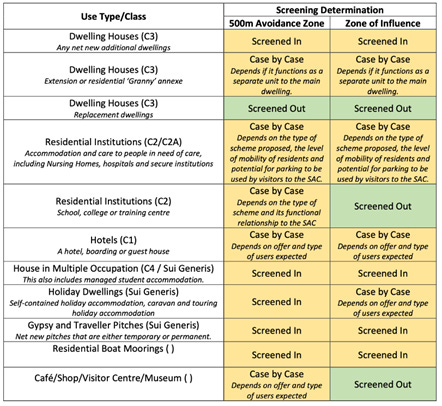 |
Development types impacted by the mitigation strategy (page 20)
None of this is to deny that Ashridge deserves protection. It plainly does. The stag beetles need their beechwoods. But people also need new homes. Delivering both requires a regulatory model that aligns responsibility, incentives, and funding, rather than relying on whatever levers are available to a local authority. As the National Trust erects new developer-funded car parking signs across the Ashridge Estate, all roads seem to lead to reform of the Habitats Regulations.
What we’re reading:
State of exception. Over at The Critic, Philip Cunliffe has argued that Britain’s economic woes stem not from capitalism itself but from a prolonged period of weak investment, low productivity and a risk-averse business environment. Instead, we need long-term investment, innovation, entrepreneurship and competitive markets – and Cunliffe believes the state has a role in creating the conditions that enables businesses to reap the rewards of capitalism’s dynamism.
Crash and Burnham. It seems like he has already outstayed his welcome, but Andy Burnham still isn’t Prime Minister yet. Andrew O’Brien has some hard truths for him over at UnHerd. He suggests Burnham’s tax agenda might be attractive to Labour’s base but could prove difficult to sustain once it encounters fiscal realities. Wealth taxes are complex to administer, encourage capital flight and raise less revenue than advocates hope – as EA readers know well.
The kids aren’t alright. For The Spectator, Fleur Elizabeth Meston contends that while government-funded nursery provision is intended to help families and boost employment, it may have unintended costs for young children. ‘Free’ nursery may be placing growth ahead of children’s development needs, with research suggesting long hours in institutional childcare can be associated with higher stress levels. Shouldn’t childcare policy put children first?
Freeze peach. Rhys Laverty has taken to the Daily Wire to explain how Britain can strengthen free speech by moving closer to an American model of robust legal protection for expression. In line with Reversing Britain’s Free Speech Recession, a new paper from the Prosperity Institute, Laverty examines the expanding body of legislation, police practices and regulatory measures that need repealing to preserve Britain’s democratic traditions and liberal culture.
Striking back. For his Comment is Freed Substack, Lawrence Freedman has examined how Ukraine’s long-range drone campaign has evolved into a sustained strategy to weaken Russia’s war effort by isolating Crimea and striking critical infrastructure deep inside Russia. The cumulative economic effects of this – including inflation and supply disruptions – may pose a greater long-term challenge to the Kremlin than setbacks on the battlefield.
Don’t miss Len Shackleton’s tour-de-force on Labour’s union-pleasing but small business-terrifying Employment Rights Act from yesterday afternoon on Economic Affairs.
You’re currently a free subscriber to Economic Affairs. For the full experience, upgrade your subscription.
Paid subscribers support the work of Economic Affairs and the IEA's charitable mission and receive special invites to exclusive events.
| ||||||||||


