Federal support for MP Materials, USA Rare Earth, and others is rebuilding U.S. rare-earth refining. REMX, EART, and SETM ETFs offer... ͏ ͏ ͏ ͏ ͏ ͏ ͏ ͏ ͏ ͏ ͏ ͏ ͏ ͏ ͏ ͏ ͏ ͏ ͏ ͏ ͏ ͏ ͏ ͏ ͏ ͏ ͏ ͏ ͏ ͏ ͏ ͏ ͏ ͏ ͏ ͏ ͏ ͏ ͏ ͏ ͏ ͏ ͏ ͏ ͏ ͏ ͏ ͏ ͏ ͏ ͏ ͏ ͏ ͏ ͏ ͏ ͏ ͏ ͏ ͏ ͏ ͏ ͏ ͏ ͏ ͏ ͏ ͏ ͏ ͏ ͏ ͏ ͏ ͏ ͏ ͏ ͏ ͏ ͏ ͏ ͏ ͏ ͏ ͏ ͏ ͏ ͏ ͏ ͏ ͏ ͏ ͏ ͏ ͏ ͏ ͏ ͏ ͏ ͏ ͏ |
| | Written by Chris Markoch 
It’s not hard to see why investing in rare-earth metals is a long-term investment theme. Rare-earth metals are 17 metallic elements with unusual magnetic, optical, and conductive properties that make them indispensable to modern technology, including:
Defense and national security
Artificial intelligence, semiconductors, and data centers
Electrification and clean energy
The rare-earth story is frequently positioned as one of scarcity, but that isn't the case. Many countries have abundant rare-earth deposits, including the United States, Australia, Canada, Brazil, and India.
China's dominance in rare-earths stems from decades of developing its midstream processing industry, rather than just controlling the largest deposits. Beginning in the 1980s, China invested heavily in refining, separation technology, chemical engineering capacity, and magnet manufacturing—areas that other countries avoided because of cost, environmental complexity, and long development timelines.
Rare-earth refining is chemically intensive and produces radioactive byproducts, and China’s willingness to subsidize the industry and manage the environmental burden allowed it to scale rapidly while competitors fell behind. This is where today’s investment opportunities exist.
Why Rare-Earth Refining Is the Real Investment OpportunityThe bottleneck in rare-earth is in the refining process. This was a conscious choice that was made by China (to invest in refining) and many other countries, including the United States, which chose not to invest in refining.
The Trump administration is accelerating domestic rare‑earth development through targeted industrial policy, including federal funding, strategic partnerships, and streamlined permitting for critical‑mineral projects. Rather than broad deregulation, the focus has been on removing specific bottlenecks that historically made U.S. refining uneconomic—such as long environmental review timelines and limited federal support for midstream processing.
These policy shifts are designed to help companies begin refining rare-earth elements inside the United States for the first time in decades. As a result, several U.S. companies are now receiving federal support to build refining, separation, and magnet‑manufacturing capacity—marking the first major rebuild of the domestic rare‑earth supply chain in more than 30 years.
USA Rare Earth (NASDAQ: USAR): The Trump administration announced a partnership in early 2026 that gives the company access to $1.6 billion in funding. The deal also issued 16.1 million shares to the Department of War, which could increase the government’s stake to between 12% and 25%, depending on warrant exercise.
This is where some investors may believe the opportunity carries too much risk. After all, there are no guarantees in this sector, and the real payoff is likely years away. However, for patient investors with a long-term outlook, that’s an ideal argument for investing in an exchange-traded fund (ETF) that includes dozens of holdings in the sector. This provides exposure to the entire supply chain without overreliance on one or two companies.
REMX: A Diversified ETF for Rare-Earth InvestingThe VanEck Rare Earth and Strategic Metals ETF (NYSEARCA: REMX) tracks an index of global companies that mine, refine, or recycle rare-earth and strategic metals.
The fund is an ideal option for investors looking for a direct proxy for the current export-control backdrop,
REMX is a weighted average market cap fund with 38 holdings. Albemarle (NYSE: ALB) holds the most weight in the fund at around 7.2%. The fund has $2.4 billion of assets under management (AUM) with a net expense ratio of 0.58%.
REMX is up over 91% in the last 12 months. But a sharp sell-off that started in May has pushed the stock price into the middle of its 52-week range, which may create a solid entry point for investors.
EART ETF Targets the Companies Powering Future TechnologiesThe Global X Rare Earth & Critical Materials ETF (NASDAQ: EART) is a more targeted play on the rare-earth theme.
The fund targets companies that produce rare-earth components and other raw or composite materials that are essential to expanding the development of critical technologies such as electric vehicles (EVs), energy storage, robotics, and radar systems.
The fund has over 50 holdings that are weighted according to their Free Float Market Capitalization. The fund currently has around $40 million of AUM with a net expense ratio of 0.59%.
EART is up over 60% in the last 12 months. Like the REMX, the fund has been in a downtrend since mid-May, giving investors a similar opportunistic setup.
SETM ETF Provides Diversified Critical Materials ExposureIn contrast to the EART, which takes a narrower focus on the rare-earth sector, the Sprott Critical Materials ETF (NASDAQ: SETM) takes a broader view and includes a focus on several critical metals that are essential to the modern industrial economy.
For example, in percentage terms, uranium companies have the most exposure in the fund.
With its focus on a wider range of metals, the fund has at any given time between 125 and 170 holdings, which provides significant diversification. The fund has close to $560 million of AUM and a net expense ratio of 0.65%.
SETM is up 74% in the last 12 months. But like the broader sector, the fund is down over 14% in the last three months.
 Read This Story Online Read This Story Online |  Project Janus is a little-known initiative with ties to the White House, U.S. Army, and Department of Energy - and it targets the entire $3.7 trillion global energy sector.
Chief Investment Strategist Adam O'Dell believes its new fuel source, set to go online before December 18, 2026, could eliminate AI power bottlenecks and grid failures. He's releasing the name and ticker of his top stock pick at no charge. Get the full story and claim Adam O'Dell's top stock pick free |
| Written by Chris Markoch 
Microsoft Corp. (NASDAQ: MSFT) has taken steps to lessen its reliance on frontier AI models, though it's not an outright declaration of protest. In June, the tech giant launched its own proprietary AI models (Microsoft AI or MAI) across select applications in its Office suite.
What this means for the user experience is an open question, but this is a clear margin play for Microsoft. The company competes in multiple areas of the AI infrastructure buildout. In a way that makes this move about controlling the controllables.
Instead of experiencing death by a thousand cuts from OpenAI and Anthropic (i.e., the frontier models), Microsoft is trying to widen its existing moat and deliver strong returns on investment (ROI) from its AI spend. But will this be sufficient to alter the sentiment towards MSFT, which has declined approximately 20% year-to-date?
Microsoft Expands MAI to Reduce Reliance on OpenAIHere's the news behind the news. Bloomberg reported that Microsoft is quietly routing some Excel and Outlook prompts to MAI, its in-house model family, rather than to OpenAI or Anthropic. Tens of thousands of prompts a week are already running on Microsoft's own tech.
That's still a small slice of total Copilot traffic. OpenAI and Anthropic handle most of it today. But the direction of that travel matters more than the current split, and Microsoft has made its intentions clear.
At Build 2026 in June, Microsoft unveiled seven MAI models, including its first reasoning model, MAI-Thinking-1. The company says it matches Anthropic's Claude Opus 4.6 on coding tasks. AI chief Mustafa Suleyman put it bluntly: "We pay a lot of money to Anthropic, so our goal is to reduce and ultimately eliminate that cost."
How Microsoft's In-House AI Could Boost Profit MarginsFor investors, an easy way to think about this is as follows. Copilot is a $30-per-seat subscription that, prior to the MAI launch, was running on top of someone else's expensive AI model by default. Every prompt costs Microsoft money to process, and multiplied across hundreds of millions of Office users, that bill adds up fast.
Owning the model instead of renting it changes the equation entirely. Microsoft doesn't need MAI to win over every customer. It just needs MAI to be good enough for everyday spreadsheet formulas and email drafts, at a fraction of the cost.
That's the ROI story. Microsoft won’t win an AI arms race on raw intelligence. But it can compete more efficiently by converting a rented cost center into owned infrastructure.
Microsoft Uses MAI to Strengthen Its AI Competitive MoatMicrosoft chief executive officer (CEO) Satya Nadella has reportedly said he feared Microsoft becoming "the next IBM.” By that, he meant a company that let someone else own the most important layer of technology. MAI is Microsoft's answer to that fear.
Instead of a single point of AI dependency, Microsoft now runs a three-way hedge. It holds a stake in OpenAI, embeds Anthropic's Claude in Copilot, and increasingly leans on its own models where the economics make sense. That flexibility is arguably a bigger moat than any one model's benchmark score.
It also insulates Microsoft from a ticking clock. Microsoft's current discounted OpenAI pricing won't last forever, and that deal isn't set to expire until 2032. Building a credible in-house alternative now gives Microsoft leverage in any future renegotiation, rather than leaving it stuck paying whatever OpenAI or Anthropic decides to charge.
The Bear Case: Risks to Microsoft's AI StrategyBefore getting too bullish, a few caveats are worth weighing. This shift is still incremental, and Microsoft hasn't published any timeline for expanding it further. Most Copilot workloads still run on outside models today.
There's also a quality question. Microsoft's own materials frame MAI as matching prior-generation Anthropic models, not necessarily the current large language models (LLMs). If MAI-powered features feel noticeably worse, customer goodwill could take a hit that outweighs the cost savings.
What It Means for OpenAI and AnthropicThis is a warning shot worth watching. Anthropic filed confidentially for an IPO in June, and OpenAI is reportedly preparing a similar filing. Their biggest enterprise distribution partner is now also a competitor, building cheaper in-house alternatives.
That doesn't mean OpenAI or Anthropic are in immediate trouble. Both still handle the bulk of Copilot's AI traffic, and Microsoft has made it clear that it isn't ending either partnership. But the "picks and shovels" trade just got a little more complicated for anyone betting purely on third-party AI labs staying indispensable.
Microsoft Stock Rebounds After Hitting a 52-Week LowMicrosoft hit a 52-week low in late June. The 10% bounce off that level isn’t a sign that everything is perfect, but it does suggest that investors are leaning into the stock’s value proposition.
At around 22x forward earnings, Microsoft is trading at a discount to the S&P 500 and to its own history. An argument could be made that MSFT wasn’t overvalued when the sell-off began in November, and there’s ample reason to believe it’s undervalued now. The relative strength indicator reached oversold territory when MSFT bottomed in June.
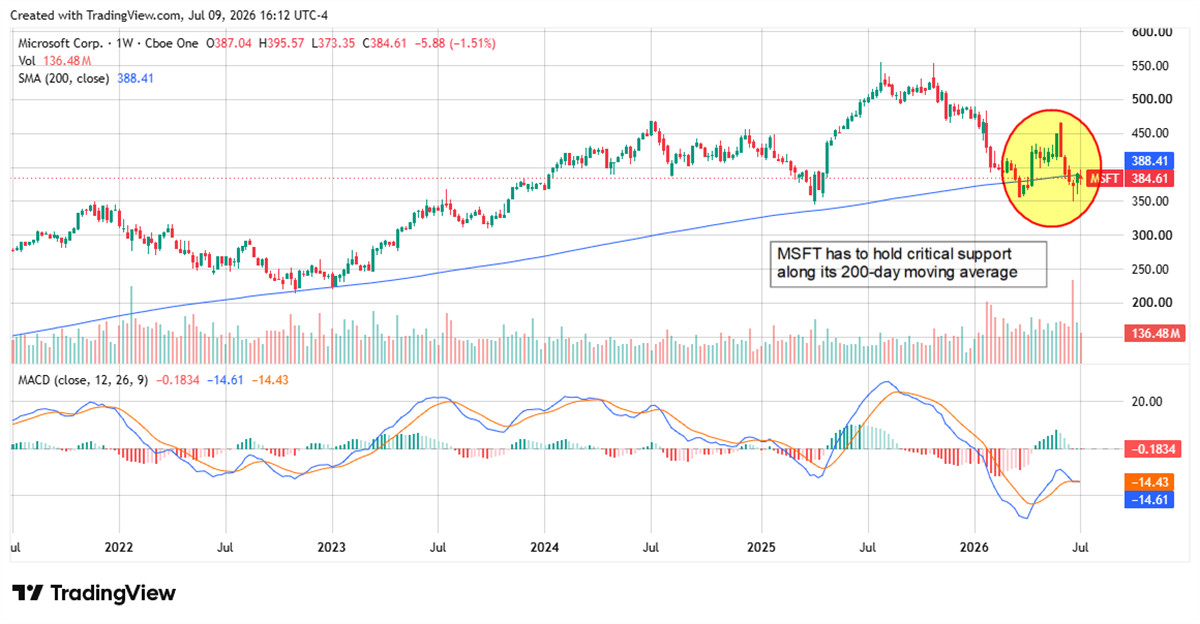
But a larger story comes from analysts and institutions. The MSFT consensus price target of $559.84 is approximately 45% below its recent trading range. Plus, out of 48 analysts tracked by MarketBeat, 41 give MSFT a Buy rating, and seven rate it as a Hold. Analysts notoriously don’t like to be wrong, which may explain why some analysts have trimmed their price targets, but the overall sentiment remains bullish.
The same cautious optimism can be found in its institutional ownership. There's no question that buying has slowed in the first two quarters of the year. But buying still outpaces selling, and with MSFT at 22x earnings, this could be an attractive target for money that hasn’t left the market and is looking for growth in the second half.
Read This Story Online |  The U.S. Army and Department of Energy are launching Project Janus - a high-priority initiative ordered by President Trump to deploy a revolutionary new fuel. The first powerplant running this fuel is expected to go live before December 18, 2026.
One obscure defense contractor already has a five-year head start on every competitor. The name, ticker symbol, and full story are being revealed at no cost. Click here to get the stock name, ticker, and full Project Janus details free |
| Written by Thomas Hughes 
Delta Air Lines (NYSE: DAL) lived up to its motto, with the Q2 2026 earnings results showing strength, suggesting its shares can Keep Climbing. Drivers include outperformance driven by international demand, overall demand, premiumization, and structural cost advantages, which together provide ample cash flow.
The critical detail in the release was the guidance, which forecasts that these trends will continue. More importantly, guidance was raised, prompting a robust response from analysts.
While no upgrades or price target revisions were tracked within the first hours of the release, several commentaries hit the wires. Analyst commentary reaffirms the robust trends, including numerous initiations, upgrades, and price target increases ahead of the earnings release on July 10.
As it stands, MarketBeat tracks 27 analysts rating DAL as a consensus Moderate Buy; coverage is up versus the prior month, quarter, and year, with sentiment firming and an 89% Buy-side bias in the data. The consensus price target assumes fair value near the early-July highs, but the trend matters. Recent revisions place this market in the high-end range, between $100 and $116, which would be a fresh all-time high when reached.
Delta’s July Pullback: A Touch-and-Go Event, Buy the DipDelta’s price pullback reflects a market expecting strength, as the Q2 results and guidance revealed nothing but that. Revenue growth accelerated sequentially and year over year with a robust 18.7% advance, ahead of expectations.
Delta’s strength was seen across metrics, underpinned by a mere 1% increase in capacity. Total revenue per average seat mile (TRASM) grew by 12.4%, with strength in the main cabin and premium, which grew by 17%. Domestic revenue grew by 12% and international revenue by 8%, with cargo up by 39% and maintenance services by 32%. Loyalty, a forward-looking indicator, grew by 19%, and corporate traffic grew by double digits.
While margin contracted in the quarter, and slightly more than expected, the contraction was minimal. More importantly, top-line strength carried through to the bottom line, leaving the adjusted earnings per share of $1.56 above forecasts by 400 bps. Looking ahead, the company expects strength to continue and reaffirmed its guidance. The critical details are that free cash flow and capital returns will continue, and that the guidance may be cautious. Travel trends remain robust across leisure and business segments, potentially accelerated by falling energy prices.
Delta’s Cash Flow Recovery Story Takes FlightDelta’s stock price recovery is underpinned by growth but, more importantly, the cash flow it produces. Drivers of the share price include persistent debt reduction, improving investment-grade balance-sheet quality, and the return of capital to shareholders.
Q3 capital returns included dividends but no share buybacks, with the dividend annualizing to about 1%. The payout ratios reveal no red flags for investors, as the company is in a position to continue executing its strategy while increasing its dividend annually. Balance sheet highlights include increased cash, reduced debt, and improving equity, with equity up 4.6% year to date.
Institutional activity reflects the potential in a DAL investment. The group owns a substantial 70% of the stock and has been accumulating at a nearly $2-to-$1 pace over the trailing 12 months. They provide a solid support base and market tailwind that will likely remain in place, given the guidance. In this scenario, DAL’s share price might continue pulling back in Q3, but the downside is limited, and higher share prices are likely by year’s end. Critical support targets are near $85 and $80; lower lows are unexpected.
Delta’s risks center on cost controls and execution. Costs, including labor, continue to rise while a major C-suite transition is underway. Two retirements and one exec’s departure for new opportunities resulted in several promotions and consolidated roles. The risk lies in disruptive hiccups tied to the role changes, specifically during the upcoming seasonal shift. If Delta fails to match capacity to demand, it risks losing pricing power, which would be detrimental to both top- and bottom-line results. In the longer term, Delta is expected to sustain modest growth over the next five years.
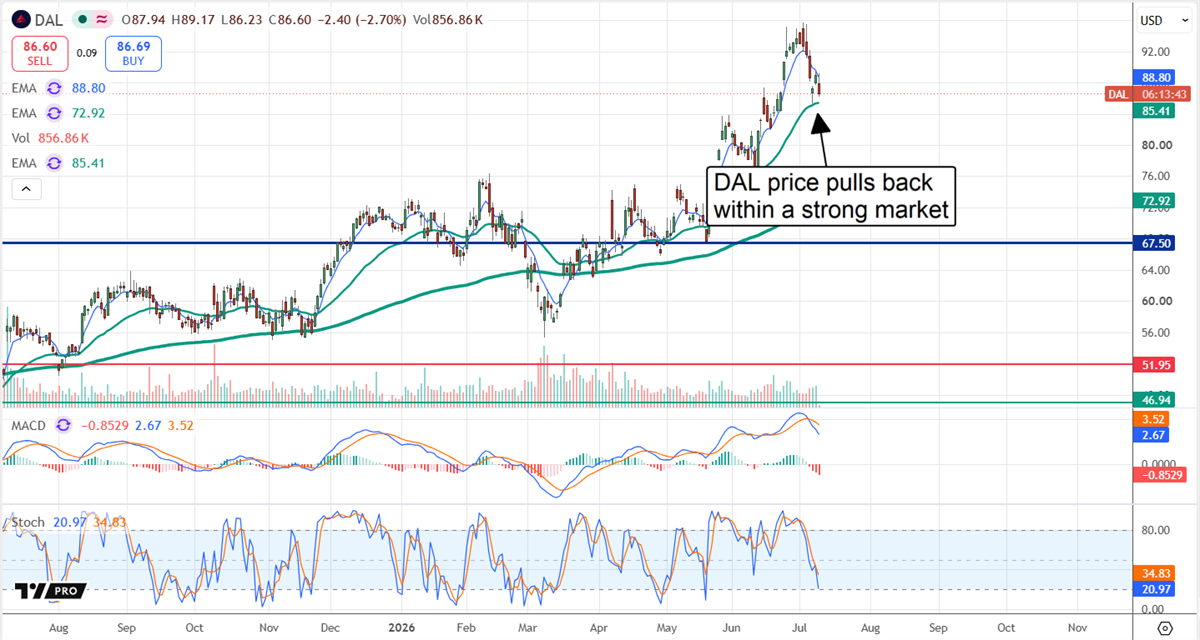
The stock price action is favorable, despite the early Q3 price pullback. Delta is rising on a wave of strength, cash flow, and dividends that has yet to play out, leaving the underlying uptrend intact. The likely outcome is that support kicks in at or near the early July lows, leading to a trend-following signal and price rebound later this year. Signals of strength include MACD convergence on the weekly chart, suggesting the latest highs will at least be retested, and support at the 30-day exponential moving average.
Read This Story Online |  Under Executive Order 14299, President Trump has ordered the U.S. Army and Department of Energy to launch a bold new joint project on American soil.
Most people won't know this operation is underway - but its outcome could be pivotal to America's future. Chief Investment Strategist Adam O'Dell of Money and Markets has the full story. Click here now to see what the Army and DoE are preparing |
|
| |
|
|