
| From | Environment Colorado <[email protected]> |
| Subject | Three solutions, one goal: Saving the bees |
| Date | July 12, 2026 3:05 PM |
Links have been removed from this email. Learn more in the FAQ.
Links have been removed from this email. Learn more in the FAQ.
:
John,
Bees pollinate the wildflowers that brighten our landscapes and many of the foods that fill our grocery stores. But these essential pollinators are increasingly under threat.
From bee-killing pesticides to shrinking habitat, the challenges bees face are growing more and more severe.
Here are just three of the things Environment Colorado is doing to help:
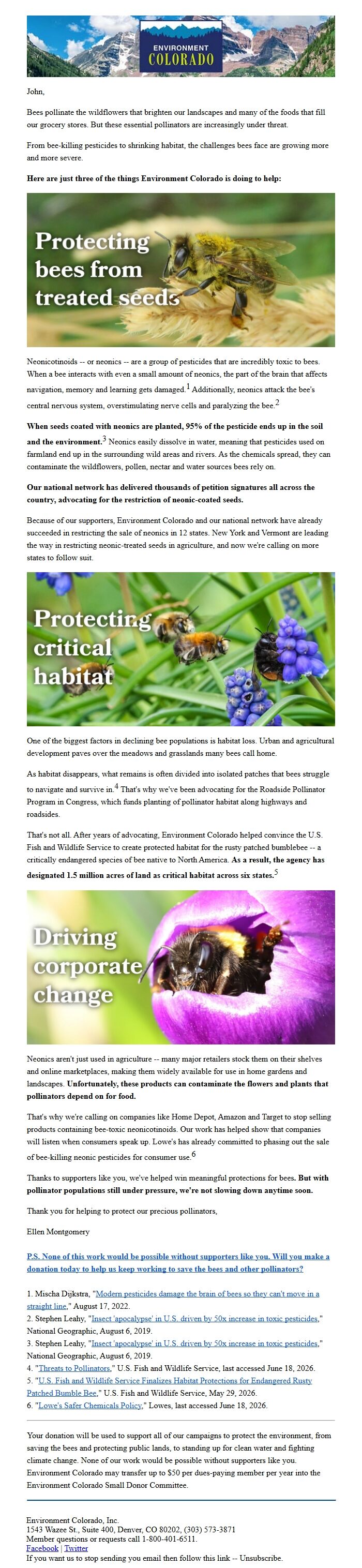
Neonicotinoids -- or neonics -- are a group of pesticides that are incredibly toxic to bees. When a bee interacts with even a small amount of neonics, the part of the brain that affects navigation, memory and learning gets damaged.[1] Additionally, neonics attack the bee's central nervous system, overstimulating nerve cells and paralyzing the bee.[2]
When seeds coated with neonics are planted, 95% of the pesticide ends up in the soil and the environment.[3] Neonics easily dissolve in water, meaning that pesticides used on farmland end up in the surrounding wild areas and rivers. As the chemicals spread, they can contaminate the wildflowers, pollen, nectar and water sources bees rely on.
Our national network has delivered thousands of petition signatures all across the country, advocating for the restriction of neonic-coated seeds.
Because of our supporters, Environment Colorado and our national network have already succeeded in restricting the sale of neonics in 12 states. New York and Vermont are leading the way in restricting neonic-treated seeds in agriculture, and now we're calling on more states to follow suit.
One of the biggest factors in declining bee populations is habitat loss. Urban and agricultural development paves over the meadows and grasslands many bees call home.
As habitat disappears, what remains is often divided into isolated patches that bees struggle to navigate and survive in.[4] That's why we've been advocating for the Roadside Pollinator Program in Congress, which funds planting of pollinator habitat along highways and roadsides.
That's not all. After years of advocating, Environment Colorado helped convince the U.S. Fish and Wildlife Service to create protected habitat for the rusty patched bumblebee -- a critically endangered species of bee native to North America. As a result, the agency has designated 1.5 million acres of land as critical habitat across six states.[5]
Neonics aren't just used in agriculture -- many major retailers stock them on their shelves and online marketplaces, making them widely available for use in home gardens and landscapes. Unfortunately, these products can contaminate the flowers and plants that pollinators depend on for food.
That's why we're calling on companies like Home Depot, Amazon and Target to stop selling products containing bee-toxic neonicotinoids. Our work has helped show that companies will listen when consumers speak up. Lowe's has already committed to phasing out the sale of bee-killing neonic pesticides for consumer use.[6]
Thanks to supporters like you, we've helped win meaningful protections for bees. But with pollinator populations still under pressure, we're not slowing down anytime soon.
Thank you for helping to protect our precious pollinators,
Ellen Montgomery
P.S. None of this work would be possible without supporters like you. Will you make a donation today to help us keep working to save the bees and other pollinators?
[link removed]
1. Mischa Dijkstra, "Modern pesticides damage the brain of bees so they can't move in a straight line," August 17, 2022.
[link removed]
2. Stephen Leahy, "Insect 'apocalypse' in U.S. driven by 50x increase in toxic pesticides," National Geographic, August 6, 2019.
[link removed]
3. Stephen Leahy, "Insect 'apocalypse' in U.S. driven by 50x increase in toxic pesticides," National Geographic, August 6, 2019.
[link removed]
4. "Threats to Pollinators," U.S. Fish and Wildlife Service, last accessed June 18, 2026.
[link removed]
5. "U.S. Fish and Wildlife Service Finalizes Habitat Protections for Endangered Rusty Patched Bumble Bee," U.S. Fish and Wildlife Service, May 29, 2026.
[link removed]
6. "Lowe's Safer Chemicals Policy," Lowes, last accessed June 18, 2026.
[link removed]
-----------------------------------------------------------
Your donation will be used to support all of our campaigns to protect the environment, from saving the bees and protecting public lands, to standing up for clean water and fighting climate change. None of our work would be possible without supporters like you. Environment Colorado may transfer up to $50 per dues-paying member per year into the Environment Colorado Small Donor Committee.
-----------------------------------------------------------
Join us on Facebook: [link removed]
Follow us on Twitter: [link removed]
Environment Colorado, Inc.
1543 Wazee St., Suite 400, Denver, CO 80202, (303) 573-3871
Member questions or requests call 1-800-401-6511.
If you want us to stop sending you email then follow this link: [link removed]
John,
Bees pollinate the wildflowers that brighten our landscapes and many of the foods that fill our grocery stores. But these essential pollinators are increasingly under threat.
From bee-killing pesticides to shrinking habitat, the challenges bees face are growing more and more severe.
Here are just three of the things Environment Colorado is doing to help:
Neonicotinoids -- or neonics -- are a group of pesticides that are incredibly toxic to bees. When a bee interacts with even a small amount of neonics, the part of the brain that affects navigation, memory and learning gets damaged.[1] Additionally, neonics attack the bee's central nervous system, overstimulating nerve cells and paralyzing the bee.[2]
When seeds coated with neonics are planted, 95% of the pesticide ends up in the soil and the environment.[3] Neonics easily dissolve in water, meaning that pesticides used on farmland end up in the surrounding wild areas and rivers. As the chemicals spread, they can contaminate the wildflowers, pollen, nectar and water sources bees rely on.
Our national network has delivered thousands of petition signatures all across the country, advocating for the restriction of neonic-coated seeds.
Because of our supporters, Environment Colorado and our national network have already succeeded in restricting the sale of neonics in 12 states. New York and Vermont are leading the way in restricting neonic-treated seeds in agriculture, and now we're calling on more states to follow suit.
One of the biggest factors in declining bee populations is habitat loss. Urban and agricultural development paves over the meadows and grasslands many bees call home.
As habitat disappears, what remains is often divided into isolated patches that bees struggle to navigate and survive in.[4] That's why we've been advocating for the Roadside Pollinator Program in Congress, which funds planting of pollinator habitat along highways and roadsides.
That's not all. After years of advocating, Environment Colorado helped convince the U.S. Fish and Wildlife Service to create protected habitat for the rusty patched bumblebee -- a critically endangered species of bee native to North America. As a result, the agency has designated 1.5 million acres of land as critical habitat across six states.[5]
Neonics aren't just used in agriculture -- many major retailers stock them on their shelves and online marketplaces, making them widely available for use in home gardens and landscapes. Unfortunately, these products can contaminate the flowers and plants that pollinators depend on for food.
That's why we're calling on companies like Home Depot, Amazon and Target to stop selling products containing bee-toxic neonicotinoids. Our work has helped show that companies will listen when consumers speak up. Lowe's has already committed to phasing out the sale of bee-killing neonic pesticides for consumer use.[6]
Thanks to supporters like you, we've helped win meaningful protections for bees. But with pollinator populations still under pressure, we're not slowing down anytime soon.
Thank you for helping to protect our precious pollinators,
Ellen Montgomery
P.S. None of this work would be possible without supporters like you. Will you make a donation today to help us keep working to save the bees and other pollinators?
[link removed]
1. Mischa Dijkstra, "Modern pesticides damage the brain of bees so they can't move in a straight line," August 17, 2022.
[link removed]
2. Stephen Leahy, "Insect 'apocalypse' in U.S. driven by 50x increase in toxic pesticides," National Geographic, August 6, 2019.
[link removed]
3. Stephen Leahy, "Insect 'apocalypse' in U.S. driven by 50x increase in toxic pesticides," National Geographic, August 6, 2019.
[link removed]
4. "Threats to Pollinators," U.S. Fish and Wildlife Service, last accessed June 18, 2026.
[link removed]
5. "U.S. Fish and Wildlife Service Finalizes Habitat Protections for Endangered Rusty Patched Bumble Bee," U.S. Fish and Wildlife Service, May 29, 2026.
[link removed]
6. "Lowe's Safer Chemicals Policy," Lowes, last accessed June 18, 2026.
[link removed]
-----------------------------------------------------------
Your donation will be used to support all of our campaigns to protect the environment, from saving the bees and protecting public lands, to standing up for clean water and fighting climate change. None of our work would be possible without supporters like you. Environment Colorado may transfer up to $50 per dues-paying member per year into the Environment Colorado Small Donor Committee.
-----------------------------------------------------------
Join us on Facebook: [link removed]
Follow us on Twitter: [link removed]
Environment Colorado, Inc.
1543 Wazee St., Suite 400, Denver, CO 80202, (303) 573-3871
Member questions or requests call 1-800-401-6511.
If you want us to stop sending you email then follow this link: [link removed]
Message Analysis
- Sender: Environment America
- Political Party: n/a
- Country: United States
- State/Locality: n/a
- Office: n/a
-
Email Providers:
- ActionKit