
Email
Iran War TRUTH: What Two Congressmen Led Me To
| From | Iran War TRUTH via Evan Brooks from TRC <[email protected]> |
| Subject | Iran War TRUTH: What Two Congressmen Led Me To |
| Date | July 12, 2026 9:51 AM |
Links have been removed from this email. Learn more in the FAQ.
Links have been removed from this email. Learn more in the FAQ.
There's a strategy behind the Iran war. I know because two private meetings
with U.S. Congressmen on March 2nd
<[link removed]>
Сⅼіϲkhеrе and I'll reveal the shocking details. <[link removed]>
Iran War TRUTH:
What Two Private Meetings Led Me To
There's a strategy behind the Iran war.
I know because two private meetings with U.S. Congressmen on March 2nd —
three days after the first missiles fell — sent me down a research path I
wasn't expecting.
What I found at the end of it: a coordinated operation, a shadow group
running it, and one company at the dead center of all of it.
Click here to see the strategy behind the Iran war.
<[link removed]>
Today's Market Update For You
The Dollar Index Holds Near 101 Despite Renewed Middle East Risk — Why the
DXY's Resistance to Safe-Haven Flows Signals a Dollar That Is Strong for the
Wrong Reasons
The U.S. Dollar Index has held near 101 through the latest round of Middle
East escalation, little changed even as crude surged4.4% and renewed Hormuz
tensions reignited safe-haven demand. The September rate-hike probability
embedded in futures reached64%, which through conventional rate-differential
logic should have pushed the DXY meaningfully higher — a hawkish Fed relative
to the ECB's steadier posture and the Bank of Japan's accommodative stance
historically drives dollar appreciation through the carry trade channel.
Instead, the index has traded in a narrow100–102 range, suggesting the market
is pricing two offsetting forces in rough equilibrium: a hawkish rate path that
strengthens the dollar on fundamentals, and a geopolitical energy shock that —
by raising U.S. inflation and threatening growth — partially undermines the
credit quality of dollar assets from a purchasing-power standpoint.
The apparent contradiction — a currency that should benefit from both
safe-haven demand and rate-differential advantage trading flat — resolves
through a distinction between types of dollar strength. The DXY near101 is
dollar strength driven by relative monetary hawkishness rather than relative
economic dynamism: the dollar is strong because the Fed is tighter than peers,
not because the U.S. growth outlook has improved. That matters for asset
allocation because rate-differential strength and growth-driven strength have
different equity market implications. In a rate-differential regime, U.S.
equities face the dual headwind of higher discount rates and currency
translation losses on multinational revenue. For emerging markets, the
consequence is more acute: a DXY near101 means dollar-denominated debt service
costs are elevated, and the policy rate of3.50%–3.75% makes U.S. Treasuries a
competitive alternative to EM risk, reinforcing capital outflows. The Turkish
lira, Brazilian real, and South African rand have shown extreme sensitivity to
Fed policy signals, moving2%–3% on single FOMC statements — a pattern that
intensifies when oil-driven inflation pressures simultaneously squeeze EM
commodity importers.
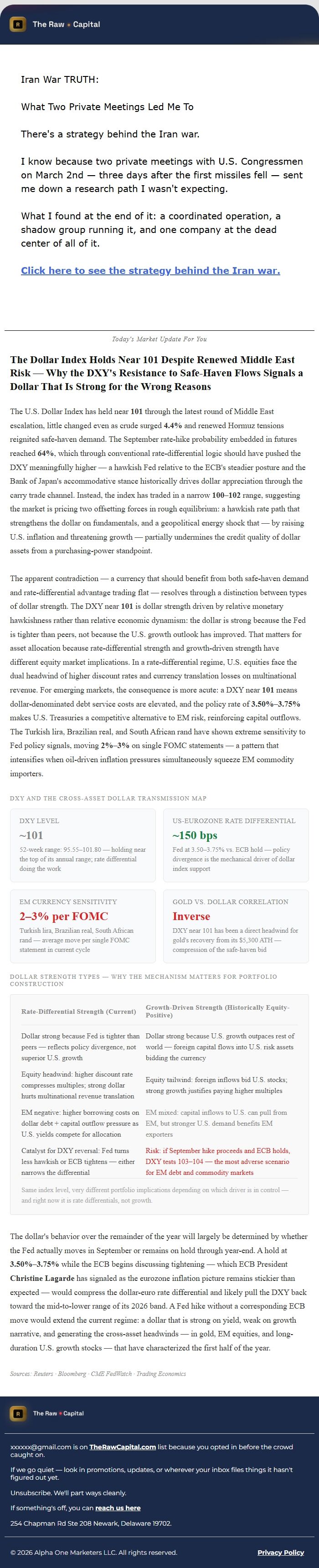
DXY and the Cross-Asset Dollar Transmission Map
DXY Level~10152-week range: 95.55–101.80 — holding near the top of its annual
range; rate differential doing the work
US-Eurozone Rate Differential~150 bpsFed at 3.50–3.75% vs. ECB hold — policy
divergence is the mechanical driver of dollar index support
EM Currency Sensitivity2–3% per FOMCTurkish lira, Brazilian real, South
African rand — average move per single FOMC statement in current cycle
Gold vs. Dollar CorrelationInverseDXY near 101 has been a direct headwind for
gold's recovery from its $5,300 ATH — compression of the safe-haven bid
Dollar Strength Types — Why the Mechanism Matters for Portfolio Construction
Rate-Differential Strength (Current) Growth-Driven Strength (Historically
Equity-Positive)
Dollar strong because Fed is tighter than peers — reflects policy divergence,
not superior U.S. growthDollar strong because U.S. growth outpaces rest of
world — foreign capital flows into U.S. risk assets bidding the currency
Equity headwind: higher discount rate compresses multiples; strong dollar
hurts multinational revenue translationEquity tailwind: foreign inflows bid
U.S. stocks; strong growth justifies paying higher multiples
EM negative: higher borrowing costs on dollar debt + capital outflow pressure
as U.S. yields compete for allocationEM mixed: capital inflows to U.S. can pull
from EM, but stronger U.S. demand benefits EM exporters
Catalyst for DXY reversal: Fed turns less hawkish or ECB tightens — either
narrows the differentialRisk: if September hike proceeds and ECB holds, DXY
tests 103–104 — the most adverse scenario for EM debt and commodity markets
Same index level, very different portfolio implications depending on which
driver is in control — and right now it is rate differentials, not growth.
The dollar's behavior over the remainder of the year will largely be
determined by whether the Fed actually moves in September or remains on hold
through year-end. A hold at3.50%–3.75% while the ECB begins discussing
tightening — which ECB PresidentChristine Lagarde has signaled as the eurozone
inflation picture remains stickier than expected — would compress the
dollar-euro rate differential and likely pull the DXY back toward the
mid-to-lower range of its 2026 band. A Fed hike without a corresponding ECB
move would extend the current regime: a dollar that is strong on yield, weak on
growth narrative, and generating the cross-asset headwinds — in gold, EM
equities, and long-duration U.S. growth stocks — that have characterized the
first half of the year.
Sources: Reuters · Bloomberg · CME FedWatch · Trading Economics
<[link removed]>
[email protected] is on TheRawCapital.com <[link removed]>
list because you opted in before the crowd caught on.
If we go quiet — look in promotions, updates, or wherever your inbox files
things it hasn't figured out yet.
Unsubscribe
<[link removed]>
. We'll part ways cleanly.
If something's off, you can reach us here <mailto:[email protected]>
254 Chapman Rd Ste 208 Newark, Delaware 19702.
© 2026 Alpha One Marketers LLC. All rights reserved. Privacy Policy
<[link removed]>
with U.S. Congressmen on March 2nd
<[link removed]>
Сⅼіϲkhеrе and I'll reveal the shocking details. <[link removed]>
Iran War TRUTH:
What Two Private Meetings Led Me To
There's a strategy behind the Iran war.
I know because two private meetings with U.S. Congressmen on March 2nd —
three days after the first missiles fell — sent me down a research path I
wasn't expecting.
What I found at the end of it: a coordinated operation, a shadow group
running it, and one company at the dead center of all of it.
Click here to see the strategy behind the Iran war.
<[link removed]>
Today's Market Update For You
The Dollar Index Holds Near 101 Despite Renewed Middle East Risk — Why the
DXY's Resistance to Safe-Haven Flows Signals a Dollar That Is Strong for the
Wrong Reasons
The U.S. Dollar Index has held near 101 through the latest round of Middle
East escalation, little changed even as crude surged4.4% and renewed Hormuz
tensions reignited safe-haven demand. The September rate-hike probability
embedded in futures reached64%, which through conventional rate-differential
logic should have pushed the DXY meaningfully higher — a hawkish Fed relative
to the ECB's steadier posture and the Bank of Japan's accommodative stance
historically drives dollar appreciation through the carry trade channel.
Instead, the index has traded in a narrow100–102 range, suggesting the market
is pricing two offsetting forces in rough equilibrium: a hawkish rate path that
strengthens the dollar on fundamentals, and a geopolitical energy shock that —
by raising U.S. inflation and threatening growth — partially undermines the
credit quality of dollar assets from a purchasing-power standpoint.
The apparent contradiction — a currency that should benefit from both
safe-haven demand and rate-differential advantage trading flat — resolves
through a distinction between types of dollar strength. The DXY near101 is
dollar strength driven by relative monetary hawkishness rather than relative
economic dynamism: the dollar is strong because the Fed is tighter than peers,
not because the U.S. growth outlook has improved. That matters for asset
allocation because rate-differential strength and growth-driven strength have
different equity market implications. In a rate-differential regime, U.S.
equities face the dual headwind of higher discount rates and currency
translation losses on multinational revenue. For emerging markets, the
consequence is more acute: a DXY near101 means dollar-denominated debt service
costs are elevated, and the policy rate of3.50%–3.75% makes U.S. Treasuries a
competitive alternative to EM risk, reinforcing capital outflows. The Turkish
lira, Brazilian real, and South African rand have shown extreme sensitivity to
Fed policy signals, moving2%–3% on single FOMC statements — a pattern that
intensifies when oil-driven inflation pressures simultaneously squeeze EM
commodity importers.
DXY and the Cross-Asset Dollar Transmission Map
DXY Level~10152-week range: 95.55–101.80 — holding near the top of its annual
range; rate differential doing the work
US-Eurozone Rate Differential~150 bpsFed at 3.50–3.75% vs. ECB hold — policy
divergence is the mechanical driver of dollar index support
EM Currency Sensitivity2–3% per FOMCTurkish lira, Brazilian real, South
African rand — average move per single FOMC statement in current cycle
Gold vs. Dollar CorrelationInverseDXY near 101 has been a direct headwind for
gold's recovery from its $5,300 ATH — compression of the safe-haven bid
Dollar Strength Types — Why the Mechanism Matters for Portfolio Construction
Rate-Differential Strength (Current) Growth-Driven Strength (Historically
Equity-Positive)
Dollar strong because Fed is tighter than peers — reflects policy divergence,
not superior U.S. growthDollar strong because U.S. growth outpaces rest of
world — foreign capital flows into U.S. risk assets bidding the currency
Equity headwind: higher discount rate compresses multiples; strong dollar
hurts multinational revenue translationEquity tailwind: foreign inflows bid
U.S. stocks; strong growth justifies paying higher multiples
EM negative: higher borrowing costs on dollar debt + capital outflow pressure
as U.S. yields compete for allocationEM mixed: capital inflows to U.S. can pull
from EM, but stronger U.S. demand benefits EM exporters
Catalyst for DXY reversal: Fed turns less hawkish or ECB tightens — either
narrows the differentialRisk: if September hike proceeds and ECB holds, DXY
tests 103–104 — the most adverse scenario for EM debt and commodity markets
Same index level, very different portfolio implications depending on which
driver is in control — and right now it is rate differentials, not growth.
The dollar's behavior over the remainder of the year will largely be
determined by whether the Fed actually moves in September or remains on hold
through year-end. A hold at3.50%–3.75% while the ECB begins discussing
tightening — which ECB PresidentChristine Lagarde has signaled as the eurozone
inflation picture remains stickier than expected — would compress the
dollar-euro rate differential and likely pull the DXY back toward the
mid-to-lower range of its 2026 band. A Fed hike without a corresponding ECB
move would extend the current regime: a dollar that is strong on yield, weak on
growth narrative, and generating the cross-asset headwinds — in gold, EM
equities, and long-duration U.S. growth stocks — that have characterized the
first half of the year.
Sources: Reuters · Bloomberg · CME FedWatch · Trading Economics
<[link removed]>
[email protected] is on TheRawCapital.com <[link removed]>
list because you opted in before the crowd caught on.
If we go quiet — look in promotions, updates, or wherever your inbox files
things it hasn't figured out yet.
Unsubscribe
<[link removed]>
. We'll part ways cleanly.
If something's off, you can reach us here <mailto:[email protected]>
254 Chapman Rd Ste 208 Newark, Delaware 19702.
© 2026 Alpha One Marketers LLC. All rights reserved. Privacy Policy
<[link removed]>
Message Analysis
- Sender: n/a
- Political Party: n/a
- Country: n/a
- State/Locality: n/a
- Office: n/a
-
Email Providers:
- Iterable