Dear Reader,
When a former advisor to the Pentagon released this AI Black Paper…
He warned that the brewing crisis in AI would cause:
“A multi-trillion dollar stock market meltdown that will catch millions of Americans off guard….torching their stock portfolios, retirement accounts, and even their personal savings faster than any crisis we’ve seen before.”
Well, now with problems at Nvidia and ChatGPT…
It looks like he may have undersold the case.
And as soon as July 29th at 6:30 PM the entire AI bubble could implode.
If you have money in the markets or assets you need to protect…
I suggest you view this AI Black Paper now.
Because it not only details the full nature of this crisis…
But it walks you through 3-steps to avoid the coming carnage (including a way you could take home gains of as high as 600% or more in 12 months during the coming crash).
But do it soon…
Because once this crisis hits, you won’t get any second chances.
Click here to view this analysis and see how to prepare.
Regards,
Matt Insley
Publisher, Paradigm Press
FedEx’s Earnings Drop May Be Missing the Bigger Freight Story
Author: Thomas Hughes. Publication Date: 6/25/2026.

Key Points
- FedEx shares fell after its fiscal fourth-quarter earnings beat as investors focused on weaker-than-expected calendar-year guidance.
- FedEx completed the FedEx Freight spin-off on June 1, creating a leaner parcel and logistics company.
- FedEx’s capital returns, institutional support and post-spin-off cash flow outlook could support the stock after the pullback.
- Special Report: The company SpaceX cannot operate without
FedEx (NYSE: FDX) shares fell more than 5% following its Q4 fiscal year 2026 (FY2026) earnings release, raising the question of whether it’s time to exit this recovery story or lean further into the trade. The main risk is a weaker-than-expected earnings outlook.
The offset is that the consensus estimate may not fully reflect the impact of the FedEx Freight spin-off and the improvements in cash flow it should bring, as well as the possibility of conservative guidance. FedEx Freight’s spin was completed in early June, setting the stage for accelerated growth and margin strength in the coming quarters.
FedEx Enters Transition Year on Strong Footing
Gold to $5,000? (Ad)
Top analysts are calling for $5,000 gold within months - and one $15 fund is designed to turn that rally into monthly income of up to 64% a year.
While most investors chase mining stocks or ETFs, this single position lets you collect steady payouts without trading or options strategies.
Click here to see how to claim your first payout todayFedEx ended fiscal 2026 on an upbeat note, with fourth-quarter revenue rising 12.5% year over year (YOY) to $25 billion, ahead of analyst expectations. Revenue outpaced MarketBeat’s reported consensus by more than 385 basis points (bps), driven by strength in both segments. FedEx Freight grew by 4.8% in its final quarter in the portfolio, while FedEx Express posted a much stronger 13.7% increase. Express revenue rose on the strength of volume and pricing, both domestically and internationally, and is expected to remain solid in the coming quarters.
Margin news is also encouraging. The company’s GAAP margin contracted because of one-offs, many of which were non-cash charges or tied to spin-off activities. However, adjusted margin was much better, reflecting structural improvements over the past year and leaving adjusted profits higher on a YOY basis. The key detail is that Q4 adjusted earnings topped $6.31, up 390 bps YOY and 36 cents ahead of the consensus forecast.
Guidance is the sticking point as the transition year begins, but investors should note that the transition includes a shift in reporting periods. FedEx’s fiscal year will now align with the calendar year, leaving the next seven months as a standalone period. As it stands, management expects spin-off-linked momentum to continue through year-end and calendar-year revenue growth in the range of 11%. Earnings are forecast at an adjusted midpoint of $17.50, well below the consensus, but the calendar-year forecast and fiscal-year period estimates may not be directly aligned.
FedEx Improves Capacity to Return Capital
One of the effects of the FedEx Freight spin-off is improved capacity to return capital. The spin not only brought a multibillion-dollar cash injection to the parent company’s balance sheet, but it also improved the long-term cash flow outlook. FedEx’s new war chest is specifically earmarked for debt reduction, aggressive share buybacks, and other tax-efficient measures designed to boost shareholder value.
As it stands, the company returned approximately $2.2 billion on a trailing 12-month (TTM) basis and is already on track to increase that figure over the next 12 months. The company raised its dividend payout by 5% for the transition period and is likely to increase it again in the upcoming 2027 fiscal year. Buybacks amounted to 1.4% of the share count on a TTM basis.

Analysts Caution Sets Up Dip-Buying Opportunity
Analysts responded cautiously to the news, praising the FQ4 strength but expressing concern about the guidance. The likely result is that they cap upside potential over the coming months while maintaining the bullish posture indicated by the data. MarketBeat tracks 29 analysts with current ratings; they rate the stock a Moderate Buy, with a 62% Buy-side bias within the group. The consensus estimate suggests 12% upside relative to the pre-release closing price as of late June, but investors should expect that to decline as the summer progresses.
The catalyst for higher share prices will likely come later this year. Subsequent earnings results should reflect the company’s strengths and internal improvements, along with signs of what the next year may bring. While quarterly reports can provide the needed market impetus, calendar-year 2027 guidance will matter most. Assuming growth, margin strength, cash flow, and capital returns continue, the stock’s uptrend will likely remain intact.
Institutions are among the reasons the FDX pullback looks like a buy-the-dip opportunity. The group owns more than 85% of the stock and has been accumulating at a $2-to-$1 pace over the TTM period, sustaining a bullish balance in each quarter. That pace will likely continue given the discount in the share price and the cash flow outlook, although institutions may slow their buying until later in the year when new catalysts emerge.
Chart action reflects a market top, with the June highs offset by clear and significant MACD divergence. The divergence points to underlying weakness, with prices above $320 setting the stage for a post-release pullback. The question is how deeply FDX may retrace, and the floor could be near $280. That level aligns with prior support and recent price action, while MACD remains at historically high levels, potentially creating a trigger point for institutions and other buy-and-hold investors.
Short Squeeze Alert—Moderna Stock Surges on New Strategy
Author: Chris Markoch. Publication Date: 7/1/2026.

Key Points
- Moderna shares rose nearly 20% after Science Day, but the gain is partly attributed to a short squeeze, not fundamentals alone.
- Moderna's pipeline spans three horizons targeting cancer and rare diseases, though Horizons 2 and 3 will not generate revenue until after 2028.
- With MRNA trading near double its consensus price target of $37, analysts suggest waiting for a better entry point before adding exposure.
- Special Report: The company SpaceX cannot operate without
Shares of Moderna (NASDAQ: MRNA) are acting like it’s 2020 again. The stock is up nearly 20% since the company’s Science Day event.
At that event, Moderna outlined its strategy for using mRNA to combat cancer and rare diseases. It’s a move beyond vaccines, and investors seem to like it.
Gold to $5,000? (Ad)
Top analysts are calling for $5,000 gold within months - and one $15 fund is designed to turn that rally into monthly income of up to 64% a year.
While most investors chase mining stocks or ETFs, this single position lets you collect steady payouts without trading or options strategies.
Click here to see how to claim your first payout todayLooks, however, can be deceiving. Before the event, MRNA had short interest of over 16.5%, which required more than 10 days for short sellers to cover their positions.
The result? A classic short squeeze that has sent the stock to nearly double its consensus price target of around $37 as of June 30.
That said, the price action alone isn’t disqualifying. The expansion of mRNA as a treatment for disease is where the promise has always been. That leaves investors with a decision ahead of the company’s Q2 2026 earnings report, scheduled for July 30.
Why mRNA Still Matters
The promise of mRNA is that it changes how medicine is made. Traditional drugs are manufactured in factories and injected into the body. mRNA medicines work differently. They deliver genetic instructions, and the body’s own cells produce the protein needed to treat the disease.
That matters for two reasons. The same platform can be reprogrammed for different diseases by changing only the instructions. And that flexibility could make drug development faster and more efficient over time.
COVID-19 vaccines proved the platform works in infectious disease. The question Moderna is now trying to answer is whether the same approach can deliver meaningful results for cancer, autoimmune diseases, and rare diseases.
If the answer is yes, the platform becomes far more valuable than its vaccine franchise alone. That’s the long-term story driving the recent move.
3 Horizons, 1 Long Runway
At Science Day, Moderna organized its business into three "Horizons" that map how the platform scales over time.
Horizon 1 is Moderna’s commercial engine. It includes four approved vaccines (Spikevax, mRESVIA, mNEXSPIKE, and mCOMBRIAX), the investigational intismeran autogene cancer therapy, and a rare disease franchise led by a propionic acidemia treatment. This accounts for the bulk of the company’s current revenue.
Horizon 2 is the next wave. T-cell engagers targeting multiple myeloma and ovarian cancer, cancer antigen therapies for solid tumors and Lynch syndrome, and a multiple sclerosis therapeutic linked to the Epstein-Barr virus. Most are in Phase 1 or Phase 2 trials. The earliest meaningful readout is mRNA-1195 for multiple sclerosis, which is expected in the second half of 2026.
Horizon 3 is the long-term bet. The headline asset is mRNA-6007, an in vivo CAR-T therapy aimed at lupus. Moderna expects this to enter human trials by the end of 2027.
That’s a lot of potential. However, neither Horizon 2 nor Horizon 3 will generate revenue until after 2028. Phase 1 and Phase 2 readouts are clinical milestones, not commercial ones. The path from trial to approval to launch takes years.
Why Caution Is Warranted
On June 26, the day after Moderna’s Science Day event, Piper Sandler reiterated its Overweight rating on MRNA and raised its price target to $77 from $69. Even at the prior target, Piper Sandler was already one of the more bullish analysts.
It’s important to note, however, that the new price target doesn’t leave much upside for MRNA after its recent gains. Analysts may be waiting to weigh in until the company’s earnings report, especially since there won’t be any revenue or earnings from these new initiatives for several years.
That puts the entire burden on Horizon 1. The four approved vaccines, the intismeran Phase 3 program, and disciplined cash management have to fund the pipeline long enough for the platform story to pay off.
That’s why long-term investors who aren’t already in the stock should wait for a better entry point. It’s also a reason for current shareholders to consider taking some risk off the table.
Where the Squeeze Logically Gives Back
The most likely first pullback level is $60. It's a round-number psychological level and represents a healthy give-back of about half the move off the mid-June breakout. Pullbacks of that size are normal after a sharp rally; they reflect routine profit-taking and leave the bullish structure intact. Anyone trimming into the squeeze would look to add back near this level.
The deeper, higher-conviction support is $55. That was the top of the April-to-June trading range, and the launch point of the Science Day breakout candle. Prior resistance becomes new support, and this is where the squeeze froth fully resets without breaking the thesis.
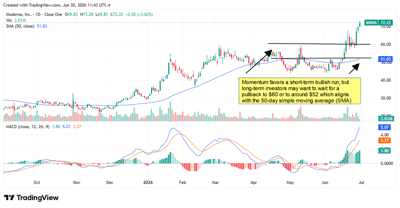
The line in the sand is $52, where the 50-day SMA sits at $51.83. A close below that level would mean the breakout has failed, and the stock has fallen back into the range it traded in before Science Day. At that point, the platform re-rate would need a fresh catalyst, such as the July 30 earnings report, to reassert itself.
This message is a paid sponsorship sent on behalf of Paradigm Press, a third-party advertiser of InsiderTrades.com and MarketBeat.
If you have questions or concerns about your subscription, please email our South Dakota based support team at [email protected].
If you no longer wish to receive email from InsiderTrades.com, you can unsubscribe.
Copyright 2006-2026 MarketBeat Media, LLC. All rights reserved.
345 N Reid Place, Sixth Floor, Sioux Falls, S.D. 57103-7078. U.S.A..