Editor's Note: Chris Rowe spent 30 years on Wall Street before he started tracking institutional money flows for everyday investors - he was one of the first to flag the AI infrastructure buildout as the biggest capital event since the dot-com boom, years before SpaceX confirmed it. See his full breakdown here.
SpaceX is public now.
And here's what that actually tells you: the AI infrastructure buildout isn't a story anymore. It's confirmed, audited, real money - the kind serious enough to take the most valuable private company on earth onto the public markets.
Autonomous flight systems. AI-driven navigation. Millions of decisions processed in real time.
None of it runs without the digital backbone built by a handful of companies most investors have never heard of.
Chris Rowe has spent three decades tracking exactly this kind of institutional money flow - watching where capital moves before it becomes a headline. That instinct is what put the AI infrastructure buildout on his radar long before SpaceX confirmed it was real.
Right now he's watching a much bigger number than SpaceX's recent IPO.
Amazon, Google, Meta, and Microsoft have already committed $700 billion this year alone to build that backbone out - more than the entire dot-com buildout combined, from just four companies, in a single year.
That money doesn't stay with Amazon, Google, Meta, and Microsoft.
It flows down. Through the chipmakers. The network builders. The data infrastructure. The small companies trading for a few dollars that most people will never read a headline about.
[See the companies Chris Rowe is tracking →]
In 1995, Netscape proved the internet was real - and the people who chased Netscape missed the real money. It went to the companies hiding behind the headline: Amazon, Cisco, Qualcomm.
SpaceX just did the same thing for AI infrastructure. It proved the buildout is real.
The only question now is whether you find the companies hiding behind it before everyone else does.
Get Chris Rowe’s full list of companies positioned to capture this $700 billion wave.
Bill Spencer
P.S. $700 billion is already in motion - Chris Rowe has already identified where the early money in this buildout is landing see his breakdown before the next wave of corporate spending hits.
Cerebras Systems, Inc: The Next Rags-to-Riches AI Story?
Author: Thomas Hughes. Date Posted: 6/25/2026.
Key Points
- Cerebras Systems targets the $125 billion AI inference market with chips that deliver double to triple the token-generation throughput of traditional GPU setups.
- Key growth catalysts include revenue-generating deals with OpenAI and AWS, supply chain insulation from HBM shortages, and the ability to ramp production ahead of competitors.
- Ten of 11 analyst ratings are Buys, with the consensus price target approximately 60% above late-June levels, as analysts view company guidance as conservative.
- Special Report: The company SpaceX cannot operate without
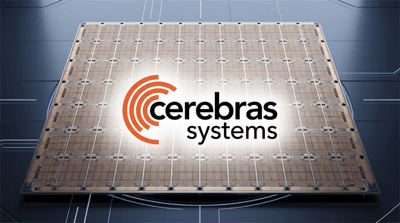
In a world where bigger is better, Cerebras Systems (NASDAQ: CBRS) appears to be well positioned. Instead of linking numerous AI cores together and creating data-transfer bottlenecks along the way, Cerebras chips are massive, comparable to dinner plates, and house thousands of cores on a single chip.
The advantage of this approach is straightforward: speed. Housing AI cores on one chip enables lightning-fast performance that traditional GPU technology cannot match. The tradeoff is memory capacity: NVIDIA’s (NASDAQ: NVDA) Vera Rubin natively supports far more memory, making it the better choice for training and advanced applications.
Are we ignoring the same signal Wall Street ignored in 1929? (Ad)
In 1929, a 20-something broker named Irving Weiss shorted the market before Black Monday and made a fortune. His son Martin digitized those same methods into Weiss Ratings - a system now tracking 22,000 stocks with 1.2 billion daily calculations.
That system called the Dot-Com bust, the 2008 crisis, and the 2020 crash. Right now it has issued a Code Red, flagging 10 popular US stocks as must-sells while upgrading 3 under-the-radar companies to an urgent Buy.
Watch the free briefing and get the names of the 3 Buy stocksMeanwhile, Cerebras Systems' focus on speed makes its AI technology especially well-suited to real-time inference, the much larger market.
Cerebras Set to Dominate in the AI Inference Market
Currently estimated at approximately $125 billion as of mid-2026, the inference market is expected to grow at a solid double-digit compound annual growth rate for at least the next four to five years, roughly doubling over that period. While GPUs remain the foundation for inference, demand is broadening to include more specialized equipment better suited to the task.
Cerebras's other advantages include the far simpler programming required compared with multi-GPU setups, a smaller footprint, since one Cerebras chip can replace dozens of servers, and lower operating costs. For comparable computing power, the chips deliver industry-leading speeds, often generating tokens at two to three times the throughput of traditional GPU setups, depending on the model.
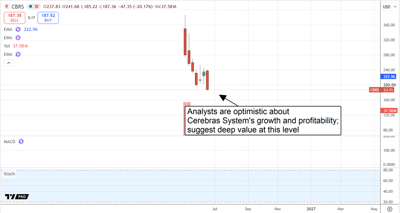
CBRS Pulls Back to IPO Lows With Catalysts in Play
Cerebras Systems has several catalysts in play, including a growing number of business deals, supply chain insulation, and new product launches. Deals such as those with OpenAI and Amazon’s (NASDAQ: AMZN) Amazon Web Services are generating revenue now and are expected to ramp in upcoming quarters.
OpenAI is currently porting GPT 5.4 and GPT 5.5 to Cerebras infrastructure and plans to deploy 750 megawatts of its own capacity soon.
The deal with AWS promises to generate a rapidly growing revenue stream through a disaggregated inference setup: AWS's Trainium chips handle the prefill stage—processing the input—while Cerebras's CS-3 systems run the high-speed decode stage that generates the output tokens.
Other catalysts for Cerebras include manufacturing and construction that do not require high-bandwidth memory (HBM), insulating the firm from industry bottlenecks. As a result, Cerebras can ramp production of its chips while others are forced to wait on memory modules, putting it in a position to gain market share quickly.
Hurdles Drive Volatility for CBRS Shareholders
However, as strong as the outlook may be, the company still has hurdles and headwinds to overcome. Among them is customer concentration, which relies on a limited number of hyperscalers, including the United Arab Emirates-backed G42 Holdings, Ltd. That dependence exposes the company to government scrutiny and export controls. Meanwhile, the sharp increase in inference demand forced the company to lease back previously committed capacity, temporarily weighing on margins.
The more pressing concern is competition. In-house chips aim to achieve much of what Cerebras Technology is doing, and there is also the memory shortfall to consider. While Cerebras chips are extremely fast, they have limited on-chip memory, which affects their usefulness in some applications.
While the systems are excellent at producing output, they struggle with input and need front-end assistance with massive prompts, such as enterprise-grade requests based on potentially endless datasets. The deal with Amazon is an example, as Cerebras systems need the Trainium infrastructure to sort and organize the data into digestible pieces it can use to generate super-fast responses.
The company’s plan is to increase its memory capacity over time by shrinking the size of the SRAM modules within each chip. It has done so successfully across several generations and is on track to do so again with its upcoming technology. The caveat is that there is a physical limit to how much can be placed on a single wafer because nodes can only get so small.
Optimistic Analysts Highlight Value Opportunity in CBRS Stock
The initial analyst outlook for Cerebras is bullish. The first 11 reports to appear on MarketBeat’s tracking page since the IPO include 10 Buy ratings, a 92% Buy-side bias. The group sees the stock as fairly valued near its IPO level, roughly 60% above the late-June price action. The risk is that price action could continue selling off, as is often the case with IPO stocks, but the analysts' commentary suggests otherwise. They view company guidance as conservative and expect strengths to emerge as the year progresses.
Among those strengths is the potential for accelerated gross margin expansion. The combination of capacity ramping and rising compute costs creates a dual lever for growth. In this scenario, CBRS will likely outperform its guidance in the upcoming quarters and improve its profitability outlook.
As it stands, profits are expected by next year, and profitability is expected to improve meaningfully over the subsequent three to five years.
Winnebago Misses Estimates, But Surges 14% After Earnings
Author: Chris Markoch. Date Posted: 6/29/2026.

Key Points
- Winnebago Industries missed revenue and earnings estimates in Q3 2026 and lowered full-year guidance, yet shares rose 14.4% on June 25.
- Revenue fell approximately 10% year over year to $698.70 million, while adjusted EPS of 66 cents declined roughly 18%, reflecting a challenged RV demand environment.
- WGO reclaimed its 50-day moving average on heavy volume after earnings, with the MACD turning positive and resistance noted in the $36 to $38 zone.
- Special Report: The company SpaceX cannot operate without
Winnebago Industries (NYSE: WGO) reported earnings on June 25, and the results showed a company dealing with a consumer under pressure. The company missed on its top and bottom lines and lowered its full-year guidance. Still, WGO ended the day up 14.4% on a day when the broader market was struggling to find direction.
The company’s quarterly report could be neatly summarized in the first minute of the conference call.
Gold to $5,000? (Ad)
Top analysts are calling for $5,000 gold within months - and one $15 fund is designed to turn that rally into monthly income of up to 64% a year.
While most investors chase mining stocks or ETFs, this single position lets you collect steady payouts without trading or options strategies.
Click here to see how to claim your first payout todayAt that point, president and chief executive officer (CEO) Michael Happe remarked: “Our fiscal third quarter results reflect a demand environment that remains challenged with limited near-term visibility to stable conditions.”
That sentiment was echoed in the company’s earnings presentation, which featured a slide titled “Managing the Controllables.” Highlighting these statements is not meant to be dismissive of the company.
Rather, those statements reflect the blunt reality facing the company, which investors must understand to put the outlook for WGO in context.
Analysts and Industry Data Foreshadowed a Tough Quarter
The company’s weak Q3 2026 earnings report was foreshadowed by analysts who lowered their price targets ahead of the report. On June 23, Roth Mkm and Benchmark both lowered their targets for WGO to $32 and $40 from $38 and $48.
That lines up with the summer 2026 forecast from the RV Industry Association, which revised its forecast for shipped units to a range of 300,000 to 328,100, with a median of 314,000 units. At the median, that marks an 8.2% year-over-year decline.
Winnebago’s report aligned with that outlook. The company delivered revenue of $698.70 million, below estimates of $755.68 million. Adjusted earnings per share (EPS) of 66 cents also fell short of the 81-cent estimate. Making matters worse, those figures were down approximately 10% and 18% year over year, respectively.
Some context softens the blow. The company's gross margin came in at 13.6%, essentially flat with the 13.7% reported in the year-ago quarter. That suggests Winnebago is preserving pricing discipline even as volume contracts. On a GAAP basis, net income was $14.5 million, or 51 cents per diluted share. That's still a profitable quarter in what management plainly called a challenged demand environment.
A Different Consumer Meets a Different Winnebago
The recreational vehicle (RV) industry thrived in 2020 and 2021. Consumers looking to travel but remain socially distant leaned hard into the outdoor lifestyle, including RVs. The benefit of low interest rates to accommodate financing and stimulus money flowing through the economy fueled a boom for many RV makers, including Winnebago.
But those days are a distant memory. The macroeconomic picture has inverted, and the industry is now faced with more “choiceful” consumers. Interest is still there; commitment is lacking.
That fits into the bucket of things Winnebago can’t control.
However, while the state of the consumer is different, so is Winnebago. WGO trades right around where it was in 2019. But since the end of its 2019 fiscal year, the company acquired Newmar. Then, in 2021, it added Barletta Boats. More recently, the company acquired the Grand Design motorhome brand. That’s given the company several new revenue streams, and the company’s report makes it clear that the Newmar and Grand Design brands were bright spots in an otherwise poor quarter.
But that’s not showing up in the numbers. Winnebago made downward revisions to its full-year guidance. The company now expects revenue between $2.65 billion and $2.75 billion and adjusted EPS of $1.65 to $2.00. Those numbers don’t suggest growth, but if they represent a worst-case scenario, it could explain the post-earnings price action
The WGO Chart Hints at a Short-Term Setup
The setup on the chart is worth a closer look. WGO gapped higher on Thursday to close at $30.87 on volume of 1.4 million shares. The move reclaimed the 50-day simple moving average (SMA) at $30.18 in a single session, flipping a key short-term resistance level into support.
The pattern echoes a setup from late summer 2025. Back then, the stock built a multi-week base near $28 to $30 before breaking out and spiking through the fall. WGO has spent the last two months consolidating in that same price zone, and Thursday's surge on outsized volume could mark the start of a similar leg higher.

Momentum indicators are starting to confirm. The moving average convergence divergence (MACD) line has crossed above its signal line, and the histogram has turned positive. That's an early bullish trigger, though it needs follow-through to carry weight.
Resistance sits in the $36 to $38 zone, where the stock topped last fall, and again near $44, where buyers stalled in February. A failure to hold the $28 level would invalidate the setup. For investors who can stomach the cyclical risk, the current reaction offers a defined-risk entry into a name already trading at depressed multiples.
This email content is a paid sponsorship provided by True Market Insiders, a third-party advertiser of MarketBeat. Why did I receive this message?.
If you have questions about your account, please feel free to email MarketBeat's South Dakota based support team at [email protected].
If you would no longer like to receive promotional emails from MarketBeat advertisers, you can unsubscribe or manage your mailing preferences here.
© 2006-2026 MarketBeat Media, LLC. All rights protected.
345 N Reid Place, Sixth Floor, Sioux Falls, S.D. 57103-7078. United States of America..