Dear Reader,
Most people are looking at AI the wrong way.
They're chasing the next hot stock.
The next chatbot.
The next flashy headline.
But AI does not run on excitement.
It runs on power.
It runs on data centers.
It runs on infrastructure.
And right now, that buildout is turning into one of the biggest money flows in America.
He believes it sits in the path of the AI infrastructure boom...
And could be one of the most important retirement opportunities most people have never heard of.
The part that makes this urgent?
Trump has reportedly invested up to $25 million of his own money.
Alex says regular Americans can learn how to access this fund for around $15 through a regular brokerage account.
This is the kind of thing I'd rather see early than read about later.
Good investing,
Rachel Gearhart
Publisher, The Oxford Club
Energy Fuels Just Made a Bold Bet on Rare Earth Magnets
By Jeffrey Neal Johnson. Originally Published: 6/25/2026.
Key Points
- Energy Fuels' $1.9 billion acquisition of Vacuumschmelze creates a domestic mine-to-magnet supply chain that bypasses Chinese export controls on rare earth materials.
- Energy Fuels' uranium production, which reached 1.6 million pounds in the first half of 2026, provides internal cash flow to fund the rare earth expansion without excessive debt.
- The Sumter, South Carolina magnet facility is projected to generate $65 million to $75 million in run-rate EBITDA at current capacity, with significant upside as output scales.
- Special Report: The company SpaceX cannot operate without
Traders who dumped Energy Fuels (NYSEAMERICAN: UUUU) shares after its $1.9 billion deal to buy German magnet maker Vacuumschmelze are missing a major shift.
The immediate share price pullback reflects short-term dilution anxiety rather than a reassessment of long-term asset value. By acquiring Vacuumschmelze, Energy Fuels is pursuing a vertical integration strategy to secure a domestic mine-to-magnet supply chain.
The $15 Gold Fund That Pays Up to $1,152/Month (Ad)
Gold is hitting record highs, but most investors are leaving income on the table. A $15 fund is quietly paying out up to $1,152 a month to regular investors - no mining stocks, no options, no physical metal required.
Chief Income Strategist Tim Plaehn calls it a breakthrough strategy that transforms gold's rally into reliable monthly payouts. The next distribution is just days away.
Discover the gold income fund before the next payout dateThe broader industrial economy is shifting toward nuclearizing the power grid to support AI data centers and advanced electric vehicle networks. By linking raw material mining with precision manufacturing, Energy Fuels is building an integrated domestic pipeline that bypasses foreign restrictions on critical minerals. The short-term dip in the stock price masks a strategic business transition that is insulated against geopolitical volatility, positioning Energy Fuels as a cornerstone of national security and Western industrial supply chains.
Shovels in Australia and Magnets in Carolina
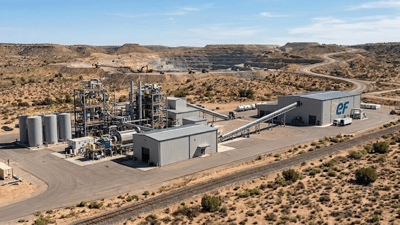
To understand the asset value, investors must map out the operational pipeline. The loop starts with the excavation of heavy mineral sands at the shovel-ready Donald Project in Australia, where a final investment decision is expected in the third quarter of 2026. Monazite feedstock from this mine will then be processed and separated into heavy rare earth oxides at the White Mesa Mill in Utah. These separated oxides will be transported to Australian Strategic Materials' Korean Metals Plant for conversion into high-purity metals and alloys, with plans to replicate this processing step at a future American Metals Plant.
The final stage of this loop occurs at Vacuumschmelze's advanced magnetics manufacturing plants, specifically the newly commissioned facility in Sumter, South Carolina. This facility has the physical capacity to produce 2,000 tonnes per annum of permanent neodymium-iron-boron magnets, with a clear pathway to scale to 12,000 tonnes per annum. This domestic footprint is supported by a 20-year, $725 million conditional loan commitment from the U.S. Office of Strategic Capital, which will accelerate the expansion of the White Mesa Mill. Energy Fuels is also progressing discussions with Export Finance Australia for a 220 million Australian dollars (approx. $146 million U.S.) lending package to support the Donald Project, alongside an existing $41 million grant from the U.S. Department of War.
Yellowcake Yields Are Funding the New Rare Earth Frontier
Expensive acquisitions often trigger shareholder anxiety about toxic debt or excessive equity issuance. However, Energy Fuels has an internal funding mechanism that sets it apart from riskier, still-developing players. The company remains the leading natural uranium producer in the United States, and its primary business is generating strong cash flow.
According to the mid-year operational update, first-half uranium production reached 1.6 million pounds of finished uranium oxide, achieving full-year guidance in just six months. Processing costs at the White Mesa Mill are tracking at an exceptionally low $9 to $12 per pound, while mining costs at the Pinyon Plain mine range between $23 and $30 per pound. With spot uranium prices trading at healthy premiums, this highly profitable uranium segment acts as an internal cash generator. This reliable cash stream supports Energy Fuels' aggressive rare-earth expansion, reducing the need to rely on high-interest debt.
Breaking China's Magnetic Monopoly
A primary risk for magnet manufacturers is their reliance on imported raw materials. In late 2025 and April 2026, China implemented stringent export controls on critical heavy rare earth additives, including dysprosium and terbium.
These export controls directly impacted Vacuumschmelze, capping its 2025 adjusted EBITDA at $28.6 million and resulting in a net loss of $50.6 million due to severe feedstock constraints.
Energy Fuels' heavy rare-earth separation capabilities directly address this challenge. By processing monazite at the White Mesa Mill, Energy Fuels can deliver a domestic, reliable stream of heavy rare-earth oxides to Vacuumschmelze's plants.
Unshackling the German firm from Chinese supply restrictions should unlock significant operating leverage. Once fully supplied, the Sumter facility alone is expected to generate $65 million to $75 million in run-rate EBITDA at its current 2,000 tonnes-per-annum capacity. Scaling to 4,000 tonnes per annum projects run-rate EBITDA to $130 million to $140 million, highlighting the explosive margin expansion potential of this deal.
Energy Fuels Recharges Its Outlook
The market's initial reaction treated the acquisition as a risky, premium-priced gamble, but a closer look at the price chart suggests a near-term floor is being established. While some observers claim the deal creates an outright Western monopoly, a more realistic assessment points to a highly lucrative domestic duopoly.
Energy Fuels' primary competitor is MP Materials (NYSE: MP), which has a market capitalization of $10.2 billion and is constructing a 10,000-tonne-per-annum permanent magnet facility in Northlake, Texas, supported by a 10-year defense contract. This dual-player dynamic ensures healthy competition while establishing a secure, diversified supply base for Western automotive and defense clients.
Wall Street is increasingly recognizing this potential. On June 22, 2026, H.C. Wainwright reiterated its Buy rating and maintained its $29 price target, signaling strong analyst backing immediately before the transaction announcement. Recent headlines and the options market reinforce this bullish outlook, with a tight volume put/call ratio of 0.17. Meanwhile, short interest stands at 39.76 million shares, representing 16% of the free float. As Energy Fuels achieves its vertical integration milestones over the coming quarters, this heavy short position could provide a powerful short-squeeze catalyst.
Prepare for the Final Atomic Attraction
The strategic alignment of low-cost upstream mining and processing with downstream magnet fabrication creates a highly resilient business model. Cautious investors may prefer to monitor the progress of upcoming regulatory approvals and the formal transaction close in early 2027 before initiating a core position to capitalize on the positive analyst forecasts.
European Banks Are Outperforming : Can These 3 Keep It Going?
By Dan Schmidt. Originally Published: 6/25/2026.

Key Points
- European banks remain attractively valued compared with many U.S. peers despite a strong 2025 rally.
- Banco Bilbao Vizcaya Argentaria and Banco Santander offer strong profitability, shareholder returns and global diversification.
- ING Group offers income and value, but its higher capital ratio and payout profile make the risk-reward setup more mixed.
- Special Report: The company SpaceX cannot operate without
European banks delivered their best performance in years in 2025, and investors have been tempted to take profits during the sector’s recent pullback. But this rally is no bubble, and there’s plenty of evidence that international bank stocks are still undervalued compared with their domestic peers.
European banks continue to trade at single-digit multiples while posting double-digit revenue growth, making the sector attractive amid sudden commodity tailwinds. Some stocks in the industry stand out more than others, however, and diversifying investments in this space can help investors capture a range of bullish factors.
Despite Commodity Headwinds, European Banks Are Still on Sale
The $15 Gold Fund That Pays Up to $1,152/Month (Ad)
Gold is hitting record highs, but most investors are leaving income on the table. A $15 fund is quietly paying out up to $1,152 a month to regular investors - no mining stocks, no options, no physical metal required.
Chief Income Strategist Tim Plaehn calls it a breakthrough strategy that transforms gold's rally into reliable monthly payouts. The next distribution is just days away.
Discover the gold income fund before the next payout dateEuropean banks are still emerging as an undervalued industry after a decade of negative rates. The previous rate environment crushed bank margins, driving the European banking sector into a deep decline that was further aggravated by war-induced commodity shocks. But now oil headwinds are shifting, and European banks benefit from a Goldilocks environment. When markets are neither too hot nor too cold, investors tend to reap the rewards.
The European financial value shift isn’t just about oil, rates, and vibes; the sector has some very accommodative metrics that show certain stocks remain undervalued. Some of these metrics include:
Common Equity Tier 1 (CET1) Ratio - A metric used to measure a bank’s health by comparing its capital to its risk-weighted assets. A Goldilocks range is preferred for this metric: too high means capital is unproductive, too low means the bank is taking too much risk.
Return on Tangible Equity (ROTE) - Strips out factors like intellectual property and brand value to determine profit generated from capital invested by shareholders and is often considered the metric that best measures the pure performance of a bank’s capital.
Dividend Payout Ratio (DPR) - The percentage of a company’s earnings returned to shareholders as dividends. DPR is useful for gauging a bank’s financial health, as a dividend cut is often devastating to its outlook.
Banco Bilbao: The Profit Machine Keeps Churning
Banco Bilbao Viscaya Argentaria (NYSE: BBVA) is one of the best-performing multinational banks in the Eurozone, thanks to its growth in emerging markets. The bank reported ROTE of 21.7% and CET1 above 12% in Q1 2026, yet it trades at around 10.3 times forward earnings. The dividend yields 4.63% with a 54.3% DPR, but the company is aggressively buying back shares, and net interest income was up more than 20% year-over-year (YOY).
BBVA shares bounced off a clear short-term low and have now resumed their upward momentum. The stock price continues to make higher lows, and a pair of momentum indicators has confirmed the uptrend. The Relative Strength Index (RSI) is above 50, a commonly recognized bullish threshold, and the Moving Average Convergence Divergence (MACD) has been trending upward since mid-May. BBVA’s technical uptrend matches its fundamental strength, which is why it ranks at the top of today’s list.

Santander: Capital Compounder Still Undervalued
Banco Santander S.A. (NYSE: SAN) has surged nearly 65% over the last 12 months, but the Iran war briefly thwarted its bid to reach all-time highs. However, Santander retains a superb 15% ROTE with a CET1 of 14%, and its banking offerings are more globally diversified than BBVA. The stock isn’t a bargain like it was in previous months, but the 1.57% dividend has an approximately 17% DPR, and the stock trades at just 11 times earnings.
SAN shares challenged the 200-day moving average earlier this year, but the bullish uptrend proved strong enough to weather the storm. The stock price quickly surged back above the 50-day moving average, a move backed by the RSI’s ascension into bullish territory. The latest attempt to test the 50-day was swiftly rejected, and the move was reinforced by the RSI, so SAN shares have the all clear to make more all-time highs.

ING Group: Higher Risk Package With Income and Value
Amsterdam-based ING Group N.V. (NYSE: ING) appears affordable at 11 times earnings, but its 16% CET1 and 57% DPR make it the bank with the most mismatched risk profile on our list. However, a 4.7% yield is hard to ignore for a bank stock trading at about 11.4 times forward earnings, and management raised net interest income (NII) guidance in the last earnings report.
The RSI has been the guiding light during the volatile period, directing investors toward gains as the underlying share price fluctuated. Despite a brief June dip, the dependable momentum indicator has remained above 50, demonstrating that buyers have yet to relent. The 50-day moving average also remains a viable support level, reinforcing the bullish case as the stock makes new all-time highs.

This message is a sponsored message provided by The Oxford Club, a third-party advertiser of DividendStocks.com and MarketBeat.
This ad is sent on behalf of The Oxford Club, 105 W. Monument Street Baltimore, MD 21201.
If you need assistance with your newsletter, please contact MarketBeat's U.S. based support team at [email protected].
If you no longer wish to receive email from DividendStocks.com, you can unsubscribe.
Copyright 2006-2026 MarketBeat Media, LLC. All rights reserved.
345 North Reid Place #620, Sioux Falls, S.D. 57103. United States of America..