Below is an important message from one of our highly valued sponsors. Please read it carefully as they have some special information to share with you.
Dear Reader,
I don’t mean to alarm you…
But according to this former advisor to the Pentagon and CIA…
An 80% “Dow Drop” could be just DAYS away.
His viral AI Black Paper explains WHEN this crisis could happen and WHY it’s now all but inevitable…
And why people like Sam Altman, Michael Burry and even Stanley Druckenmiller, are beginning to prepare.
Plus it details the 3 critical steps you should take to prepare (including one that could allow you to take home returns as high as 600% or more in 12 months as the crash plays out).
So I suggest you review this researchnow.
Because as you’ll see, when this crisis hits…
It will be a BLOODBATH.
And you don’t have long to prepare.
Click here to view this urgent warning now.
Regards,
Matt Insley
Publisher, Paradigm Press
These 3 Bitcoin Miner Stocks Are Riding the AI Data Center Boom
Submitted by Dan Schmidt. Article Published: 6/22/2026.

Key Points
- Hut 8, TeraWulf, and Core Scientific have each gained more than 90% year-to-date by converting Bitcoin mining facilities into AI data centers with long-term triple-net leases.
- Core Scientific stands out as the most attractive option, already collecting rent from CoreWeave, trading at just 25 times sales, and planning to wind down Bitcoin mining by end of 2026.
- TeraWulf and Hut 8 carry elevated risk due to high valuation multiples, Bitcoin-related losses, and data center revenues that remain largely unrealized future income streams.
- Special Report: The company SpaceX cannot operate without
"A rising tide lifts all boats" is a familiar piece of market jargon, and it is easy to see why it resonates during rallies like the AI gold rush. Everyone seems to want a piece of the data center market today, including some former Bitcoin miners that are strategically pivoting to the next big thing. Three companies stand out in this theme: Hut 8 Corp. (NASDAQ: HUT), TeraWulf Inc. (NASDAQ: WULF), and Core Scientific Inc. (NASDAQ: CORZ). Each has seen its stock soar more than 100% year-to-date (YTD), but are these gains based on real future cash flows or just hype from a powerful rally?
Pivoting From Bitcoin Miner to Data Center Landlord
All three companies share characteristics that appeal to AI hyperscalers. As former Bitcoin miners, these firms already own large facilities with scalable, grid-connected electrical power. To capitalize on the AI rush, they have refurbished these sites with data center shells capable of supporting high-density GPU racks. Once the conversion is complete, they look for tenants that bring their own racks and build out the AI cloud infrastructure.
The $15 Gold Fund That Pays Up to $1,152/Month (Ad)
Gold is hitting record highs, but most investors are leaving income on the table. A $15 fund is quietly paying out up to $1,152 a month to regular investors - no mining stocks, no options, no physical metal required.
Chief Income Strategist Tim Plaehn calls it a breakthrough strategy that transforms gold's rally into reliable monthly payouts. The next distribution is just days away.
Discover the gold income fund before the next payout dateWhat makes the landlord comparison work is the structure of the deals these companies are signing with tenants. The agreements are typically triple-net and take-or-pay, meaning tenants are responsible for taxes, insurance, and maintenance, and pay 100% of their bill whether they use all of the capacity or not. This shift from Bitcoin mining to data center landlord changes the way these companies generate income. Instead of relying on volatile, commodity-linked revenue streams like mining, these firms can now point to dependable, recurring revenue through decade-long rent contracts. It is also a relatively smooth transition, since Bitcoin mining and data center operations require many of the same skills and inputs, such as a constant power supply, a solid foundation, and experience running dense computer facilities.
3 Stocks Capitalizing on Data Center Energy Demand
Hut 8, TeraWulf, and Core Scientific have not simply ridden the coattails of the AI rally; they are active participants with REIT-style contracts. But each is tied to different counterparties and timelines, and the Bitcoin overhang remains. A deeper look at the numbers is necessary before committing any investment capital to these names.
Hut 8 Corp: High Value Contracts But Revenue Realization Still Far Out
Hut 8 has generated some of the biggest headlines this year for its data center buildout, including a $4.25 billion senior secured note offering for its Beacon Point property in Texas. The Beacon Point data center is expected to provide up to 1,000 megawatts (MW) of capacity, with another potential 1,000 MW from the River Bend location in Louisiana. In Q1 2026, Hut 8 announced that Beacon Point had secured a 15-year triple-net lease valued at $9.8 billion, which could exceed $25 billion with escalators. The problem with this stock is timing. Neither River Bend nor Beacon Point is expected to be operational until 2027, and the company’s 16,000 Bitcoin token hoard is becoming an albatross. Q1 2026 earnings revealed a massive earnings-per-share (EPS) miss; the company lost $1.98 per share despite beating revenue projections by 40%. Bitcoin losses are weighing on the balance sheet, and the stock currently trades at 45 times sales.
Steady, secure revenue is coming, but the stock is priced for perfect execution. Both data centers are still under construction, and the decline in BTC is driving losses. The stock is up more than 150% YTD, and it may be time to take some profits. A bearish cross on the Moving Average Convergence Divergence (MACD) indicator has cast a cloud over the rally, especially since a bullish crossover preceded the biggest upswing in April.

TeraWulf: Strong Technicals, Weak Fundamentals, and High Short Interest
TeraWulf has an aggressive pipeline, and there is evidence that its high-performance compute (HPC) transition is paying off. The company reported $21 million in HPC leasing revenue in Q1 2026, up more than 100% from Q4 2025. Some of its contracted tenants include Core42 and the Google-backed Fluidstack, giving the stock a compelling narrative amid the buildout. But TeraWulf has been issuing significant amounts of equity to fund expansion, including an $800 million stock offering in April. Shareholder dilution may be one reason the stock carries 26% short interest as of the end of May.
The company generated just $34 million in revenue in Q1, down 1.1% year-over-year (YOY). Like Hut 8, the data center rent remains a future revenue stream, and the stock trades at 82 times sales. Despite the weak fundamentals, the chart looks attractive. There is strong price support at the 50-day moving average, and the Relative Strength Index (RSI) is in bullish territory without reaching overbought status. Traders seem to believe the company can execute its plan flawlessly, but with shares up more than 140% YTD, there is plenty of downside if missteps occur.

Core Scientific: Cheapest Valuation and Already Collecting Rent
Unlike Hut 8 and TeraWulf, Core Scientific is already collecting rent from a key AI player in CoreWeave Inc. (NASDAQ: CRWV). The company is providing CoreWeave with 243 MW of compute as of Q1 2026, with the remaining 347 MW scheduled to come online in early 2027. The total agreement is worth more than $10 billion, and Core Scientific raised the project’s cash gross-margin target to 80-85% from 75-80%. CORZ shares also look cheapest from a valuation standpoint at just 25 times sales. Q1 2026 also saw the company post a surprise EPS loss due to a $266 million mining impairment charge, but the Bitcoin mining operation is expected to be fully wound down by the end of 2026.
Core Scientific may have the cleanest fundamentals, but the chart is choppy at best. The bearish MACD cross earlier this month hints at fading momentum, and the price is struggling to surpass the June 2 all-time high of $29.05. However, CORZ has the strongest fundamentals, the smallest YTD gain (90%), and the only currently operational site. If one of these three stocks has upside not currently priced in, it is this one.

Cerebras Systems, Inc: The Next Rags-to-Riches AI Story?
Submitted by Thomas Hughes. Article Published: 6/25/2026.
Key Points
- Cerebras Systems targets the $125 billion AI inference market with chips that deliver double to triple the token-generation throughput of traditional GPU setups.
- Key growth catalysts include revenue-generating deals with OpenAI and AWS, supply chain insulation from HBM shortages, and the ability to ramp production ahead of competitors.
- Ten of 11 analyst ratings are Buys, with the consensus price target approximately 60% above late-June levels, as analysts view company guidance as conservative.
- Special Report: The company SpaceX cannot operate without
In a world where bigger is better, Cerebras Systems (NASDAQ: CBRS) appears to be well positioned. Instead of linking numerous AI cores together and creating data-transfer bottlenecks, Cerebras chips are massive—comparable to dinner plates—and house thousands of cores on each one.
The advantage of this approach is straightforward: speed. By placing AI cores on a single chip, Cerebras enables lightning-fast performance that traditional GPU technology cannot match. The tradeoff is memory capacity: NVIDIA’s (NASDAQ: NVDA) Vera Rubin natively supports far more memory, making it the better choice for training and advanced applications.
A letter from Shannon Stansberry (Ad)
Porter Stansberry nearly canceled the entire project. When he first saw the claimed returns - only one down year in nearly two decades and total gains of almost 2,000% - his immediate reaction was disbelief.
It took a trusted friend's personal vouching for Emmet Savage and a face-to-face trip to Ireland to change his mind. The full documentary, Investigating Project Prophet, is now live.
Watch the full story and see the verified track record for yourselfMeanwhile, Cerebras' speed makes its AI technology especially well-suited to real-time inference, the much larger market.
Cerebras Set to Dominate in the AI Inference Market
Currently estimated at approximately $125 billion as of mid-2026, the inference market is expected to expand at a healthy double-digit compound annual growth rate for at least the next four to five years, roughly doubling in that time. While GPUs remain the foundation for inference, hardware demand is increasingly shifting toward more specialized equipment better suited to the task.
Cerebras' other advantages include the far simpler programming required compared to multi-GPU setups, a smaller footprint—since one Cerebras chip can replace dozens of servers—and lower operating costs. For comparable computing power, the chips deliver industry-leading speeds, often generating two to three times the token throughput of traditional GPU setups, depending on the model.
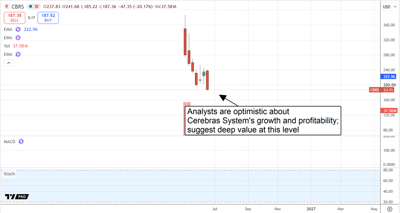
CBRS Pulls Back to IPO Lows With Catalysts in Play
Cerebras Systems has several catalysts in play, including a growing number of business deals, supply chain insulation, and new product launches. Deals such as those with OpenAI and Amazon’s (NASDAQ: AMZN) Amazon Web Services are already generating revenue and are expected to ramp in the coming quarters.
OpenAI is currently porting GPT 5.4 and GPT 5.5 to Cerebras infrastructure and plans to deploy 750 megawatts of its own capacity soon.
The deal with AWS promises to generate a rapidly growing revenue stream through a disaggregated inference setup: AWS's Trainium chips handle the prefill stage—processing the input—while Cerebras' CS-3 systems run the high-speed decode stage that generates the output tokens.
Other catalysts for Cerebras include manufacturing and construction that do not require high-bandwidth memory (HBM), insulating the company from industry bottlenecks. The result is that Cerebras can ramp production while others are forced to wait on memory modules, putting it in a position to gain market share quickly.
Hurdles Drive Volatility for CBRS Shareholders
However, as strong as the outlook may be, the company still has hurdles and headwinds to overcome. Among them is customer concentration, which leaves Cerebras reliant on a limited number of hyperscalers, including the United Arab Emirates-backed G42 Holdings, Ltd. That exposure increases the risk of government scrutiny and export controls. Meanwhile, the sharp increase in inference demand forced the company to lease back previously committed capacity, temporarily pressuring margins.
The more pressing concern is competition. In-house chips are attempting to achieve much of what Cerebras Technology is doing, and the memory shortfall remains a key issue. While Cerebras chips are extremely fast, they have limited on-chip memory, which limits their usefulness in some applications.
While the systems are excellent at producing output, they struggle with input and need front-end assistance with massive prompts, such as enterprise-level requests based on potentially endless datasets. The deal with Amazon is an example: Cerebras systems need the Trainium infrastructure to sort and organize the data into digestible pieces they can use to generate super-fast responses.
The company’s plan is to increase memory capacity over time by shrinking the size of the SRAM modules within each chip. It has done so successfully across several generations and is on track to do so again with its upcoming technology. The caveat is that there is a physical limit to how much can be placed on a single wafer because nodes can only get so small.
Optimistic Analysts Highlight Value Opportunity in CBRS Stock
The initial analyst outlook for Cerebras is bullish. The first 11 reports to appear on MarketBeat’s tracking page since the IPO include 10 Buy ratings, representing a 92% Buy-side bias. The group sees the stock as fairly valued near its IPO level, roughly 60% above the late-June price action. The risk is that the stock could continue to sell off, as often happens with IPOs, but analyst commentary suggests otherwise. Analysts view company guidance as conservative and expect strengths to emerge as the year progresses.
Among those strengths is the potential for accelerated gross margin expansion. The combination of capacity ramping and rising compute costs creates a dual lever for growth. In this scenario, CBRS will likely outperform guidance in the upcoming quarters and improve its profitability outlook.
As it stands, profits are expected by next year, with profitability projected to improve aggressively over the following three to five years.
This email content is a sponsored email sent on behalf of Paradigm Press, a third-party advertiser of The Early Bird and MarketBeat.
If you need help with your newsletter, please feel free to email our U.S. based support team at [email protected].
If you no longer wish to receive email from The Early Bird, you can unsubscribe.
Copyright 2006-2026 MarketBeat Media, LLC.
345 N Reid Pl. #620, Sioux Falls, South Dakota 57103. United States..