Dear Friend,
For a century, America fought wars over energy buried six thousand miles away.
The largest energy source on Earth was under our own feet the whole time - much of it beneath the desert near the Grand Canyon.
How big?
50,000 times every oil and gas reserve on the planet.
Combined.
The center of the Earth runs as hot as the sun's surface.
Tapping a sliver of it could power civilization for two million years.
The size was never the problem. The reach was - until a drilling crew hit the DOE's 2035 targets twelve years early, and costs fell 50% in 18 months.
Google signed. Gates invested. The Pentagon made it a priority.
One company has quietly built this for sixty years.
See the company sitting on the biggest energy source on Earth >>
“The Buck Stops Here,”
Kelly Maguire
Behind the Markets
European Banks Are Outperforming : Can These 3 Keep It Going?
Author: Dan Schmidt. Article Published: 6/25/2026.

Key Points
- European banks remain attractively valued compared with many U.S. peers despite a strong 2025 rally.
- Banco Bilbao Vizcaya Argentaria and Banco Santander offer strong profitability, shareholder returns and global diversification.
- ING Group offers income and value, but its higher capital ratio and payout profile make the risk-reward setup more mixed.
- Special Report: Everyone wanted SpaceX. Smart money wants this.
European banks delivered their best performance in years in 2025, and investors have been tempted to take profits during the sector’s recent pullback. But this rally is no bubble, and there’s plenty of evidence that international bank stocks are still undervalued compared to their domestic peers.
European banks continue to trade at single-digit multiples while posting double-digit revenue growth, making the sector attractive amid sudden commodity tailwinds. But some stocks in the industry stand out more than others, and diversifying investments in this space can help investors capture a range of bullish factors.
Despite Commodity Headwinds, European Banks Are Still on Sale
A drilling crew just broke a record nobody expected (Ad)
A drilling crew in Beaver County, Utah hit 15,765 feet of solid granite in 16 days - a job the Department of Energy projected would take 64. They reached DOE's 2035 performance targets twelve years early, cutting costs in half within 18 months.
When Congress moved to cut solar and wind tax credits, this energy source kept its full credits through 2033. One company has been building in this space for sixty years, and a July 4th catalyst is now 12 days away.
See the company at the center of Project FORGE right nowEuropean banks are still emerging as an undervalued industry after a decade of negative rates. The previous rate environment crushed bank margins, driving the European banking sector into a deep decline, which was further aggravated by war-induced commodity shocks. But now oil headwinds are shifting, and European banks benefit from a Goldilocks environment. And when markets are neither too hot nor too cold, investors tend to reap the rewards.
The European financial value shift isn’t just about oil, rates, and vibes; the sector has some highly accommodative metrics that show certain stocks remain undervalued. Some of these metrics include:
Common Equity Tier 1 (CET1) Ratio - A metric used to measure a bank’s health by comparing its capital to its risk-weighted assets. A Goldilocks range is preferred for this metric: too high means capital is unproductive, too low means the bank is taking too much risk.
Return on Tangible Equity (ROTE) - Strips out factors like intellectual property and brand value to determine profit generated from capital invested by shareholders and is often considered the metric that best measures the pure performance of a bank’s capital.
Dividend Payout Ratio (DPR) - The percentage of a company’s earnings returned to shareholders as dividends. DPR is useful for gauging a bank’s financial health, as a dividend cut is often devastating to its outlook.
Banco Bilbao: The Profit Machine Keeps Churning
Banco Bilbao Viscaya Argentaria (NYSE: BBVA) is one of the best-performing multinational banks in the Eurozone, thanks to its growth in emerging markets. The bank reported ROTE of 21.7% and CET1 above 12% in Q1 2026, yet it trades at around 10.3 times forward earnings. The dividend yields 4.63%, with a 54.3% DPR, but the company is aggressively buying back shares, and net interest income was up more than 20% year-over-year (YOY).
BBVA shares bounced off a clear short-term low and have now resumed their upward momentum. The stock price continues to make higher lows, and a pair of momentum indicators has confirmed the uptrend. The Relative Strength Index (RSI) is above 50, a commonly recognized bullish threshold, and the Moving Average Convergence Divergence (MACD) has been trending upward since mid-May. BBVA’s technical uptrend matches its fundamental strength, which is why it ranks at the top of today’s list.

Santander: Capital Compounder Still Undervalued
Banco Santander S.A. (NYSE: SAN) has surged nearly 65% over the last 12 months, but the Iran war briefly thwarted its bid to reach all-time highs. However, Santander retains a superb 15% ROTE with a CET1 of 14%, and its banking offerings are more globally diversified than BBVA. The stock isn’t a bargain like it was in previous months, but the 1.57% dividend has an approximately 17% DPR, and the stock trades at just 11 times earnings.
SAN shares challenged the 200-day moving average earlier this year, but the bullish uptrend proved strong enough to weather the storm. The stock price quickly surged back above the 50-day moving average, a move backed by the RSI’s ascent into bullish territory. The latest attempt to test the 50-day was swiftly rejected, and the RSI held firm, giving SAN shares the all-clear to make more all-time highs.

ING Group: Higher Risk Package With Income and Value
Amsterdam-based ING Group N.V. (NYSE: ING) appears affordable at 11 times earnings, but its 16% CET1 ratio and 57% DPR make it the bank with the most mismatched risk profile on our list. However, a 4.7% yield is hard to ignore for a bank stock trading at about 11.4 times forward earnings, and management raised net interest income (NII) guidance in the last earnings report.
The RSI has been the guiding light during the volatile period, helping investors navigate the underlying share price fluctuations. Despite a brief June dip, the dependable momentum indicator has remained above 50, showing that buyers have yet to relent. The 50-day moving average also remains a viable support level, reinforcing the bullish case as the stock makes new all-time highs.

3 Inflation-Fighting Stocks Built for Higher Oil Prices
Author: Thomas Hughes. Article Published: 6/21/2026.

Key Points
- Elevated oil prices stemming from damaged global energy infrastructure are fueling persistent inflation, creating demand for inflation-resistant stocks with pricing power.
- TJX Companies, the largest off-price retailer, posted fiscal Q2 comps above 6% and targets up to $3 billion in share buybacks for 2026.
- Ollie's Bargain Outlet and Casey's General Stores offer inflation resilience through debt-free or self-funded models, share buybacks, and opportunistic growth strategies.
- Special Report: Everyone wanted SpaceX. Smart money wants this.
Inflation is here and is unlikely to disappear anytime soon, creating a need for investors to find inflation-resistant stocks that can help offset broader market volatility.
Today’s inflation concerns are underpinned by elevated oil prices. Although the Iran conflict appears to be winding down, the damage to global oil infrastructure will remain. Estimates vary, but most agree that global energy capacity is down by double digits, and it will take at least a year in most cases to come back online. In extreme cases, estimates run as high as five years.
Your $29.97 book is free today (Ad)
Bill Poulos is giving away his 'Safe Trade Options Formula' book at no charge - the same book that sells for $29.97 on his website.
Inside, you'll find a 5-part trade framework designed to make every trade a safer one. This free offer won't last - the price goes back to $29.97 soon.
Click here to claim your free copy before the offer endsOil demand outpaces supply by nearly 1 million barrels per day. That leads to declining stockpiles and upward pressure on oil prices, which in turn fuels inflation. Inflation-resistant stocks are so because they cater to essentials and necessities—things that people and businesses need regardless of cost. This provides pricing power for those companies, supporting margins and cash flow while enabling capital returns that can boost investor returns over time.
Ollie’s Bargain Outlets: A Cheap Play on Off-Price Retail
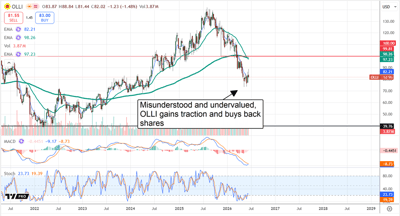
It’s easy to lump Ollie’s Bargain Outlet (NASDAQ: OLLI) in with the dollar store crowd, as it sells many of the same items. The difference is that Ollie’s is a bargain-basement closeout model, whereas dollar stores are traditional retailers. Ollie’s is not tied to a fixed inventory or product line; it sells what it can source cheaply and passes the savings along to customers. It is more like a baby TJX Companies—nimble and flexible in the face of consumer headwinds, opportunistically taking advantage of deals as they arise.
Among Ollie’s attractions is its debt-free balance sheet and ability to self-fund growth. Catalysts in 2026 include converting currently vacant Big Lots locations to the Ollie’s format and turning "dark-rent" expense into revenue-generating square footage, thereby widening margins. Cash flow is central to this investment thesis, as it is for all inflation-fighting stocks, because it enables value-building capital returns. Ollie’s does not yet pay a dividend but may in the future; capital returns currently consist of share buybacks, which reduced the share count by more than 1% on a trailing 12-month basis as of the Q1 2026 earnings report.
The analysts' group created a headwind for Ollie’s stock by lowering price targets over the past year. However, the market overreacted, sending the shares below the low end of the price target range and setting the stage for a rebound later this year.
A catalyst for that rebound could come in an upcoming earnings release if the company reports converted dark space or improved sales and margins. As it stands, the consensus calls for about 60% upside; institutions own nearly 100% of the shares and, on balance, have been accumulating in 2026.
Casey’s General Stores: Generally a Buy, No Matter What
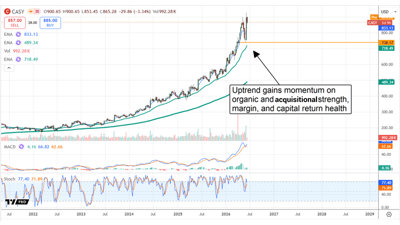
Casey’s General Stores (NASDAQ: CASY) is among the highest-quality growth stories on the market today. It is expanding its network of convenience stores through organic growth and acquisitions, self-funding the strategy while paying investors to own it.
Its advantages include high-turnover items that allow for rapid price responses, a rural moat, and high-margin prepared food items. It benefits from organic traffic and trade-down shopping and has an edge thanks to reduced competition stemming from its rural-oriented footprint.
Highlights in 2026 include the successful and rapid integration of its Fike’s acquisition and margin improvements in both inside sales and fuel sales.
Casey’s capital return includes dividends, dividend growth, and share buybacks. Catalysts in 2026 include the resumption of buybacks, which were paused in 2025 to conserve capital for acquisitions. As of mid-June, the share count had resumed its decline on both a quarterly and year-over-year basis and is expected to continue declining for the foreseeable future. The biggest risk is that the company will pause buybacks again to preserve capital for another value-building acquisition.
The TJX Companies: Top-Tier Inflation-Fighting Stock
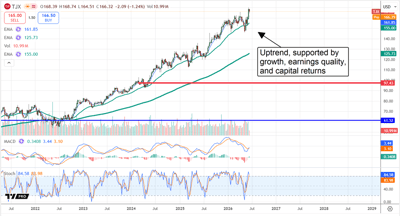
The TJX Companies (NYSE: TJX) is a top-tier inflation-fighting stock, and that is saying something because inflation-fighting stocks are inherently quality stocks. Its strength lies in its scale and reach, as it is the largest off-price retailer of fashion and home goods.
It’s growing at an industry-leading pace, underpinned by robust deal volume and consumer traffic. Its highlights include ample availability of in-demand branded merchandise and strong organic traffic. Fiscal Q2 systemwide comps increased by more than 6%, well above company forecasts, driving healthy profit margins.
TJX’s catalysts are numerous, including an increase in its buyback authorization. The company raised its 2026 target by $250 million, targeting up to $3 billion in total purchases or about 1.6% of the mid-June market cap. TJX’s dividend is also attractive, yielding 1.2% at record-high share prices. The distribution is also expected to grow; the company maintains a double-digit compound annual growth rate and has the capacity to sustain it in the coming years.
This email message is a sponsored email sent on behalf of Behind the Markets, a third-party advertiser of DividendStocks.com and MarketBeat.
If you have questions about your newsletter, please email our U.S. based support team at [email protected].
If you no longer wish to receive email from DividendStocks.com, you can unsubscribe.
© 2006-2026 MarketBeat Media, LLC. All rights reserved.
345 North Reid Place #620, Sioux Falls, SD 57103. United States..