A message from Behind the Markets Fellow Investor,
A small drilling crew just punched through to a discovery big enough to meet global electricity demand 140 times over, according to the International Energy Agency...
Right near the Grand Canyon.
See why Google, Berkshire Hathaway and the President of the United States are rushing to grab it >>
“The Buck Stops Here,”
Kelly Maguire
Behind the Markets
Special Report 3 Hotel REITs Poised to Benefit from the World CupAuthored by Chris Markoch. First Published: 6/18/2026. 
Key Points- The 2026 FIFA World Cup is expected to create more than 21 million hotel room nights across North America.
- Host Hotels, Park Hotels, and Ryman Hospitality all have meaningful exposure to World Cup-related travel demand.
- Investors may want to watch for pullbacks as all three stocks trade above analyst consensus price targets.
- Special Report: Three oil giants buried the same discovery for 50 years

The FIFA World Cup 2026 is underway, and beyond the action on the pitch, the competition for consumer dollars may be just as intense. Official estimates project U.S. accommodations and food services will generate more than $2.4 billion in incremental economic value from the tournament.
That figure includes 21.3 million hotel room nights expected across the three host countries: the United States, Canada, and Mexico. On a granular level, FIFA and the World Trade Organization (WTO) have projected that international travelers will stay an average of 12 days, attend roughly two matches each, and spend more than $400 per day.
Marc Chaikin, founder of Chaikin Analytics, is sharing a strategy he calls 'Sell This, Buy That' - a way to move out of overpriced AI stocks before the tech trade breaks down and into lesser-known names with real potential to challenge the Mag 7.
One pick he calls 'an upgrade to Tesla stock' is a little-known company that just inked a partnership with Nvidia, positioning it ahead of Tesla in the autonomous vehicle race. Get the name, ticker, and full Hotlist before markets open World Cup demand is one reason many hotel stocks have made a strong run this year. However, some of those stocks may now face valuation concerns. A better option may be to look at full-service hotel REITs (real estate investment trusts) as direct, quantifiable beneficiaries.
Analysts have specifically flagged Host Hotels & Resorts (NASDAQ: HST), Park Hotels & Resorts (NYSE: PK), and Ryman Hospitality Properties (NYSE: RHP) as having meaningful revenue exposure to World Cup markets. Each carries a different risk profile that may not be reflected in its respective stock chart.
Host Hotels & Resorts: The Momentum Leader
Host Hotels & Resorts has a concrete, named World Cup tie-in that the other companies on this list lack. Fairmont Mayakoba, one of its managed properties in Mexico, was officially selected to house national team delegations during the tournament. Management also specifically called out World Cup-related transient demand as a catalyst when it raised full-year 2026 guidance for comparable hotel RevPAR and EBITDAre earlier this year.
HST is up 40% in 2026 and more than 30% in the three months ending June 17. It’s also trading slightly above its consensus price target of $23.75. It’s fair to wonder whether the biggest gains are already priced in, especially with HST looking expensive by many conventional metrics.
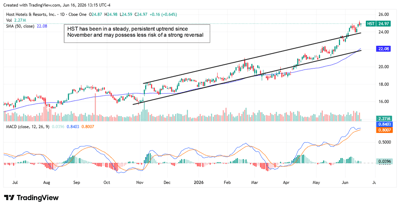
HST has been in a steady, persistent uptrend since November, with the price climbing from approximately $16 to nearly $25.
The 50-day SMA at $22.08 has been reliably ascending, and the price has stayed cleanly above it. MACD is bullish, with the line above the signal, but the histogram is narrowing slightly.
Of the three, HST's chart looks the most technically healthy—it’s the momentum leader without a parabolic overshoot risk.
Park Hotels & Resorts: The High-Risk, High-Reward Play
Park Hotels & Resorts is a Hilton spinoff with a portfolio concentrated in urban markets, several of which are active World Cup host cities.
That direct city-level exposure is the core of the bull thesis here. The stock is up roughly 30% from its May lows and is trading well above its consensus price target of $12.68.
That means the World Cup tailwind may already be largely reflected in the price.
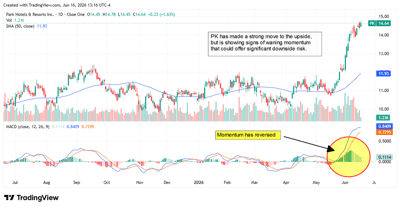
PK also has the most dramatic chart. The stock was essentially rangebound between $10 and $12 for most of the past year, then exploded higher in late May and early June, nearly a 30% move in a matter of weeks.
The 50-day SMA at $11.93 is still ascending but hasn't caught up to the price at $14.64, which shows how vertical that move was.
MACD is sharply positive, but the histogram is already starting to shrink, which is worth watching. That kind of parabolic move often consolidates or pulls back before continuing.
Ryman Hospitality Properties: The Indirect Play With Real Exposure
Rather than broad urban hotel portfolios, Ryman Hospitality Properties owns the Gaylord Hotels brand. That means massive convention and entertainment resorts in markets including Nashville, Dallas, Denver, and Washington D.C.
Its Gaylord Texan property sits in the Dallas market, which is hosting a World Cup semifinal. Dallas is one of the highest-demand World Cup markets in the country. RHP carries a consensus Buy rating, though at $123, it is trading above its consensus price target around $122.
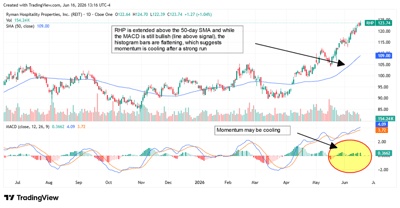
RHP has the cleanest uptrend of the three. Price has been steadily climbing since its April low near $95, now at $123 and well above the 50-day SMA at $109. MACD is still bullish, with the line above the signal, but the histogram bars are flattening, which suggests momentum is cooling after a strong run. Not a reversal signal yet—more of an "extended and catching its breath" setup.
Is It Too Late to Get in on This Trade?
As noted above, each stock has made strong gains this year, and each is starting to show technical signals that momentum is slowing. But each company also shows consistency in revenue that isn’t event-driven.
That fits with recent data from Accio showing that Baby Boomers and the wealthiest U.S. households are not planning to cut back on travel and entertainment spending and, in some cases, are expected to increase it, especially in luxury and experience-based segments, which fit nicely with the business model of these REITs.
For investors considering these names, the question is whether patient investors are better served waiting for a technical pullback toward the 50-day SMA on any of the three before adding exposure, rather than chasing extended moves that are already well ahead of analyst consensus. |