Three oil giants buried the same discovery for 50 years 
Palantir’s Rough 2026 Start Raises a Bigger Question About Its AI Moat
Written by Chris Markoch on June 30, 2026
Key Points
- Palantir Technologies shares have fallen sharply in 2026, leaving investors to weigh weak technical momentum against another earnings catalyst.
- Palantir Technologies’ bull case rests on its ontology-driven enterprise AI platform, not a token-based model business like OpenAI or Anthropic.
- Palantir Technologies’ valuation remains the core bear argument, even as revenue growth, profitability and defense demand continue to support the long-term case.
- Special Report: Trump’s Currency Coup Exposed

Palantir Technologies Inc. (NASDAQ: PLTR) has been among the worst-performing technology stocks in the first half of 2026. PLTR is down nearly 35%, and with lighter summer volume in place, the next catalyst won’t arrive until the company reports earnings on Aug 3. History says that may not be enough to lift PLTR.
To be clear, there are many reasons why investors may be hesitant to buy PLTR, particularly if that means starting a new position. But it’s important to understand what Palantir is about, and more importantly, what it’s not.
Marc Chaikin, founder of Chaikin Analytics, says two forces - AI disruption and fracturing global trade - are triggering a historic wealth transfer already underway in 2026. Household names like Intuit (-57%), Boston Scientific (-49%), and Tractor Supply (-40%) are cratering, while lesser-known companies like Sandisk (+573%) and Rackspace (+444%) surge.
Chaikin has identified specific stocks he believes investors should sell before they fall further - and the names may surprise you. He's also pinpointing a company tapped as Nvidia's self-driving partner and a potential AI megadeal that could split into three high-growth stocks.
Stream his free presentation to get every buy and sell recommendation with no membership or credit card required. Watch Marc Chaikin's free presentation and get his full buy-and-sell list today Enterprise AI Spending Is Moving From Tokens to Outcomes
Since the beginning of the year, enterprise companies have been delivering a clear message. That is, they are no longer willing to throw money at Anthropic or OpenAI on a spend-at-all-cost basis. Instead, they’re pulling back until they can prove a return on investment (ROI).
That would be bad news for Palantir if, as Michael Burry said, Anthropic was "eating Palantir’s lunch." But it’s not, and that’s a point that Palantir co-founder and chief executive officer (CEO) Alex Karp has repeatedly made.
That begs the question: How is Palantir different? Simply put, Palantir’s AIP doesn't sell tokens. Instead, it sells outcomes wrapped in an ontology, deployed via boot camps designed to prove ROI in weeks. Palantir is answering a fundamentally different question from the start: “How do we get measurable value from AI?”
The Ontology Is the Palantir Moat Investors Keep Underestimating
Palantir's ontology isn't a collection of workflows you can lift and shift—it's a semantic representation of how an enterprise actually operates: every object, property, action, permission, and relationship that defines the business, built collaboratively with the customer over months by Forward Deployed Engineers. It encodes business logic, regulatory compliance rules, audit trails, and operational decision authority. Sankar's line on earnings calls is literal, not marketing: the ontology IS the moat.
Gold is hitting record highs, but most investors are leaving income on the table. A $15 fund is quietly paying out up to $1,152 a month to regular investors - no mining stocks, no options, no physical metal required.
Chief Income Strategist Tim Plaehn calls it a breakthrough strategy that transforms gold's rally into reliable monthly payouts. The next distribution is just days away. Discover the gold income fund before the next payout date What the Technical Setup Tells Investors
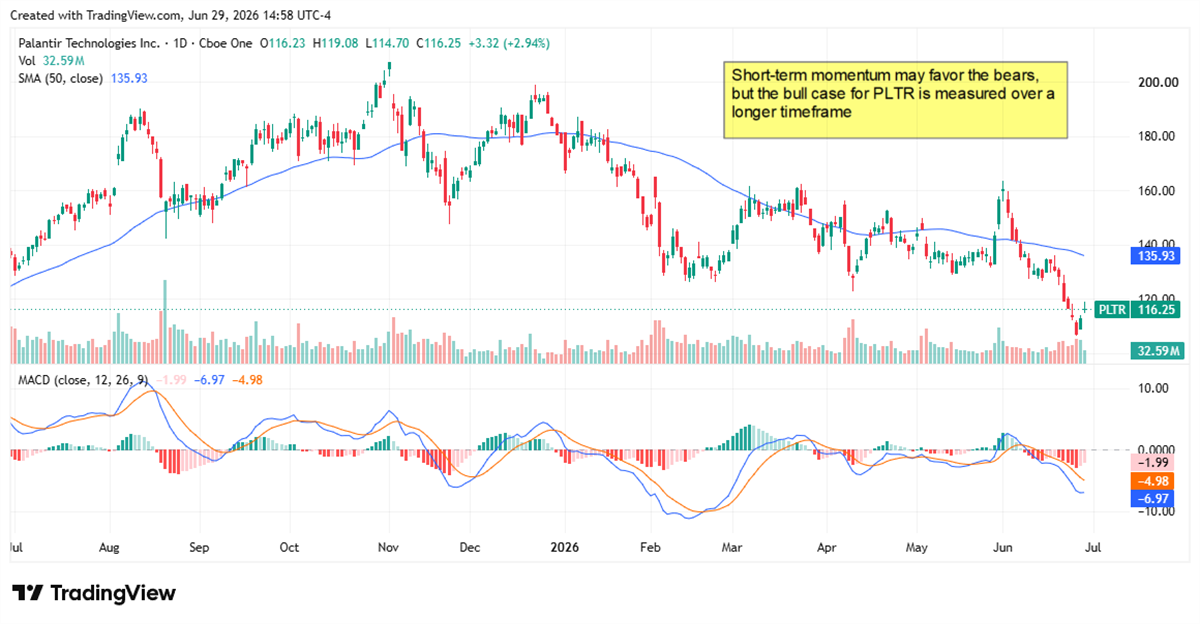
The PLTR daily chart confirms what the year-to-date number already says—the trend is broken, and the indicators have not yet flagged a turn. Investors looking at this chart need to separate the trend signal from the entry signal. The first is unambiguously bearish. The second is starting to develop, but it isn't there yet.
Palantir stock closed around $116.25, sitting roughly $19.68 below its 50-day SMA of $135.93. The 50-day has been sloping lower since the March peak near $180, and it acted as resistance during the May rally attempt. Until the 50-day flattens, every bounce should be treated as a counter-trend move rather than a trend change.
The moving average convergence divergence (MACD) reinforces that reading. The MACD line sits at -6.97, with the signal line at -4.98 and the histogram at -1.99. All three readings are well below the zero line, and the MACD line remains below its signal line—bearish momentum is still in force, not exhausted. A first sign of reversal would be the histogram bars contracting toward zero, followed by a bullish MACD crossover. Neither has happened yet.
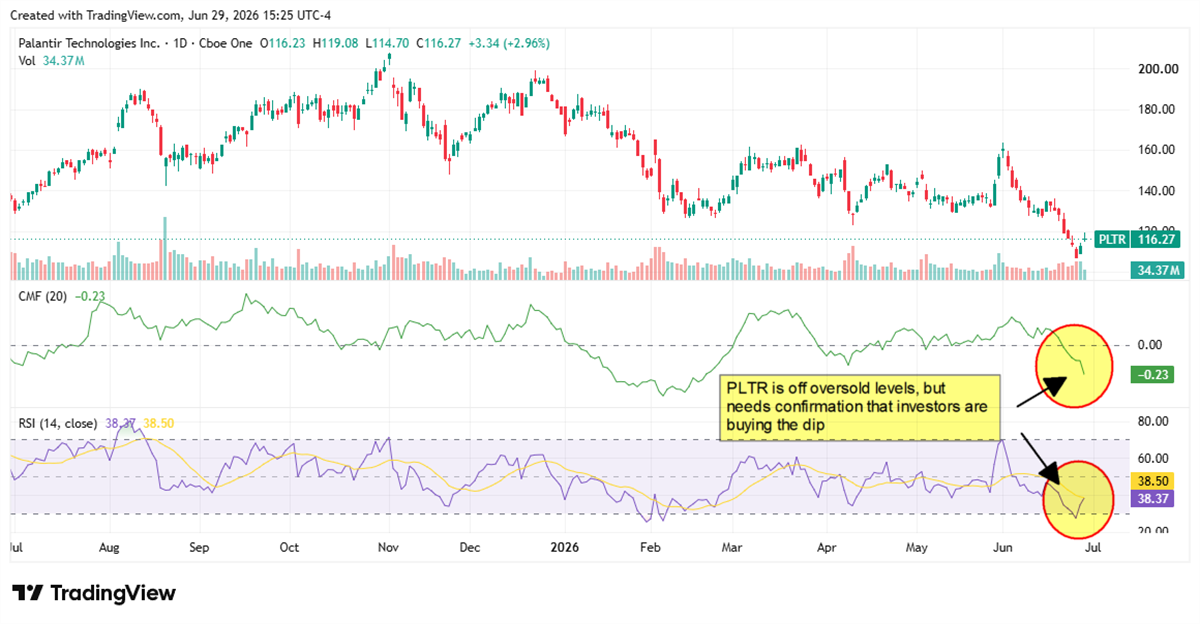
The relative strength index (RSI) has recently bounced off oversold territory, but that alone does not confirm a reversal. Investors would need to see stronger price action and evidence of renewed buying before treating the recent move as more than a stabilization attempt ahead of Palantir’s expected August earnings report.
What the Bear Case Gets Right—and What It Misses
The crux of the bearish argument against PLTR comes down to valuation, and at a surface level, it’s compelling. Palantir secured a $10 billion, 10-year Enterprise Agreement with the U.S. Army in 2025. To put that into perspective, Palantir generated approximately $4.5 billion in revenue for the full year 2025.
However, that $10 billion isn’t guaranteed income, and even if it does come in, recognition of it may be lumpy. The same argument can be made on the commercial side of the company’s business.
That has many investors happily reminding Palantir shareholders that fundamentals don’t matter until they do. With the stock down approximately 35% in 2026 and trading about 9% above its 52-week low, momentum has been on its side. But technical momentum signals emotion. Results like Palantir has delivered in its quarterly earnings are the buying signal the company continues to flash.
The Palantir analyst forecasts on MarketBeat have a consensus price target of $190.46, an increase of over 60%. It’s worth noting that some analysts have issued price targets well below the consensus target. However, much of their analysis focuses on concerns that aren’t relevant to Palantir’s business model.
That’s not an argument for a 10x gain from PLTR. But investors with a long-term time horizon are likely to find that investing at these levels will be profitable over time.
Read this article online ›
Featured Articles
Did you find this article useful?
 
| 