
|
Welcome to You’re Probably Getting Screwed, a weekly newsletter and video series from J.D. Scholten and Justin Stofferahn about the Second Gilded Age and the ways economic concentration is putting politics and profits over working people.



 |
Welcome to You’re Probably Getting Screwed, a weekly newsletter and video series from J.D. Scholten and Justin Stofferahn about the Second Gilded Age and the ways economic concentration is putting politics and profits over working people.
“They’ll be gittin’ the wind next, they’ve got the time now.” The “they” in this quote from Jack Beatty’s “Age of Betrayal” are the railroads. It captures the concerns Americans had during the Gilded Age about how the immense power railroads had rapidly accumulated was upending everyday life. Today the term rail barons likely conjures up images from the past - black and white photos with monocles and top hats - but there is a new generation of rail barons that has amassed a level of power our forbearers could have never imagined. Not content, they want to tighten their grip over the plumbing of commerce ever further and their efforts have generated opposition from a broad swath of Americans from MAGA Republicans to proponents of nationalizing our rail system.
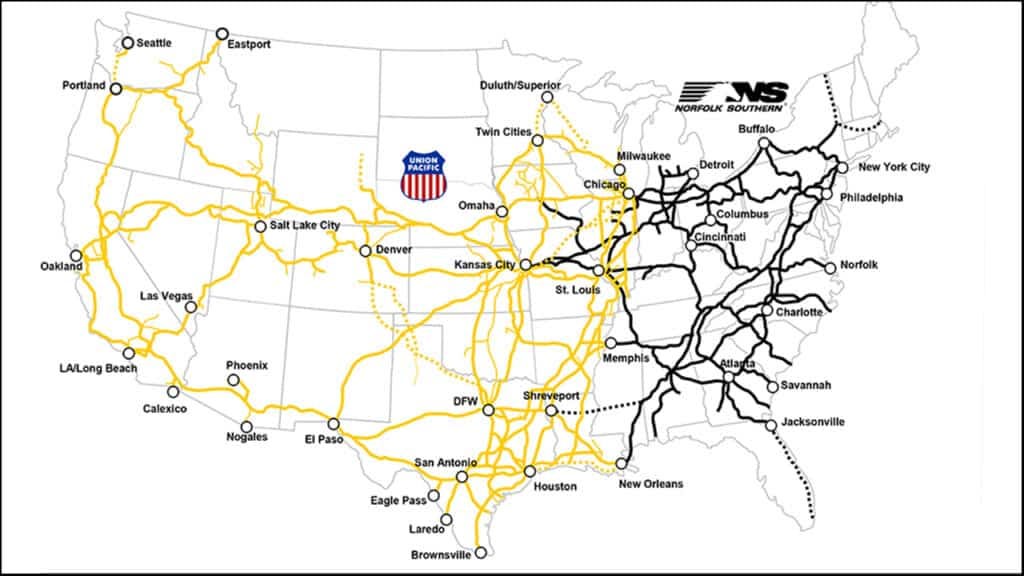
In July last year Union Pacific announced its intent to acquire Norfolk Southern. The two railroads are among the nation’s six Class I railroads, a designation from the Surface Transportation Board (STB) for the largest (gross revenues of at least $447.6 million) rail companies that account for over 90% of freight traffic. There are also Class II railroads that consist of regional and shortline railroads and Class III, consisting of local lines and switching railroads. In 1980 America had more than 40 Class I railroads but a wave of mergers following the deregulation of the railroads in the 1970s, dramatically shrank that number. If you dig deeper the situation is even more grim. The US has been carved up into two regional duopolies with Union Pacific and BNSF Railway dominating the West and Norfolk Southern and CSX Transportation controlling the East. A UP-NS merger would likely spark a BNSF-CSX merger, creating two transcontinental giants.

The UP-NS merger would establish the first transcontinental railroad in United States history. While the country’s physical rail infrastructure has spanned across the country for over a century, not once has one company had coast-to-coast control. Think about that. The immense power of the Gilded Age rail barons helped create modern antitrust enforcement. Midwest states including Minnesota, Iowa, Illinois and Wisconsin passed “Granger Laws” regulating railroad rates and prohibiting unfair pricing tactics by railroads. When those laws were struck down by the Supreme Court, Congress established the Interstate Commerce Commission and the states and then Congress passed antitrust laws, with the Sherman Act capping off that flurry of legislative activity. Yet never during that critical and animating period of history did the railroads have the kind of power Union Pacific now wants.
 |
Today railroading is America’s “most profitable industry” according to a 2019 American Journal of Transportation article that cited a 50% profit margin. Monopoly power is a major reason why. Railroads have actually lost market share to trucking in recent years dropping from 51% of the land-freight market to around 37%. Since the 1980s railroads have also abandoned nearly 100,000 miles of track, cutting the total network nearly in half. While consumer goods have shifted to trucking, heavy bulk commodities such as grain, chemicals, automotive parts and scrap steel remain reliant on rail and the barons are squeezing every penny they can. Since 2004 freight rail rates have increased 43 percent, despite just an eight percent increase in railroad operating costs. In 2013 chemical companies claimed shipments were being charged nearly twice what it cost railroads to move those goods. This has been great for shareholders with Class I railroads returning $270 billion of the $344 billion in net income generated from 2010 to 2023 to shareholders in the form of dividends and stock buybacks, but it has left communities under the railroad’s thumb.
In 2012 a study found that 78% of the 28,000 places in the United States where major railroads pick up or deliver freight are served by a single major railroad. As a result, it is estimated that these “captive shippers” produce around 50% of railroad revenue, which is a 231% increase since 2004. Farmers have faced a particularly significant squeeze from the rail barons. In some landlocked states railroads carry 85% to 95% of grain output, reflecting a near-total reliance. Approximately 95% of grain elevators are served by only one railroad. The result has been higher costs that ripple throughout the food system both in higher food prices for already cash-strapped consumers and higher costs for farmers already crushed by skyrocketing input costs and shrinking markets. Rail profits from farm products have ballooned from roughly $1 billion two decades ago to $3 billion today, and specific to the UP-NS merger, Union Pacific already generates roughly 60% of its revenue from “noncompetitive movements.”
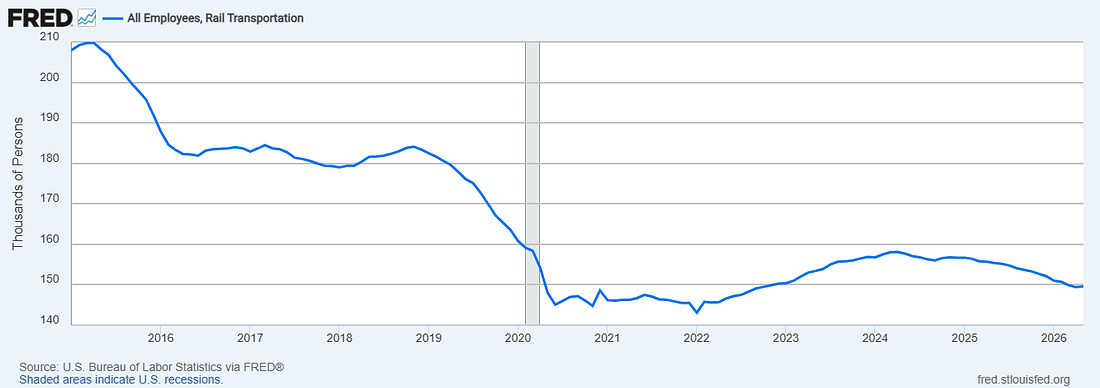
The re-monopolization and financialization of railroads has not only meant higher prices. The industry has widely adopted a strategy known as Precision Scheduling Railroading (PSR) that Vice called the “Moneyball of railroading” and involves aggressively reducing costs by scrapping locomotives and rail cars, running fewer but longer trains, abandoning stops and cutting workers. The goal is to reduce expenses below 60% of revenues. Hundreds of small rural communities have lost rail access. Since 2015 railroads have reduced their total workforce by 50,000 workers and since 2013 the railroad accident rate has risen 123% at Norfolk Southern, 52% at Union Pacific, and 72% at CSX. In the same VICE article above, SMART-TD union president Jeremy Ferguson said that the railroads were going to end up like Boeing because of these PSR strategies. You know, the company that makes planes that cannot fly.
 |
For all these reasons, this merger has generated broad concerns from all corners. A Stop the Rail Merger Coalition has formed bringing together groups like the Alliance for Chemical Distribution, BNSF, Farm Bureau and the Teamsters Rail Conference, among others. A broad array of organizations have also issued statements or sent letters to the Surface Transportation Board (the federal agency with authority over this merger) voicing concern or opposition to the merger. That list includes:
With such a broad and diverse set of opposition it begs the question who exactly supports this merger?
“Sounds good to me.” That was how President Donald Trump responded when asked about the merger last year. More recently in a May interview with Fortune Trump said, “They want to merge, very big railroad, they want to merge. And I say, ‘Well, I want 15% of the railroad if you’re going to merge. So they said ‘No,’ but they’ll say ‘Yes.’” Trump also fired Robert Primus in August 2025, the only member of the STB to have voted against the last major rail merger between Canadian Pacific and Kansas City Southern. On Monday in a case involving former Federal Trade Commission member Rebecca Slaughter, the Supreme Court determined the president could dismiss members of independent agencies, like Primus, for any reason.
For its part, the STB is not rushing the merger along as was originally feared after Trump made his comments in support and noted he was a big fan of Jim Vena, Union Pacific’s CEO. Side note, that is the same CEO that prompted Trump to deploy the National Guard to Memphis because of the crime Vena described in an Oval Office meeting. Earlier this year the STB rejected Union Pacific’s initial application to merge for being incomplete. While that problem has since been rectified, the board has now paused its process as it awaits further information from the railroads by the end of July. This has pushed any decision on the merger further out to 2027 or potentially even 2028. Given Monday’s Supreme Court decision though, there is reason to be skeptical that the STB will listen to the broad concerns of an array of American workers, farmers and businesses over the guy that can fire them at will.
Regardless of what happens with this merger, populists should ensure that the STB under a future president has reform-minded individuals on it that bring a similar energy as Slaughter, Alvaro Bedoya and Lina Khan brought to the FTC during the Biden Administration. While deregulation has dramatically limited our ability to reign in the excesses of today’s rail barons, the STB’s authority is arguably underutilized. First in the context of the current merger proposal, the STB in 2001 revised its merger guidelines to further strengthen the public interest standard for evaluating mergers and stating that any merger has to enhance competition as opposed to simply not limiting competition. Hard to see how this improves competition. (Worth noting: When the STB evaluated the merger that created CPKC in 2013, it used its old guidelines per a regulatory waiver Kansas City Southern had received.)
Beyond policing mergers, the STB could also take stronger steps to police freight rates in certain circumstances. However, to truly transform the rail industry Congress will need to take action and while not all of the opponents of the UP-NS merger will be interested in that, the base for a broad coalition has been built. Reforms could include re-regulating the railroads, introducing public options into the system or fully nationalizing it. You can read more about some of those options in Matthew Buck’s 2024 Yale Law Journal article. These reforms are not mutually exclusive, but its clear the status quo is not working for consumers, communities, farmers and workers.
YOU’RE PROBABLY (ALSO) GETTING SCREWED BY:
Monopolies
A good roundup from the Guardian on how monopoly power is squeezing consumers with high prices and degraded services that also highlights that we cannot shop our way out of the monopoly crisis. “Decades of mergers have limited consumer options. Companies are so big they can push industry-friendly regulation and charge what they want, safe in the knowledge that disgruntled customers have nowhere to go.”
AI Bubble
We have covered the AI utopia tech bros are selling us, the anticompetitive tactics AI is supercharging and how populist rage against data centers is swelling across the country. Author Cory Doctorow on the Dream Against the Machine podcast argues all of that is downstream of the most destructive part of AI, which is the massive financial bubble it has created.

Data Center Subsidies
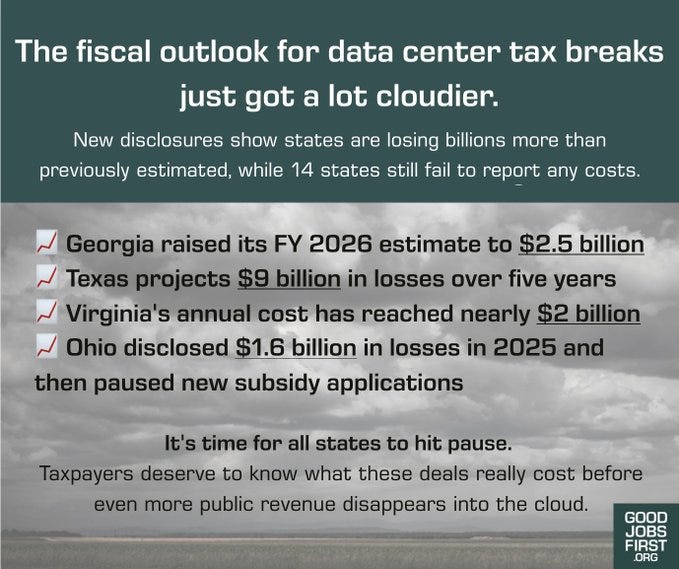
Speaking of that rage against data centers, Good Jobs First recently reported that tax subsidies for data centers are costing at least four states over $1 billion a year. There are another 14 states that still fail to disclose the fiscal implications of data center tax breaks.
 |
SOME GOOD NEWS:
Worker Cooperatives
I wrote recently about the energy that erupted around the idea of turning Spirit Airlines into a cooperative. It is just one of the many ways the cooperative model could help us create a fairer and more distributed economy. In the first in a new series called “Big Ideas” the good folks at More Perfect Union have released a video covering worker cooperatives and their potential for releasing us from the corporate domination of the Second Gilded Age.
Public Rail Now Podcast
Building off today’s story, I recently went on the podcast of Public Rail Now, an advocacy organization that fights to create a publicly-owned rail industry in America.
Antimonopoly Champions
Fight Corporate Monopolies has endorsed a slate of antimonopoly champions across the country running for everything from governor to mayor to utility regulator. You can check out the full slate here.
BEFORE YOU GO
Before you go, I need two things from you: 1) if you like something, please share it on social media or the next time you have coffee with a friend. 2) Ideas, if you have any ideas for future newsletter content please comment below. Thank you.
Break Em Up,
Justin Stofferahn
| ||||||||||


