Hello,
Thanks for signing up for MarketBeat Daily Ratings—we’re excited to have you on board.
Every weekday, you’ll get a curated summary of new “Buy” and “Sell” ratings from Wall Street’s top-rated analysts, the latest stock news, and bonus investing content—all delivered straight to your inbox.
You’re just two quick steps away from completing your sign-up:
1. Make sure our emails go to your inbox
Gmail users:
Mobile: Tap the three dots (…) in the top right and select Move to Inbox or Move to Primary
Desktop: Click the folder icon at the top and select Move to Inbox or Primary
Apple Mail users:
Tap our email address at the top (next to From: on mobile), then select Add to VIP
Other providers:
Reply to this message and add [email protected] to your contacts
2. Confirm your subscription
Click this link to confirm your subscription. This verifies your account and ensures you receive your newsletters without interruption instead of getting stuck in your spam filter.
Confirm your subscription here.
After you confirm, feel free to download our popular free report, "7 Stocks to Buy and Hold Forever" with this link.
Thanks again for subscribing—we look forward to being part of your investing journey.

Matthew Paulson
Founder and CEO, MarketBeat.
P.S. If you didn’t mean to subscribe, no problem—you can unsubscribe here.
Further Reading from MarketBeat Media Uncle Sam Plugs In: Nuclear Energy’s Cash Flow Moment Is Finally HereAuthor: Jeffrey Neal Johnson. Date Posted: 6/26/2026. 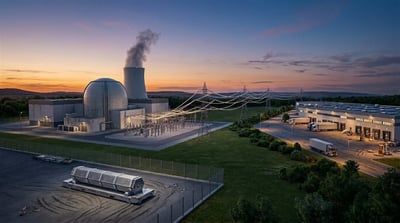
Key Points- The U.S. Department of Energy issued a $17.5 billion conditional loan commitment to accelerate construction of 10 Westinghouse AP1000 reactors nationwide.
- Walmart signed a 15-year power purchase agreement with Constellation Energy for 176 MW of clean electricity, signaling nuclear demand is expanding beyond tech.
- Cameco's 49% stake in Westinghouse and strong balance sheet position it to capitalize on a multi-decade backlog driven by federal nuclear investment programs.
- Special Report: Everyone wanted SpaceX. Smart money wants this.
The modern electric grid faces a severe supply problem. As automated industries and distribution hubs expand and create massive power demand, traditional energy networks are reaching their limits. Investors who once viewed clean energy as a speculative, high-cost venture are now witnessing a structural realignment.
A powerful combination of state-backed credit and long-term corporate commitments is driving this change. By examining the fundamental capital stacks of these energy systems, a clear picture emerges: the financial risks that historically depressed the nuclear sector are fading. This shift is turning clean energy investments into more visible, compounding cash flow engines.
How Government Backstops Protect Private EquityThe Wall Street Journal is already raising the alarm about a potential market crash, and Weiss Ratings research points to the first half of 2026 as a particularly rough stretch for certain holdings.
Some of America's most popular stocks could take serious damage as a radical market shift plays out. Analysts at Weiss Ratings have identified five names you may want to remove from your portfolio before this unfolds.
If any of these are in your portfolio, now is the time to review your positions. See the 5 stocks to avoid The main hurdle for any nuclear project is the immense upfront capital expenditure, known as CapEx. To address this bottleneck, the U.S. Department of Energy's Office of Energy Dominance Financing recently issued a $17.5 billion conditional loan commitment under the American Nuclear Supply Chain Loans program. The program funds up to five key projects, accelerating the construction of 10 Westinghouse AP1000 reactors nationwide.
Instead of offering direct government handouts, the program relies on a co-investment structure. To access low-interest federal capital, both Westinghouse and its utility partners must establish joint-venture special-purpose vehicles, with each partner committing $500 million in upfront cash equity. This structure ensures that only highly capitalized players can participate. By matching $1 billion in private equity per project site with low-cost federal debt, the program lowers the weighted average cost of capital (WACC) for new reactors. This financial de-risking makes nuclear projects attractive to institutional funds seeking stable, long-term returns.
Cameco Powers Up Westinghouse to Capture the Supply FlowThis federal program directly benefits the nuclear supply chain, starting with fuel providers. Through its 49% ownership of Westinghouse, Cameco (NYSE: CCJ) gains a highly visible, multi-decade backlog of orders for reactor equipment, services, and fuel-cycle services.
To assess Cameco's capacity to fund its share of these joint-venture equity requirements, investors can look to its exceptionally strong balance sheet. Cameco maintains a debt-to-equity ratio of 0.14 and a current ratio of 3.08. This minimal debt burden allows Cameco to meet its upfront cash commitments without diluting equity or relying on expensive commercial loans.
While its trailing price-to-earnings ratio of 97 represents a premium valuation, that premium is supported by structural supply-side moves, including its acquisition of an increased 57.4% stake in the high-grade Cigar Lake mine and the full production restart of its McArthur River assets. These moves help ensure Cameco retains strong pricing power as fuel demand accelerates.
Walmart Plugs Into Constellation Energy for PowerWhile federal loans address front-end construction risks, long-term corporate contracts are securing backend revenues. A major retail sector giant recently validated this trend. Walmart (NYSE: WMT) signed a historic 15-year power purchase agreement, or PPA, with Constellation Energy (NASDAQ: CEG) to buy 176 MW of clean electricity from the Dresden Clean Energy Center in Illinois. This agreement spans two staggered terms, beginning in 2029 and 2030, to support Walmart's automated distribution facility in Belvidere, Illinois.
This agreement shows that the race for secure, round-the-clock power is expanding beyond major tech firms like Microsoft (NASDAQ: MSFT) and into mainstream retail logistics. From a fundamental standpoint, the deal is highly efficient. It includes 30 MW of expanded capacity generated through planned uprates, which are efficiency upgrades that increase output from existing, fully licensed reactors.
This approach allows Constellation Energy to expand its power generation with minimal capital outlay, boosting operating earnings and supporting its current return on equity of 16.81%.
This high-return model also supports Constellation Energy's impressive projections, with free cash flow expected to rise from $8.4 billion in 2026–2027 to $11.5-$13.0 billion in 2028–2029.
Separating Headline Noise From Structural Balance SheetsAny long-term energy investment faces real-world hurdles. Regulatory approvals, grid connection queues, and regional supply chain bottlenecks can still slow reactor construction. In the near term, utility stocks have faced some downward pressure.
For example, Constellation Energy's stock price has declined 22% year-to-date, driven by 2026 earnings guidance of $11 to $12 per share, which fell slightly below the most optimistic Wall Street projections.
In another development, a federal grand jury recently indicted engineering manager Casey Muggleston of Constellation Energy for a $1.4 million insider trading scheme related to the Three Mile Island restart.
While this creates temporary headline risk, it does not alter Constellation Energy's underlying cash flows or its long-term corporate contracts.
Investors should focus on the fundamental cash-generation power of these operating fleets rather than short-term headline volatility.
Securing Strategic Value as the Nuclear Cycle Powers UpThe structural shift in the energy sector is real, complex, and volatile. The combination of state-backed capital and long-term corporate demand is turning nuclear energy from a complex, high-cost option into a highly reliable asset class with predictable, recurring revenue streams. For long-term investors, the fundamental health of these operators and suppliers suggests that the current pullback may offer a strong entry point. Investors might consider adding these nuclear operators and fuel suppliers to their watchlists as long-term cash flow metrics continue to strengthen. |