Dear Friend,
Elon Musk just admitted something most tech CEOs won’t.
“AI is going to demand so much electricity that we simply do not have enough.”
He’s right. Morgan Stanley estimates a 49-gigawatt power shortfall by 2028. That’s 49 missing power plants.
And here’s the part that makes it worse:
Every one of these companies signed legally binding zero-carbon commitments. Natural gas is off the table. They don’t just need power - they need clean power, around the clock, starting now.
Solar can’t do it. Wind can’t do it. Nuclear is a decade away.
So where’s the power coming from?
Beneath your feet. The center of the Earth runs at 10,000 degrees - powered by a reactor that’s been running for 4.5 billion years.
One company figured out how to tap it. Google signed. Gates invested. The DOE proved the tech works.
The AI giants are desperate. This company has what they need.
See the one company solving AI’s biggest problem >>
“The Buck Stops Here,”
Kelly Maguire
Behind the Markets
SpaceX Was Just the Beginning—2 More Massive IPOs Are on Deck
Author: Bridget Bennett. Date Posted: 6/21/2026.

Key Points
- Anthropic and OpenAI have both confidentially filed S-1s with the SEC, with analyst Luke Lango expecting two historic IPOs before year's end.
- Lango argues the better near-term trade is SpaceX's supply chain, as the company deploys $75 billion toward orbital data centers and semiconductor manufacturing.
- Pre-IPO proxy vehicles like Destiny Tech100 surged ahead of the SpaceX debut and then retraced, a pattern Lango expects to repeat with Anthropic and OpenAI listings.
- Special Report: The company SpaceX cannot operate without
The largest IPO in history just happened, and it is barely a week old. Space X (NASDAQ: SPCX), priced at $135, surged past $200 in its first days of trading and is still moving. But according to Luke Lango of InvestorPlace, the more important question is not what just happened with SpaceX. It is what comes next—because two more historic IPOs are on the way before year-end, and the template for how to play them is already written.
Why SpaceX Ran—And What It Signals
The explosive opening was not purely a matter of conviction. It was mechanics. Only about 5% of the float was tradable at launch, so even moderate demand pushed the stock sharply higher.
ALERT: Drop these 5 stocks before the market opens tomorrow! (Ad)
The Wall Street Journal is already raising the alarm about a potential market crash, and Weiss Ratings research points to the first half of 2026 as a particularly rough stretch for certain holdings.
Some of America's most popular stocks could take serious damage as a radical market shift plays out. Analysts at Weiss Ratings have identified five names you may want to remove from your portfolio before this unfolds.
If any of these are in your portfolio, now is the time to review your positions.
See the 5 stocks to avoidThat supply-demand imbalance is exactly what Lango expects to play out again when Anthropic and OpenAI go public—both of which have now confidentially filed S-1s with the SEC.
That does not mean SpaceX is a straight line from here.
Lockups begin expiring around August, and engineers who have spent a decade building the company and are suddenly holding positions worth millions will take some money off the table. That is not a bearish signal—it's human nature.
Lango's view is that the volatility is noise, not a reason to exit. His longer-term range for SpaceX is $500 to $800 within three to four years.
The Better Near-Term Trade Is the Supply Chain
The more actionable near-term call, in Lango's view, is not SpaceX itself—it's the companies that stand to absorb the $75 billion it just raised.
That capital is heading toward orbital data centers, reusable-rocket infrastructure, and a vertically integrated semiconductor manufacturing facility under construction in Texas. The parallel to the AI infrastructure trade is direct. Microsoft Corporation (NASDAQ: MSFT) and Alphabet (NASDAQ: GOOGL) were solid AI plays—but the biggest winners were the companies cashing the checks.
That includes optical names like Coherent Corp. (NYSE: COHR) and Corning (NYSE: GLW), power plays like GE Vernova (NYSE: GEV), and construction names like Caterpillar (NYSE: CAT). Lango sees the same dynamic setting up now for space AI infrastructure.
Pre-IPO Vehicles and the Proxy Trade Playbook
For investors who want exposure to Anthropic and OpenAI before they're publicly tradable, a category of publicly listed venture capital vehicles offers one route in: funds that hold pre-IPO stakes in private companies and trade on exchanges like any other stock.
The category is relatively new, but the SpaceX IPO just gave it a real-world stress test.
Two of them ran hard ahead of the SpaceX debut. The Tema Space Innovators ETF (NYSEARCA: NASA) ran from roughly $25 to around $45 before the IPO. Destiny Tech100 (NYSE: DXYZ) had an even bigger move, then gave back a significant portion of those gains once SpaceX became directly tradable. The logic is simple: when the real thing is available, investors stop buying the proxy.
That retracement is not a flaw in the trade. It is the shape of it. The window is the period between now and the IPO date, and timing the exit matters as much as the entry.
Lango expects similar vehicles with Anthropic and OpenAI exposure to follow the same trajectory, potentially doubling or more into those debuts before retracing. For investors who understand the mechanics, that is a defined setup with a clear clock on it, not a long-term hold.
Where the Money Flows for Anthropic and OpenAI
With SpaceX, the indirect plays were space-adjacent names—Rocket Lab USA (NASDAQ: RKLB), Planet Labs PBC (NYSE: PL), AST SpaceMobile (NASDAQ: ASTS), BlackSky Technology (NYSE: BKSY), and Redwire Corporation (NYSE: RDW)—which surged into the IPO and then reversed once the real thing hit.
The Anthropic and OpenAI versions of that trade involve different names with the opposite dynamics.
Software is the pressure point. The iShares Expanded Tech-Software Sector ETF (BATS: IGV) has already retreated from its highs, and Lango sees the Anthropic IPO as a further negative catalyst for names like Salesforce (NYSE: CRM), Adobe (NASDAQ: ADBE), and Intuit (NASDAQ: INTU) as frontier AI models absorb more of what those platforms do.
The long side of the rotation is big tech. Amazon.com (NASDAQ: AMZN) is a major Anthropic investor. Microsoft is deeply tied to OpenAI. NVIDIA Corporation (NASDAQ: NVDA) has exposure to both. Lango expects some selling pressure in those names into the IPOs—and frames any weakness as a buying opportunity.
The Contrarian Case for OpenAI
The consensus has shifted toward Anthropic as the momentum story. Lango's most contrarian call is that OpenAI may be the better near-term setup. It has a capable new flagship model, and the political landscape may favor it: there are reported conversations about the White House taking an equity stake in frontier AI companies, and Lango's read is that those conversations are really about OpenAI.
If that materializes before the IPO, the proxy trades for OpenAI could move fast and hard.
The liquidity for both deals flows primarily out of big tech. Investors bought Microsoft for its OpenAI exposure and Amazon for its Anthropic stake. When direct exposure becomes available, the rationale for holding those proxies fades—and that rotation is where much of the opportunity lives.
That same dynamic shapes the longer-term view on T-Mobile US (NASDAQ: TMUS), Verizon Communications (NYSE: VZ), and AT&T (NYSE: T) as Starlink continues building out. Disruption there will not resolve in a single IPO cycle—but it is worth tracking as SpaceX deploys its capital.
SpaceX did not just make history. It drew the map. Two more historic debuts are coming before year-end, and the investors who read the template correctly may be well ahead of both.
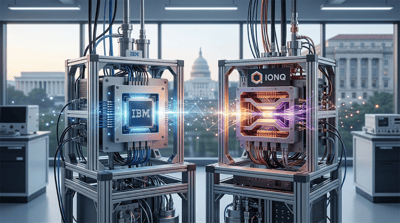
Washington’s Quantum Push Puts IBM and IonQ on the Throne
Author: Jeffrey Neal Johnson. Date Posted: 6/25/2026.
Key Points
- Federal executive orders have designated sovereign quantum dominance as a national security priority to accelerate domestic technology leadership.
- The establishment of a dedicated commercial foundry secures a reliable domestic hardware supply chain for superconducting silicon technologies.
- Proprietary hardware innovations and strategic acquisitions are positioning pure-play developer firms to capture rapid commercial and defense growth.
- Special Report: The company SpaceX cannot operate without
The global race for computational supremacy has reached a historic inflection point as Washington shifts from passive research subsidies to active, state-backed equity ownership. This unprecedented move is reshaping the investment landscape for high-performance computing, signaling to the market that sovereign dominance in quantum technology is now a national security imperative.
While traditional software sectors continue to grapple with enterprise spending headwinds, this sweeping federal intervention establishes an insulated, non-cyclical capital runway for domestic quantum leaders.
Washington Declares a Sovereign Emergency
Trump is replacing the U.S. dollar (Ad)
Porter Stansberry says a dollar reset is underway - one that has happened only once before in America's 250-year history, back in 1974 with a secret Saudi deal that reshaped an entire generation's wealth.
Today, a landmark treaty called Pax Silica - signed by 13 nations in December 2025 and barely covered in the press - is at the center of what Fortune calls 'the biggest change to the world's relationship with the dollar' in a generation. The stocks to buy, the assets to avoid, and the moves to consider are outlined in Stansberry's new briefing.
Read the full briefing and see how to position yourself nowUnder a pair of executive orders signed on June 22, 2026, the executive branch has launched a coordinated effort to secure a domestic quantum ecosystem across research, manufacturing, and national security applications.
Rather than relying solely on non-dilutive grants, the federal government is deploying a $2 billion capital allocation from the CHIPS and Science Act to take direct equity stakes in public quantum hardware developers. This equity-backed model acts as a powerful safety net, protecting critical hardware supply chains from the high borrowing costs and funding constraints currently affecting private venture markets.
Sovereign Deadlines That Guarantee a Multi-Year Capital Runway
The federal directives establish concrete, aggressive procurement deadlines that support a multi-year pipeline of public-sector demand. The first directive, the Quantum Computer for Application Development and Discovery Science (QC-ADDS) effort, mandates the delivery of at least one research-grade quantum computer to a Department of Energy facility by 2028, alongside the deployment of at least three next-generation quantum sensor projects by Sept. 30, 2028.
The second directive requires all federal agencies to migrate their high-value cryptographic assets to post-quantum cryptography (PQC) by 2030 for key establishment and 2031 for digital signatures. These mandates provide long-term revenue visibility, helping to de-risk the massive research and development expenses required to scale quantum systems.
International Business Machines Claims the Silicon Throne
As an established institutional giant, International Business Machines (NYSE: IBM) is capturing the largest share of this sovereign deployment. On May 21, 2026, the company signed a Letter of Intent to establish Anderon, a standalone independent subsidiary that will operate as America's first 300mm quantum wafer foundry in Albany, New York.
Backed by a $1 billion Department of Commerce CHIPS Act award and a matching $1 billion cash and intellectual property commitment from IBM, Anderon will supply superconducting silicon quantum wafers to outside hardware developers. This picks-and-shovels model positions the enterprise as a primary tollbooth of the domestic quantum economy.
Anderon anchors a broader $10 billion, five-year quantum spending plan targeting the development of its fault-tolerant hardware roadmap. This roadmap focuses on delivering the Quantum Starling system by 2029 and the Quantum Blue Jay system by 2033.
Robust operations support this roadmap, as Q1 2026 earnings highlighted $15.92 billion in revenue under generally accepted accounting principles (GAAP), representing 9.5% year-over-year (YOY) growth. Non-GAAP gross margins expanded by 110 basis points (BPS), driven by high-margin software integrations.
On June 22, 2026, the corporate giant joined OpenAI's Daybreak Cyber Partner Program, backed by a $5 billion investment in Project Lightwell alongside Red Hat to secure enterprise applications. To support these capital-intensive initiatives, the firm strengthened its cash position by extending its separate $10 billion syndicated credit lines the same day.
Following these catalysts, shares of IBM rebounded 4.93% on June 23, 2026, to close at $264.66. Analysts remain bullish, as JPMorgan upgraded the stock to Overweight with a $291 target, while the consensus target has risen to $306.94.
IonQ Claims Its Own Crown With Trapped-Ion Modality
In contrast to a heavy silicon foundry model, IonQ (NYSE: IONQ) represents a high-velocity, pure-play alternative. IonQ bypasses cleanroom fabs by utilizing an optics-intensive, trapped-ion hardware architecture. Because trapped-ion systems manipulate individual atoms in a vacuum using lasers, the company is less reliant on traditional semiconductor manufacturing supply chains.
This technological distinction helps explain why IonQ was omitted from the Department of Commerce's primary silicon-focused CHIPS Act awards. That independent status has allowed IonQ to focus entirely on commercial and defense integration. In January 2026, IonQ announced a $1.8 billion acquisition of SkyWater Technology, immediately expanding its advanced engineering footprint with aerospace and military clients.
This defense-first alignment is already translating to exceptional growth. On May 6, 2026, IonQ announced its Q1 2026 earnings, posting $64.7 million in revenue, a 754.7% increase YOY, and beating consensus estimates by 30%. A backlog of $470 million prompted management to raise full-year 2026 revenue guidance to a range of $260 million to $270 million. Recently trading in the $57-$58 range, IonQ has gained 28.2% year to date (YTD). Wall Street analysts maintain a Moderate Buy consensus on the stock, with Rosenblatt holding a high price target of $100 and Northland Securities recently raising its target to $70.
Evaluating the Divergence for Your Tech Portfolio
The rapid expansion of the domestic quantum sector presents two distinct investment profiles. For conservative, yield-focused portfolios, IBM offers a stable 2.59% dividend yield, paid quarterly at $1.69 per share. Its sovereign partnerships, diversified hybrid-cloud revenue, and $10 billion credit backstop insulate it from near-term downside. Investors should remain mindful of broader enterprise software consulting friction, as evidenced by peer Accenture's (NYSE: ACN) recent guidance tightening, which could cap short-term margin expansion.
For aggressive portfolios seeking asymmetric upside, IonQ is a high-beta pure play with strong top-line momentum. The main concern for IonQ is its lack of near-term GAAP profitability, as its trailing 12-month earnings per share (EPS) show a 28-cent loss. Trading at over 64x forward sales, the stock remains highly sensitive to macroeconomic interest rate shifts and broad-market capital rotations.
Seizing Your Seat on the Quantum Throne
The structural convergence of national security defense mandates and direct government equity funding has meaningfully reduced downside risk for domestic quantum computing stocks. By establishing concrete federal deployment deadlines for 2028, 2030, and 2031, Washington has guaranteed a multi-year capital runway that is largely immune to consumer spending fluctuations.
Cautious investors may prefer to establish a core position in IBM to capture the stable, dividend-supported infrastructure play, while those with a higher risk tolerance might add IonQ to their watchlist as commercial adoption of its cryptography solutions accelerates.
This email communication is a sponsored message sent on behalf of Behind the Markets, a third-party advertiser of The Early Bird and MarketBeat.
If you need help with your subscription, please contact MarketBeat's U.S. based support team at [email protected].
If you no longer wish to receive email from The Early Bird, you can unsubscribe.
Copyright 2006-2026 MarketBeat Media, LLC. All rights reserved.
345 N Reid Place, Sixth Floor, Sioux Falls, South Dakota 57103-7078. USA..