Dear Reader,
The stock market just entered a highly dangerous new phase – which is going to have dramatic consequences for your money this summer.
The signs are everywhere:
SpaceX just went public. OpenAI and Anthropic will likely follow it.
If you're thinking of buying into any of these IPOs... PLEASE DON'T. They're likely to be disasters – the most overhyped, overvalued large-cap stocks of all time, foisted on gullible investors by Wall Street insiders.
At the same time, the President and his family are openly picking winners in the stock market... while a 24-year-old just founded his own hedge fund and made $5 billion in less than a year.
But it's what's coming NEXT that I'm most worried about.
I've spent 30 years on Wall Street. I have my MBA from Harvard and spend my time in correspondence with billionaires like Warren Buffett and Bill Ackman. I've forecast the collapse of dozens of stocks.
But what I see happening today scares me – as a former money manager, as a father, and as an American.
Because our country is headed toward an economic event unlike anything we've seen in over 100 years.
Perhaps you see the signs too. Or maybe you just feel it – that creeping, nagging doubt that tells you something is dangerously wrong in our country.
If that's you, I'd urge you... listen to your gut.
If you care about your wealth, your family, and your future, you need to understand what's really coming.
I've put together a free analysis explaining exactly what I see, and the specific steps I recommend you take with your money today.
I strongly encourage you to check it out here.
Regards,
Whitney Tilson
Editor, Stansberry Investment Advisory
Former Hedge Fund Manager
Co-Founder, Teach for America
Harvard MBA
P.S. What's happening today will reset the financial system in a way most of us can't imagine. If I'm even half-right, it's going to have a huge impact on your money and your future. Get the details here...
FedEx’s Earnings Drop May Be Missing the Bigger Freight Story
Submitted by Thomas Hughes. Date Posted: 6/25/2026.

Key Points
- FedEx shares fell after its fiscal fourth-quarter earnings beat as investors focused on weaker-than-expected calendar-year guidance.
- FedEx completed the FedEx Freight spin-off on June 1, creating a leaner parcel and logistics company.
- FedEx’s capital returns, institutional support and post-spin-off cash flow outlook could support the stock after the pullback.
- Special Report: SpaceX is offering you shares. Don't take them.
FedEx (NYSE: FDX) shares fell more than 5% after its Q4 fiscal year 2026 (FY2026) earnings release, raising the question of whether investors should exit this recovery story or lean further into the trade. The main risk is a weaker-than-expected earnings outlook.
The offset is that the consensus estimate may not fully reflect the impact of the FedEx Freight spin-off and the cash flow improvements it should bring, as well as possible caution in the guidance. FedEx Freight’s spin-off was completed in early June, setting the stage for faster growth and stronger margins in the quarters ahead.
FedEx Enters Transition Year on Strong Footing
The $15 Gold Fund That Pays Up to $1,152/Month (Ad)
Gold is hitting record highs, but most investors are leaving income on the table. A $15 fund is quietly paying out up to $1,152 a month to regular investors - no mining stocks, no options, no physical metal required.
Chief Income Strategist Tim Plaehn calls it a breakthrough strategy that transforms gold's rally into reliable monthly payouts. The next distribution is just days away.
Discover the gold income fund before the next payout dateFedEx ended fiscal 2026 on an upbeat note, with fourth-quarter revenue rising 12.5% year over year (YOY) to $25 billion, ahead of analyst expectations. Revenue outpaced MarketBeat’s reported consensus by more than 385 basis points (bps), driven by strength in both segments. FedEx Freight grew 4.8% in its final quarter in the portfolio, led by a much stronger 13.7% increase at FedEx Express. Express revenue grew on the strength of volume and pricing, both domestically and abroad, and is expected to remain solid in the coming quarters.
Margin news is also positive. The company’s GAAP margin contracted because of one-time items, many of which were non-cash or tied to spin-off activities. However, the adjusted margin improved meaningfully, reflecting structural gains over the past year and leaving adjusted profits higher on a YOY basis. The key detail is that Q4 adjusted earnings topped $6.31, up 390 bps YOY and 36 cents ahead of the consensus forecast.
Guidance is the sticking point as the transition year begins, but investors should note that the transition includes a shift in reporting periods. FedEx’s fiscal year will now align with the calendar year, leaving the next seven months as a standalone period. As it stands, management expects spin-off-linked momentum to continue through year-end and calendar-year revenue growth in the range of 11%. Earnings are forecast at an adjusted midpoint of $17.50, well below the consensus, but the calendar-year forecast and fiscal-year estimates may not be aligned.
FedEx Improves Capacity to Return Capital
One benefit of the FedEx Freight spin-off is an improved ability to return capital. Not only did the spin-off bring a multibillion-dollar cash injection to the parent’s balance sheet, but it also improved the long-term cash flow outlook. FedEx’s new war chest is specifically earmarked for debt reduction, aggressive share repurchases, and other tax-efficient measures to boost shareholder value.
As it stands, the company returned approximately $2.2 billion on a trailing 12-month (TTM) basis and is already on track to grow that figure over the next 12 months. The company increased its dividend payout by 5% for the transition period and is likely to raise it again in the upcoming 2027 fiscal year. Buybacks accounted for 1.4% of the share count on a TTM basis.

Analysts’ Caution Sets Up a Dip-Buying Opportunity
Analysts responded cautiously to the news, praising the Q4 strength while expressing concern about the guidance. The likely result is that they limit upside potential over the coming months while maintaining the bullish posture suggested by the data. MarketBeat tracks 29 analysts with current ratings; they rate the stock a Moderate Buy, with a 62% buy-side bias within the group. The consensus estimate suggests 12% upside relative to the pre-release closing price, as of late June, but investors should expect that to decline as the summer progresses.
The catalyst for higher share prices will likely come later this year. Subsequent earnings results should reflect the company’s strengths and internal improvements, as well as signs of what the coming year may bring. While quarterly reports can provide the needed market impetus, it will be the calendar-year 2027 guidance that matters most. Assuming continued growth, margin strength, cash flow, and capital returns, the stock’s uptrend will likely continue.
Institutions are another reason the FDX pullback looks like a buy-the-dip opportunity. The group owns more than 85% of the stock and has been accumulating at a $2-to-$1 pace over the TTM period, sustaining a bullish balance in each quarter. That trend will likely continue given the lower valuation and cash flow outlook, though institutions may slow their buying until later in the year when new catalysts emerge.
Chart action reflects a market top, with the June highs offset by clear MACD divergence. The divergence points to underlying weakness, with prices above $320 setting the stage for a post-release pullback. The question is how far FDX may fall, and the floor could be near $280. That level aligns with prior support and recent price action, with MACD at historically high levels, potentially creating a trigger point for institutions and other long-term investors.
3 Inflation-Fighting Stocks Built for Higher Oil Prices
Submitted by Thomas Hughes. Date Posted: 6/21/2026.

Key Points
- Elevated oil prices stemming from damaged global energy infrastructure are fueling persistent inflation, creating demand for inflation-resistant stocks with pricing power.
- TJX Companies, the largest off-price retailer, posted fiscal Q2 comps above 6% and targets up to $3 billion in share buybacks for 2026.
- Ollie's Bargain Outlet and Casey's General Stores offer inflation resilience through debt-free or self-funded models, share buybacks, and opportunistic growth strategies.
- Special Report: SpaceX is offering you shares. Don't take them.
Inflation is here and unlikely to disappear soon, creating a need for investors to own inflation-resistant stocks that can help offset broader market volatility.
Today’s inflation pressures are underpinned by elevated oil prices. Although the Iran conflict appears to be winding down, the damage to global oil infrastructure will remain. Estimates vary, but most agree that global energy capacity is down by double digits, and in many cases it will take at least a year to come back online. In extreme cases, estimates run as high as five years.
What's the Best Way to Lower RMD Taxes? (Ad)
Once you turn 73, the IRS requires you to take distributions from your IRA, 401(k), and other retirement accounts - and without a plan, those required minimum distributions can carry a serious tax cost.
SmartAsset's model suggests working with a fiduciary financial advisor could potentially add 36% to 212% more dollar value to a portfolio over a lifetime. Their no-cost tool matches you with vetted advisors in your area who are legally bound to act in your interest.
Find and compare fiduciary financial advisors serving your area todayOil demand is outpacing supply by nearly 1 million barrels per day. That is leading to declining stockpiles and upward pressure on oil prices, which in turn fuels inflation. Inflation-resistant stocks are so because they cater to essentials and necessities, things that people and businesses need all the time regardless of cost. That gives these companies pricing power, supporting margins and cash flow while enabling capital returns that can boost investor returns over time.
Ollie’s Bargain Outlets: A Cheap Play on Off-Price Retail
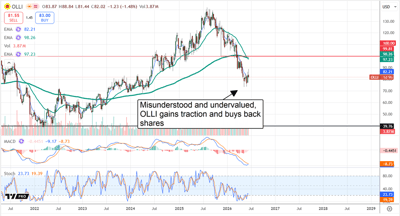
It’s easy to lump Ollie’s Bargain Outlet (NASDAQ: OLLI) in with the dollar store crowd, as it sells many of the same items. The difference is that Ollie’s is a bargain-basement, closeout model, whereas dollar stores are traditional retailers. Ollie’s is not tied to specific inventory or product lines, selling what it can find cheaply and passing the value on to customers. It is more like a baby TJX Companies, nimble and flexible in the face of consumer headwinds, opportunistically taking advantage of deals as they arise.
Among Ollie’s attractions are its debt-free balance sheet and its ability to self-fund growth. Catalysts in 2026 include converting currently vacant Big Lots locations to the Ollie’s format and turning "dark-rent" expense into revenue-generating square footage, thereby widening margins. Cash flow is central to this investment thesis, as it is for all inflation-fighting stocks, because it enables value-building capital returns. Ollie’s does not yet pay dividends but may in the future; its capital returns currently consist of share buybacks that reduced the share count by more than 1% on a trailing 12-month basis as of the Q1 2026 earnings report.
The analyst group created a headwind for Ollie’s stock by lowering price targets over the past year. However, the market overreacted, pushing the stock below the low end of the price target range and setting the stage for a rebound later this year.
A catalyst for a rebound could come in an upcoming earnings release if the company reports converted dark space or improved sales and margins. As it stands, the consensus calls for about 60% upside; institutions own nearly 100% of the shares and, on balance, have been accumulating in 2026.
Casey’s General Stores: Generally a Buy, No Matter What
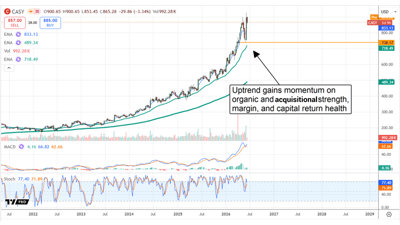
Casey’s General Stores (NASDAQ: CASY) is among the highest-quality growth stories on the market today. It is expanding its network of convenience stores through organic growth and acquisitions, self-funding the strategy, and paying investors to own it.
Its advantages include high-turnover items that allow for rapid price responses, a rural moat, and high-margin prepared food items. It also benefits from organic traffic and trade-down shopping, with an edge from diminished competition due to its rural-oriented footprint.
Highlights in 2026 include the successful and rapid integration of its Fike’s acquisition and margin improvements in both inside sales and fuel sales.
Casey’s capital returns include dividends, dividend growth, and share buybacks. Catalysts in 2026 include the resumption of buybacks, which were paused in 2025 to conserve capital for acquisitions. The story as of mid-June is that the share count resumed its decline on a quarterly and year-over-year basis and is expected to keep declining for the foreseeable future. The biggest risk is that the company will pause buybacks again, preserving capital for another value-building acquisition.
The TJX Companies: Top-Tier Inflation-Fighting Stock
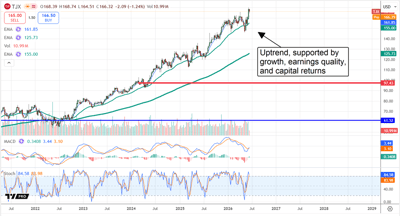
The TJX Companies (NYSE: TJX) is a top-tier inflation-fighting stock, and that is saying something because inflation-fighting stocks are inherently quality stocks. Its strength lies in its scale and reach, as it is the largest off-price retailer of fashion and home goods.
It is growing at an industry-leading pace, underpinned by robust deal volume and consumer traffic. Its highlights include ample availability of in-demand branded merchandise and strong organic traffic. Fiscal Q2 systemwide comps increased by more than 6%, well above company forecasts, driving a healthy profit margin.
TJX’s catalysts are numerous, including an increase in its buyback authorization. The company raised its 2026 target by a quarter-billion dollars, targeting up to $3 billion in total purchases, or about 1.6% of the mid-June market cap. TJX’s dividend is also attractive, yielding 1.2% at record-high share prices. The distribution is also expected to grow; the company maintains a double-digit compound annual growth rate and has the capacity to sustain it in the coming years.
This message is a sponsored email for Stansberry Research, a third-party advertiser of Earnings360 and MarketBeat.
This ad is sent on behalf of Stansberry Research, 1125 N Charles St, Baltimore, MD 21201. If you would like to optout from receiving offers from Stansberry Research please click here.
If you need help with your subscription, please email our South Dakota based support team at [email protected].
If you no longer wish to receive email from Earnings360, you can unsubscribe.
© 2006-2026 MarketBeat Media, LLC. All rights reserved.
345 N Reid Place #620, Sioux Falls, S.D. 57103-7078. USA..