
|
The Goldstein Substack - A Father-Son Publication
Dr. Goldstein is Running for Congress and his page can be found here
Beyond Politics:
How One Student’s Initiative Is Helping Develop the Next Generation of Civic Leaders in Greenwich
|
| |||||||||||||||


 |
In an era when many Americans worry that younger generations are disengaged from public life, something encouraging is happening in Greenwich.
High school students are stepping forward—not simply to advocate for political ideas, but to learn how democracy works, organize their peers, develop leadership skills, and become active participants in their communities long before they are old enough to cast a ballot.
That deserves recognition.
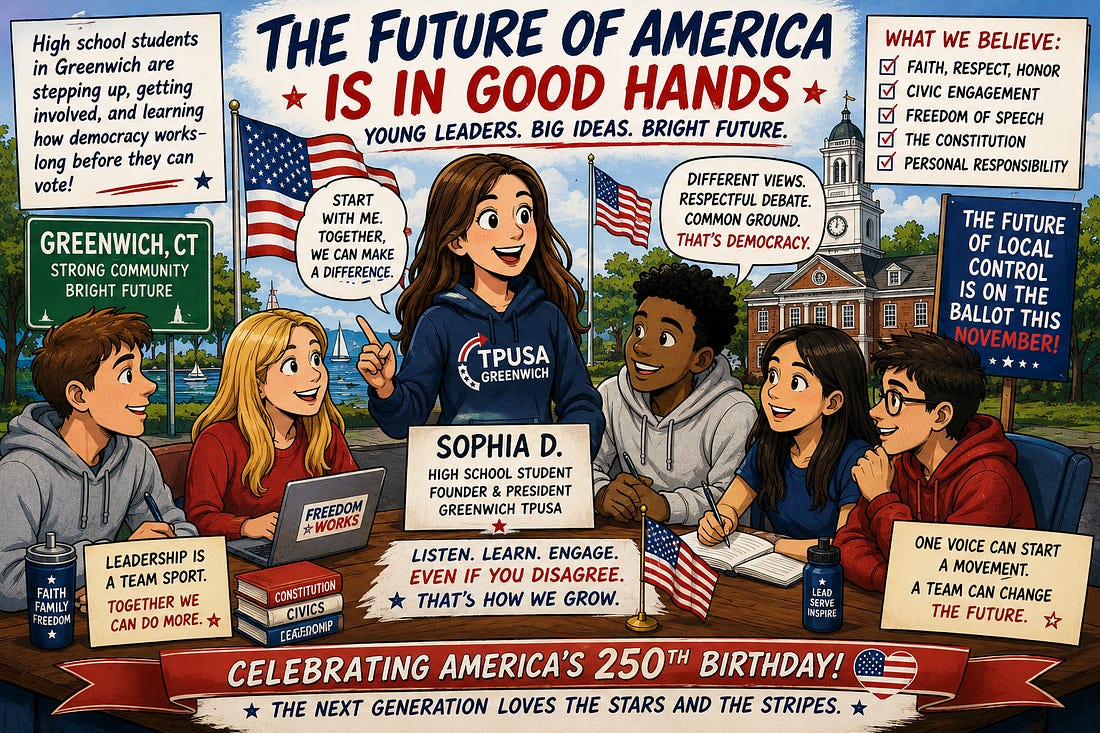
Recently, Greenwich students announced the formation of a local chapter of Turning Point USA (TPUSA), led by an incoming sophomore Sophia. While many will naturally view the organization through a political lens, that misses the broader significance of what is taking place.
The real story is not Republican versus Democrat.
The real story is civic engagement.
For too long, Americans have lamented declining participation in civic organizations, community groups, and public service. We ask why fewer young people understand government, attend local meetings, volunteer, or consider careers in public service.
Then, when students actually decide to organize, lead, and participate, they often become targets of criticism simply because of the organization they choose.
That is counterproductive.
Whether students join TPUSA, Young Democrats, student government, Model United Nations, debate clubs, or any other civic organization, they are developing skills our country desperately needs: leadership, communication, organization, public speaking, teamwork, event planning, fundraising, volunteer recruitment, and the ability to respectfully advocate for ideas.
These are not partisan skills.
They are American skills.
Democracy Begins Before Election Day
One of the greatest misconceptions about democracy is that participation begins at age eighteen.
It doesn’t.
Future leaders are developed years earlier.
They learn by attending meetings, asking questions, volunteering, debating ideas, and discovering that government is not something happening somewhere else—it is something they can influence.
Students who become involved today may someday become teachers, entrepreneurs, military officers, engineers, physicians, attorneys, nonprofit leaders, elected officials, or community volunteers.
Regardless of where life takes them, civic participation prepares them to become engaged citizens.
Leadership Is Never a Solo Endeavor
While Sophia deserves tremendous credit for taking the initiative to establish Greenwich’s TPUSA chapter and leveraging the resources of a national organization, what stood out even more was something larger than one person’s vision.
Leadership is a team sport.
Every successful movement, nonprofit organization, business, campaign, or community initiative begins with someone willing to take the first step. But lasting success comes from bringing others together, identifying their strengths, delegating responsibilities, and creating opportunities for everyone to contribute.
That was evident at the meeting. Sophia may have founded the chapter, but what is emerging is a team of young people willing to invest their time, talents, and energy in something greater than themselves.
This is exactly how future leaders are developed.
They learn that leadership is not about standing at a podium. It is about listening, organizing, building consensus, solving problems, and empowering others to lead alongside you.
These students are learning skills that cannot be taught solely from a textbook. They are learning how to organize events, communicate effectively, market ideas, resolve conflicts, build teams, and serve their community. Whether they eventually pursue careers in business, medicine, law, education, public service, or politics, these experiences will make them better leaders.
Perhaps the most valuable lesson they are learning is that meaningful change is rarely accomplished alone. It requires people with different talents working together toward a common purpose.
A New Generation Brings New Tools
Today’s students possess tools previous generations never had.
They communicate through technology and social media, create digital content, organize online, and engage audiences in ways many adults are still learning to understand.
Rather than dismissing these skills, we should encourage young people to use them responsibly—to educate, organize, solve problems, and strengthen their communities.
Every generation approaches civic engagement differently.
Today’s generation simply has different tools.
Beyond Politics
Some will undoubtedly characterize the creation of a TPUSA chapter as a response to progressive politics or what they describe as the rise of democratic socialism. Others will disagree with its viewpoints.
That debate is part of American democracy.
But the larger lesson should not be overlooked.
Students are choosing engagement over apathy.
They are choosing participation over indifference.
They are choosing leadership over spectatorship.
That is healthy for any democracy.
In fact, I hope this inspires more young people to become involved—whether through TPUSA, Young Democrats, student government, debate, Model United Nations, community service organizations, or any other civic group. A healthy democracy depends upon informed citizens who understand government and are willing to participate in improving it.
Schools Should Develop Thinkers, Not Followers
If we truly want to prepare the next generation of leaders, our schools must remain places where ideas can be debated openly and respectfully.
Educators have one of the most important responsibilities in our society: helping students develop the ability to analyze information, challenge assumptions, evaluate evidence, and think critically.
That responsibility is best fulfilled when students are encouraged to examine multiple perspectives and reach their own conclusions rather than feeling pressured—whether intentionally or unintentionally—to adopt a particular political viewpoint.
Student organizations, regardless of political affiliation, should be viewed as opportunities to practice civil discourse, leadership, and democratic engagement. They should never become targets for intimidation or unequal treatment because of their viewpoints.
The greatest classrooms have never been those that teach students what to think.
They are the classrooms that teach students how to think.
Unfortunately, many Americans believe that genuine viewpoint diversity has become increasingly limited within education. Whether or not that perception reflects every classroom, it underscores the importance of ensuring students are exposed to multiple perspectives and encouraged to engage respectfully with ideas that challenge their own.
Education should be multidisciplinary by design. History, economics, civics, philosophy, science, literature, technology, and the arts all help students understand complex issues from different perspectives.
When students encounter only one way of viewing the world, they lose opportunities to strengthen their analytical skills and become independent thinkers.
Our goal should never be to produce students who all think alike.
Our goal should be to produce citizens who can think critically, evaluate evidence, communicate respectfully, and work alongside people with whom they disagree.
Restoring Civil Discourse
One of my hopes is that people will take the time to learn about what these students are doing. Read their posts, follow their journey, and if they host public events, attend one. Listen to their ideas—even if you ultimately disagree with them. I would offer the same advice for any student-led civic organization.
Democracy is strongest when citizens are willing to understand viewpoints different from their own.
There was a time when America’s political leaders passionately defended their own beliefs while also understanding the arguments of the other side. They debated vigorously, searched for common ground where possible, and often ended the day sharing a meal or a drink together. They understood that political opponents were not personal enemies.
Technology has transformed political communication. While it has expanded access to information and allowed more voices to be heard, it has also made it easier to talk about one another rather than with one another. Social media rewards quick reactions, while thoughtful conversations require patience, listening, and humility.
That human interaction has become increasingly rare.
My hope is that organizations with differing viewpoints—whether TPUSA, Young Democrats, student government, debate teams, or others—can help reverse that trend. Imagine students coming together for public discussions where ideas are challenged respectfully, questions are welcomed, and participants leave with a better understanding of one another, even when they continue to disagree.
That is not weakness.
That is democracy at its best.
The next generation has an opportunity to improve upon what many adults have struggled to preserve. They can prove that conviction and civility are not opposites. They can demonstrate that passionate advocacy and respectful dialogue can coexist.
A Lesson for All of Us
Perhaps the greatest lesson from this new chapter isn’t just for students.
It’s for adults.
Across Connecticut—and throughout much of America—many citizens have become disengaged from the political process. Some believe their vote no longer matters. Others feel government has become too partisan, too complicated, or too disconnected from everyday life for one individual to make a difference.
Yet here are high school students—many not yet old enough to vote—who have chosen to become involved anyway.
That should inspire all of us.
If young people who have never cast a ballot believe they can help shape their communities, perhaps those of us who already possess the right to vote should ask ourselves whether we are doing enough.
Local government remains the level of government closest to the people. Decisions about education, zoning, taxes, infrastructure, public safety, open space, and the character of our neighborhoods are often made locally.
Those decisions affect our everyday lives.
They also depend upon engaged citizens.
Whether someone is Republican, Democrat, Independent, or unaffiliated, civic participation should never become a spectator sport.
The future of local control depends upon citizens who stay informed, attend meetings, ask thoughtful questions, volunteer, and vote.
As we approach this November’s local elections, perhaps these students are reminding the rest of us of something we’ve always known but too often forget:
Democracy works best when everyone participates.
Looking Toward America’s Next 250 Years
As we celebrate America’s 250th birthday, perhaps there is no better reminder of our nation’s promise than watching young people choose to become engaged in civic life.
Whether you agree with every position advanced by Greenwich TPUSA or not, I encourage you to take a look at what these students are building. Read their posts. Listen to their ideas. Consider their perspective. I would offer the same advice for any organization with a different point of view.
Democracy is strongest when we understand—not merely dismiss—those with whom we disagree.
Sophia deserves recognition for taking the initiative to establish this chapter, but what impressed me even more was the team that is beginning to form around her. Leadership is contagious, and meaningful change is almost always the product of people working together toward a common purpose.
With young Americans like these stepping forward as we celebrate our nation’s 250th anniversary, the future is bright.
They remind us that the Stars and Stripes are more than a flag. They represent a shared commitment to liberty, citizenship, service, and the ongoing work of self-government.
If this generation can combine conviction with curiosity, confidence with humility, and advocacy with respectful dialogue, then America’s next 250 years will be in very good hands.
The greatest legacy these students may leave will not be measured by elections won or organizations founded.
It will be measured by whether they inspire others—young and old alike—to become engaged in their communities, to think independently, to listen respectfully, and to believe once again that one informed, committed citizen can make a difference.
After all, democracy is not inherited.
It is practiced.
Leadership doesn’t begin on Election Day.
It begins the moment someone decides their community is worth serving.
And with young leaders like Sophia and the team forming around Greenwich TPUSA, I believe the future of the next generation that loves the Stars and Stripes—and the republic they represent—is incredibly bright.
 | A guest post by
|
The Goldstein Substack is free today. But if you enjoyed this post, you can tell The Goldstein Substack that their writing is valuable by pledging a future subscription. You won't be charged unless they enable payments.
| ||||||||||


