
| From | World Resources Institute <[email protected]> |
| Subject | SPECIAL: Europe's Heat Crisis |
| Date | June 25, 2026 8:27 PM |
Links have been removed from this email. Learn more in the FAQ.
Links have been removed from this email. Learn more in the FAQ.
Can't see this email? View in your browser ( [link removed] )
( [link removed] )
*Trusted research, data & insights* ** for a better world for people, nature & climate
DONATE TO WRI ( [link removed] )
******************************
SPECIAL EDITION WRI DIGEST *↓*
******************************
Extreme heat has become an emergency.
Since May, Europe has sweltered under two major heat waves. Cities across the continent issued extreme heat warnings. Hundreds of schools in the UK closed.
Most devastating of all is the human toll: In France, dozens have drowned seeking refuge in rivers. And in Spain, the most recent heat wave could be linked to at least 200 deaths over just a few days.
It’s not just Europe: the U.S., India and China are all bracing for high temperatures in the coming weeks.
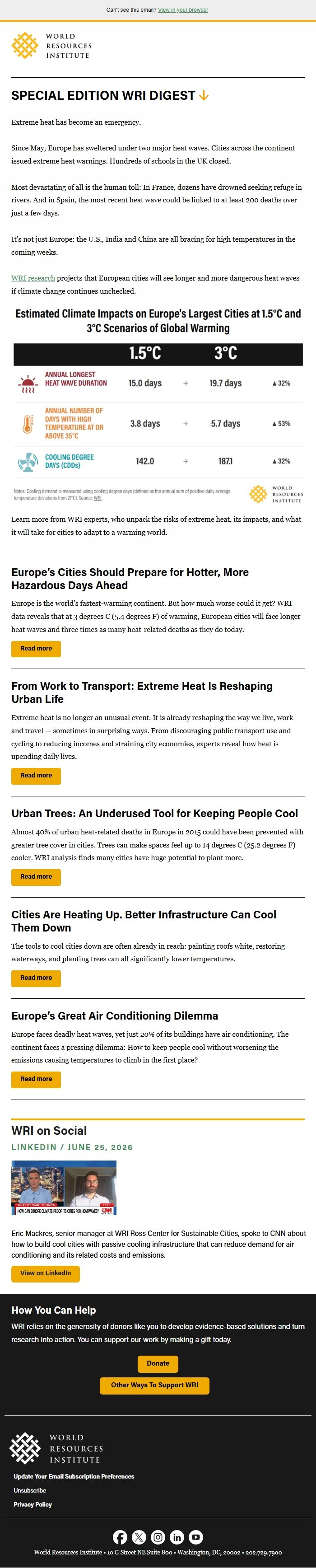
WRI research ( [link removed] ) projects that European cities will see longer and more dangerous heat waves if climate change continues unchecked.
( [link removed] )
Learn more from WRI experts, who unpack the risks of extreme heat, its impacts, and what it will take for cities to adapt to a warming world.
*******************************************************************************************************************************************************************************************************************************************************************************************************************************************************************
Europe’s Cities Should Prepare for Hotter, More Hazardous Days Ahead ( [link removed] )
*******************************************************************************************************************************************************************************************************************************************************************************************************************************************************************
Europe is the world’s fastest-warming continent. But how much worse could it get? WRI data reveals that at 3 degrees C (5.4 degrees F) of warming, European cities will face longer heat waves and three times as many heat-related deaths as they do today.
Read more ( [link removed] )
**********************************************************************************************************************************************************************************************************************************************************************************************************************************************
From Work to Transport: Extreme Heat Is Reshaping Urban Life ( [link removed] )
**********************************************************************************************************************************************************************************************************************************************************************************************************************************************
Extreme heat is no longer an unusual event. It is already reshaping the way we live, work and travel — sometimes in surprising ways. From discouraging public transport use and cycling to reducing incomes and straining city economies, experts reveal how heat is upending daily lives.
Read more ( [link removed] )
**********************************************************************************************************************************************************************************************************************************************************************************************************************************
Urban Trees: An Underused Tool for Keeping People Cool ( [link removed] )
**********************************************************************************************************************************************************************************************************************************************************************************************************************************
Almost 40% of urban heat-related deaths in Europe in 2015 could have been prevented with greater tree cover in cities. Trees can make spaces feel up to 14 degrees C (25.2 degrees F) cooler. WRI analysis finds many cities have huge potential to plant more.
Read more ( [link removed] )
***************************************************************************************************************************************************************************************************************************************************************************************************************************************
Cities Are Heating Up. Better Infrastructure Can Cool Them Down ( [link removed] )
***************************************************************************************************************************************************************************************************************************************************************************************************************************************
The tools to cool cities down are often already in reach: painting roofs white, restoring waterways, and planting trees can all significantly lower temperatures.
Read more ( [link removed] )
**************************************************************************************************************************************************************************************************************************************************************************************************************************************
Europe’s Great Air Conditioning Dilemma ( [link removed] )
**************************************************************************************************************************************************************************************************************************************************************************************************************************************
Europe faces deadly heat waves, yet just 20% of its buildings have air conditioning. The continent faces a pressing dilemma: How to keep people cool without worsening the emissions causing temperatures to climb in the first place?
Read more ( [link removed] )
*************
WRI on Social
*************
****************************************************************************************************************************************************************************************************************************************************************************************************************************************************************************************************************************************************
LINKEDIN / JUNE 25, 2026 ( [link removed] )
****************************************************************************************************************************************************************************************************************************************************************************************************************************************************************************************************************************************************
WRI's Eric Mackres on CNN ( [link removed] )
Eric Mackres, senior manager at WRI Ross Center for Sustainable Cities, spoke to CNN about how to build cool cities with passive cooling infrastructure that can reduce demand for air conditioning and its related costs and emissions.
View on LinkedIn ( [link removed] )
*How You Can Help*
WRI relies on the generosity of donors like you to develop evidence-based solutions and turn research into action. You can support our work by making a gift today.
Donate ( [link removed] )
Other Ways To Support WRI ( [link removed] )
( [link removed] )
*Update Your Email Subscription Preferences* ( [link removed] )
*Unsubscribe* ( [link removed] )
*Privacy Policy* ( [link removed] )
Facebook ( [link removed] ) Twitter ( [link removed] ) Instagram ( [link removed] ) LinkedIn ( [link removed] ) YouTube ( [link removed] )
World Resources Institute • 10 G Street NE Suite 800 • Washington, DC, 20002 • 202.729.7900
( [link removed] )
*Trusted research, data & insights* ** for a better world for people, nature & climate
DONATE TO WRI ( [link removed] )
******************************
SPECIAL EDITION WRI DIGEST *↓*
******************************
Extreme heat has become an emergency.
Since May, Europe has sweltered under two major heat waves. Cities across the continent issued extreme heat warnings. Hundreds of schools in the UK closed.
Most devastating of all is the human toll: In France, dozens have drowned seeking refuge in rivers. And in Spain, the most recent heat wave could be linked to at least 200 deaths over just a few days.
It’s not just Europe: the U.S., India and China are all bracing for high temperatures in the coming weeks.
WRI research ( [link removed] ) projects that European cities will see longer and more dangerous heat waves if climate change continues unchecked.
( [link removed] )
Learn more from WRI experts, who unpack the risks of extreme heat, its impacts, and what it will take for cities to adapt to a warming world.
*******************************************************************************************************************************************************************************************************************************************************************************************************************************************************************
Europe’s Cities Should Prepare for Hotter, More Hazardous Days Ahead ( [link removed] )
*******************************************************************************************************************************************************************************************************************************************************************************************************************************************************************
Europe is the world’s fastest-warming continent. But how much worse could it get? WRI data reveals that at 3 degrees C (5.4 degrees F) of warming, European cities will face longer heat waves and three times as many heat-related deaths as they do today.
Read more ( [link removed] )
**********************************************************************************************************************************************************************************************************************************************************************************************************************************************
From Work to Transport: Extreme Heat Is Reshaping Urban Life ( [link removed] )
**********************************************************************************************************************************************************************************************************************************************************************************************************************************************
Extreme heat is no longer an unusual event. It is already reshaping the way we live, work and travel — sometimes in surprising ways. From discouraging public transport use and cycling to reducing incomes and straining city economies, experts reveal how heat is upending daily lives.
Read more ( [link removed] )
**********************************************************************************************************************************************************************************************************************************************************************************************************************************
Urban Trees: An Underused Tool for Keeping People Cool ( [link removed] )
**********************************************************************************************************************************************************************************************************************************************************************************************************************************
Almost 40% of urban heat-related deaths in Europe in 2015 could have been prevented with greater tree cover in cities. Trees can make spaces feel up to 14 degrees C (25.2 degrees F) cooler. WRI analysis finds many cities have huge potential to plant more.
Read more ( [link removed] )
***************************************************************************************************************************************************************************************************************************************************************************************************************************************
Cities Are Heating Up. Better Infrastructure Can Cool Them Down ( [link removed] )
***************************************************************************************************************************************************************************************************************************************************************************************************************************************
The tools to cool cities down are often already in reach: painting roofs white, restoring waterways, and planting trees can all significantly lower temperatures.
Read more ( [link removed] )
**************************************************************************************************************************************************************************************************************************************************************************************************************************************
Europe’s Great Air Conditioning Dilemma ( [link removed] )
**************************************************************************************************************************************************************************************************************************************************************************************************************************************
Europe faces deadly heat waves, yet just 20% of its buildings have air conditioning. The continent faces a pressing dilemma: How to keep people cool without worsening the emissions causing temperatures to climb in the first place?
Read more ( [link removed] )
*************
WRI on Social
*************
****************************************************************************************************************************************************************************************************************************************************************************************************************************************************************************************************************************************************
LINKEDIN / JUNE 25, 2026 ( [link removed] )
****************************************************************************************************************************************************************************************************************************************************************************************************************************************************************************************************************************************************
WRI's Eric Mackres on CNN ( [link removed] )
Eric Mackres, senior manager at WRI Ross Center for Sustainable Cities, spoke to CNN about how to build cool cities with passive cooling infrastructure that can reduce demand for air conditioning and its related costs and emissions.
View on LinkedIn ( [link removed] )
*How You Can Help*
WRI relies on the generosity of donors like you to develop evidence-based solutions and turn research into action. You can support our work by making a gift today.
Donate ( [link removed] )
Other Ways To Support WRI ( [link removed] )
( [link removed] )
*Update Your Email Subscription Preferences* ( [link removed] )
*Unsubscribe* ( [link removed] )
*Privacy Policy* ( [link removed] )
Facebook ( [link removed] ) Twitter ( [link removed] ) Instagram ( [link removed] ) LinkedIn ( [link removed] ) YouTube ( [link removed] )
World Resources Institute • 10 G Street NE Suite 800 • Washington, DC, 20002 • 202.729.7900
Message Analysis
- Sender: World Resources Institute
- Political Party: n/a
- Country: n/a
- State/Locality: n/a
- Office: n/a