Dear Friend,
The last time Wall Street was slow to understand AI’s power problem, one boring stock did this: +1,700% in under two years.
Its name was Vertiv.
A $10,000 stake became $180,000.
Another, Modine, ran 1,900%.
Neither was a chip company. Neither was a household name. They just made the unglamorous equipment data centers can’t run without.
And got repriced when the world caught on.
Why it matters now: that was the first wave.
The wave hitting today is more than three times larger, and it runs straight through one small supplier almost no one has connected to Elon Musk yet.
The playbook is repeating.
The name isn’t on TV.
See the stock running the same playbook >>
“The Buck Stops Here,”
Kelly Maguire
Behind the Markets
These 3 Stocks Lowered Their Share Counts Drastically in Q1
Author: Leo Miller. Originally Published: 6/9/2026.

Key Points
- Buyback authorizations are one thing, but companies actually executing on this potential spending is how shareholders can really see value.
- In Q1 2026, these three stocks demonstrated large buyback spending in action, putting significant dents in their share counts.
- One well-known social media company lowered its share count by 16%, a level of spending rarely seen in one quarter.
- Special Report: Forget SpaceX. Buy the company Musk can't replace.
While markets often view large-scale buyback authorizations as positives in and of themselves, authorizations are only one part of the buyback equation. Unlike dividends, which companies must pay after declaring them, there is no hard requirement for companies to use the buyback capacity they authorize.
As a result, many of the benefits of buybacks do not materialize until companies put their words into action. In Q1 2026, these three firms did exactly that, spending billions on share repurchases. However, looking at raw dollars alone does not fully capture the scale of their buybacks. Their spending was also very high relative to market capitalization, enabling significant share count reductions.
Pinterest Sees Massive Share Count Drop in Q1
Better than SpaceX? Grab this ticker instead. (Ad)
Larry Benedict generated $274 million for his clients by finding the trades most investors missed. Now he says 'The Final Phase of Elon's Master Plan' is about to trigger one of the biggest wealth transfers in market history.
He's identified one ticker positioned to capture it - and it isn't SpaceX or Tesla. He's releasing the name for free, but the window is closing.
Get the full details and the ticker name before access closesFirst up is the visual discovery application Pinterest (NYSE: PINS), which has had a rough start to 2026, down more than 15% on the year. Pinterest’s adjusted earnings per share (EPS) performance has been a major weak spot in recent quarters. The company has missed this metric in five of its last six reports.
However, its latest quarter was an exception, with Pinterest beating on both sales and adjusted EPS. Sales topped $1 billion, with solid year-over-year (YOY) growth of 18%—one of its best showings in several quarters. Meanwhile, adjusted EPS rose 17% YOY to 27 cents. Notably, Pinterest has nearly tripled its monthly active user base since 2017, with the figure now standing at 631 million.
Pinterest also spent heavily on buybacks during the quarter. Total repurchases came in at approximately $2 billion, reducing its outstanding share count by a whopping 16%. That is an astounding figure, one that many companies would be happy to achieve over the course of multiple years. Additionally, the company still has significant buyback capacity of $2 billion that it can use to lower its share count further.
Southwest Drops Over $1 Billion on Buybacks as Fuel Prices Take a Toll
Shares of Southwest Airlines (NYSE: LUV) are essentially flat in 2026, with factors outside its control weighing heavily on the company. These include elevated jet fuel prices, which surged after the conflict in Iran began. The company notes that in its latest quarter, fuel was a 22-cent headwind to adjusted EPS. That is substantial, considering that Southwest’s total adjusted EPS during the quarter was just 45 cents.
Still, Southwest was able to materially improve its bottom line, as the company posted an adjusted loss per share of 13 cents a year ago. Operating margin improved by 810 basis points to 4.6%, which the company credits to its transformation initiatives. These initiatives include a shift away from its first-come, first-served seating model. The goal is to attract customers who are willing to pay more to secure their seats and, in turn, drive margins higher.
Southwest’s buyback spending in Q1 came in at $1.25 billion, allowing the firm to reduce its outstanding share count by a very significant 5%. This marks a continuation of Southwest’s highly aggressive buyback strategy. Since the beginning of 2025, Southwest has lowered its share count by around 19%. The company still has a moderate amount of buyback capacity, with $450 million left under its current authorization.
United Therapeutics Scores Tyvaso Win, Lowers Share Count Over 3%
United Therapeutics (NASDAQ: UTHR) has fared much better than Pinterest and Southwest during 2026, with shares up more than 10%. The stock has seen three single-day spikes of 10% or greater this year. The most recent came in late March, when the company released strong results for its nebulized Tyvaso treatment. The drug met its primary endpoint for the treatment of idiopathic pulmonary fibrosis (IPF).
Tyvaso is already approved for other conditions, and the company is aiming to make IPF its next market. If approved, analysts at Jefferies suggest Tyvaso could represent a $5 billion to $10 billion opportunity in IPF. Given that outlook, it is not surprising that shares gained more than 12% after these results.
In March, United entered into and utilized a $1.5 billion accelerated share repurchase (ASR) program, buying back its stock quickly. As a result, the company saw its outstanding share count fall by around 3.2% during the quarter. When announcing the program, management was resolute in its confidence in the future of UTHR shares. The company’s CEO noted, “we believe there is a clear disconnect between United Therapeutics’ fundamentals and valuation." The company retains $500 million in buyback capacity, equal to around 2% of its market capitalization.
Pinterest Holds Large Buyback Firepower After Spending Spree
Pinterest, Southwest, and United Therapeutics put their money where their mouth was in Q1 2026, sending their share counts down significantly. Pinterest was the clear standout, and comparing its spending with Southwest’s illustrates the point.
In one quarter, Pinterest reduced its share count by 16%, just shy of the impressive 19% reduction Southwest achieved over five quarters. The company’s remaining buyback capacity is still very large, equal to almost 17% of its $12 billion market capitalization. Pinterest’s heavy spending suggests it has strong confidence in the future, even as shares remain under pressure.
Casey’s Is Looking Like a Hot Buy as Growth, Buybacks, and Guidance Align
Author: Thomas Hughes. Originally Published: 6/11/2026.

Key Points
- Casey's General Stores uptrend is intact and on track for fresh highs this year.
- Analysts and institutions underpin price action, aggressively accumulating shares this year.
- Self-funded growth, better-than-expected results, and capital returns drive value for shareholders.
- Special Report: Forget SpaceX. Buy the company Musk can't replace.
Casey’s General Stores (NYSE: CASY) is a compelling buy. The strong guidance for fiscal 2027 (FY2027) reinforces the investment thesis, and the early Q2 2026 price action reflects a natural market adjustment that should support future gains.
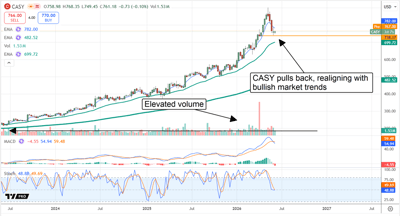
Signals including technical chart patterns, analyst sentiment, and institutional activity were bullish ahead of the June 9 earnings release, pushing the stock to unsustainable levels. June’s pullback brought the market back in line with those sentiment trends, setting CASY up to continue its uptrend as the year progresses. Notably, CASY reinforced that thesis the day after earnings, surging 19%.
Casey’s Market Signals Strength and Confidence: Uptrend Intact
Better than SpaceX? Grab this ticker instead. (Ad)
Larry Benedict generated $274 million for his clients by finding the trades most investors missed. Now he says 'The Final Phase of Elon's Master Plan' is about to trigger one of the biggest wealth transfers in market history.
He's identified one ticker positioned to capture it - and it isn't SpaceX or Tesla. He's releasing the name for free, but the window is closing.
Get the full details and the ticker name before access closesCasey’s chart signals remain robust. With price action on the brink of becoming parabolic, the indicators include a steadily strengthening MACD, a MACD line converging with recent highs, and a stochastic reading that points to improving support. The more telling signal is the dip pattern, which shows buyers stepping in each time support is tested. The likely outcome is that CASY investors will continue buying dips as they appear, with key fundamental factors providing the incentive.
Casey’s investment thesis begins with growth through consolidation. The gas and convenience store market is highly fragmented, leaving companies like Casey well positioned to expand through acquisition. The thesis is strengthened by the management team’s two-pronged approach: handling fuel and in-store operations separately, with strong results in both areas. Fuel margins remain consistently high, as do in-store margins, supporting healthy cash flow, profitability, and balance sheet strength. The balance sheet is central to the thesis because it is fortress quality, enabling self-funded expansion and capital returns.
Capital returns are an important catalyst in 2026. The company halted buybacks in fiscal 2025 to preserve capital and cash flow for a major acquisition. As 2026 reaches the middle of the year, that acquisition is complete, integration appears to be progressing smoothly, and cash flow priorities are shifting back toward capital returns, including dividends and share repurchases.
Casey’s Has Catalysts and Tailwinds Driving Bullish Price Action
Signs of cash flow strength can be seen in the dividend, which was recently increased by 14% for the 25th consecutive annual increase, and in buybacks, which are reducing the share count. Highlights from the company’s fiscal Q4 2026 release include $63 million in quarterly buybacks, representing 0.18% of market cap, and a 0.5% year-over-year decline in shares outstanding. Looking ahead, Casey’s General Stores will likely continue reducing its share count quarter by quarter unless it needs to make another acquisition.
Analyst and institutional trends also underpin the stock’s price action, reinforcing the view that the June pullback was a natural and necessary market function. The consensus price target is rising quickly and is likely to continue trending higher as the year progresses. Up 5% in the 30 days preceding the earnings release and 75% on a trailing 12-month basis, consensus provides solid support for this market, with the high-end target of $915 pointing to a fresh all-time high. And $915 is no outlier; several targets place the stock in the high-$800s to low-$900s, and more are likely to follow over time.
Institutional trends are equally bullish. MarketBeat’s data show that institutions own more than 85% of the stock and have been accumulating on balance for seven consecutive quarters. Their activity accelerated in 2025 as the Fike’s acquisition progressed, held at a higher level in 2026, and picked up again in Q2. The takeaway is that institutions are confident in the company’s growth trajectory and capital return strategy and are likely to help limit downside during periods of weakness.
Casey’s General Stores Wows With Earnings Strength and FY2027 Guidance
Casey’s General Stores delivered an outstanding quarter, with revenue topping $4.55 billion, up 14.5% and more than 500 basis points (bps) above expectations. Strength came from both segments and new stores. Inside comps grew 5.5%, fuel comps rose 1.5%, and store count increased by nearly 14%.
Margin performance was another bright spot, with management driving wider margins in both segments. Fuel was the standout, with fuel gallon margin up nearly 10 cents to a historically high level, while inside comps were also strong. EBITDA grew 33.2%, well ahead of revenue, net income rose 65.5%, and GAAP earnings per share increased 66.2%, helped by the reduced share count.
Guidance is the catalyst for higher share prices. The company expects systemwide comps in the low single digits, with inside sales up as much as 5% and fuel gallons flat. The takeaway is that low-single-digit comps, combined with a 14% increase in store count, translate into better-than-expected guidance and a stronger outlook for capital returns.
This email content is a sponsored message provided by Behind the Markets, a third-party advertiser of The Early Bird and MarketBeat.
If you need assistance with your newsletter, please contact MarketBeat's South Dakota based support team at [email protected].
If you no longer wish to receive email from The Early Bird, you can unsubscribe.
© 2006-2026 MarketBeat Media, LLC. All rights protected.
345 North Reid Place, Sixth Floor, Sioux Falls, South Dakota 57103. U.S.A..