
Email
NEWS RELEASE: Help Butterflies, Bees And Other Pollinators During Pollinator Week
| From | Wisconsin Department of Natural Resources <[email protected]> |
| Subject | NEWS RELEASE: Help Butterflies, Bees And Other Pollinators During Pollinator Week |
| Date | June 22, 2026 2:03 PM |
Links have been removed from this email. Learn more in the FAQ.
Links have been removed from this email. Learn more in the FAQ.
DNR News Release Header Image [ [link removed] ]
*FOR IMMEDIATE RELEASE: *June 22, 2026
*Contact: *DNR Office of Communications
[email protected]
Help Butterflies, Bees And Other Pollinators During Pollinator Week
"Celebrate Wisconsin's Native Pollinators By Creating Habitat And Volunteering
"
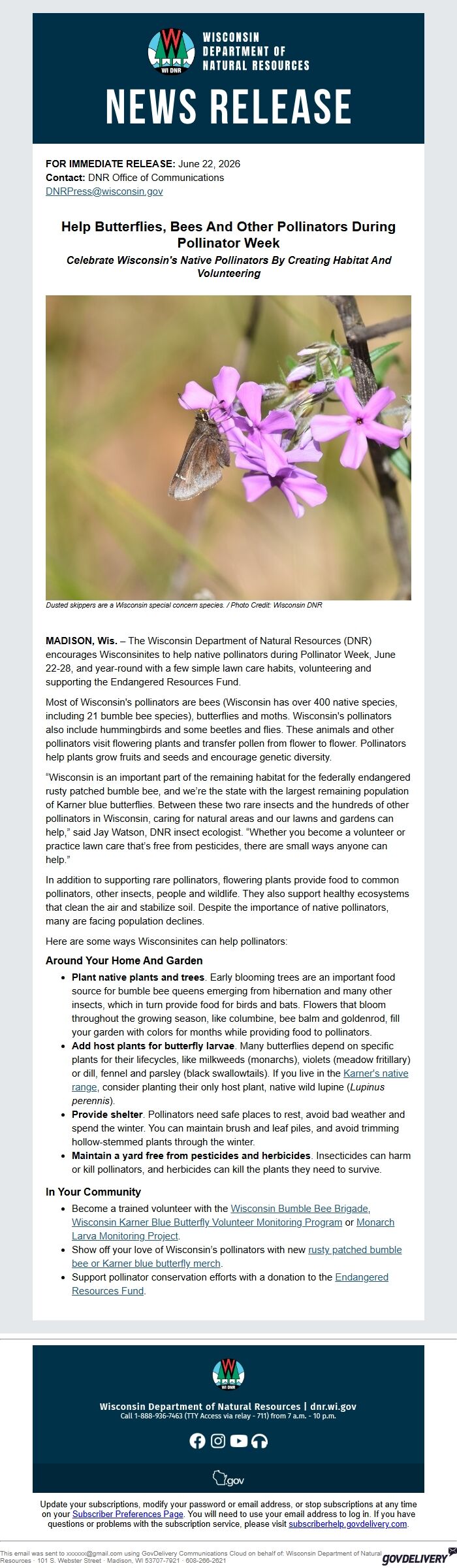
a brown and white/grey dusted skipper butterfly visiting a purple phlox flower
Dusted skippers are a Wisconsin special concern species. / Photo Credit: Wisconsin DNR
*
MADISON, Wis.* – The Wisconsin Department of Natural Resources (DNR) encourages Wisconsinites to help native pollinators during Pollinator Week, June 22-28, and year-round with a few simple lawn care habits, volunteering and supporting the Endangered Resources Fund.
Most of Wisconsin's pollinators are bees (Wisconsin has over 400 native species, including 21 bumble bee species), butterflies and moths. Wisconsin's pollinators also include hummingbirds and some beetles and flies. These animals and other pollinators visit flowering plants and transfer pollen from flower to flower. Pollinators help plants grow fruits and seeds and encourage genetic diversity.
“Wisconsin is an important part of the remaining habitat for the federally endangered rusty patched bumble bee, and we’re the state with the largest remaining population of Karner blue butterflies. Between these two rare insects and the hundreds of other pollinators in Wisconsin, caring for natural areas and our lawns and gardens can help,” said Jay Watson, DNR insect ecologist. “Whether you become a volunteer or practice lawn care that’s free from pesticides, there are small ways anyone can help.”
In addition to supporting rare pollinators, flowering plants provide food to common pollinators, other insects, people and wildlife. They also support healthy ecosystems that clean the air and stabilize soil. Despite the importance of native pollinators, many are facing population declines.
Here are some ways Wisconsinites can help pollinators:
Around Your Home And Garden
* *Plant native plants and trees*. Early blooming trees are an important food source for bumble bee queens emerging from hibernation and many other insects, which in turn provide food for birds and bats. Flowers that bloom throughout the growing season, like columbine, bee balm and goldenrod, fill your garden with colors for months while providing food to pollinators.
* *Add host plants for butterfly larvae*. Many butterflies depend on specific plants for their lifecycles, like milkweeds (monarchs), violets (meadow fritillary) or dill, fennel and parsley (black swallowtails). If you live in the Karner's native range [ [link removed] ], consider planting their only host plant, native wild lupine ("Lupinus perennis").__
* *Provide shelter*. Pollinators need safe places to rest, avoid bad weather and spend the winter. You can maintain brush and leaf piles, and avoid trimming hollow-stemmed plants through the winter.
* *Maintain a yard free from pesticides and herbicides*. Insecticides can harm or kill pollinators, and herbicides can kill the plants they need to survive.
In Your Community
* Become a trained volunteer with the Wisconsin Bumble Bee Brigade [ [link removed] ], Wisconsin Karner Blue Butterfly Volunteer Monitoring Program [ [link removed] ] or Monarch Larva Monitoring Project [ [link removed] ].
* Show off your love of Wisconsin’s pollinators with new rusty patched bumble bee or Karner blue butterfly merch [ [link removed] ].
* Support pollinator conservation efforts with a donation to the Endangered Resources Fund [ [link removed] ].
________________________________________________________________________
[ [link removed] ]
[ [link removed] ]
[ [link removed] ] [ [link removed] ] [ [link removed] ] [ [link removed] ]
[ [link removed] ] Update your subscriptions, modify your password or email address, or stop subscriptions at any time on your Subscriber Preferences Page [ [link removed] ]. You will need to use your email address to log in. If you have questions or problems with the subscription service, please visit subscriberhelp.govdelivery.com [ [link removed] ].
________________________________________________________________________
This email was sent to [email protected] using GovDelivery Communications Cloud on behalf of: Wisconsin Department of Natural Resources · 101 S. Webster Street · Madison, WI 53707-7921 · 608-266-2621 GovDelivery logo [ [link removed] ]
body .abe-column-block { min-height: 5px; } table.gd_combo_table img {margin-left:10px; margin-right:10px;} table.gd_combo_table div.govd_image_display img, table.gd_combo_table td.gd_combo_image_cell img {margin-left:0px; margin-right:0px;} table.govd_hr {min-width: 100%;} p, li, h1, h2, h3 { overflow-wrap: normal; word-wrap: normal; word-break: keep-all; -moz-hyphens: none; -ms-hyphens: none; -webkit-hyphens: none; hyphens: none; mso-hyphenate: none; }
*FOR IMMEDIATE RELEASE: *June 22, 2026
*Contact: *DNR Office of Communications
[email protected]
Help Butterflies, Bees And Other Pollinators During Pollinator Week
"Celebrate Wisconsin's Native Pollinators By Creating Habitat And Volunteering
"
a brown and white/grey dusted skipper butterfly visiting a purple phlox flower
Dusted skippers are a Wisconsin special concern species. / Photo Credit: Wisconsin DNR
*
MADISON, Wis.* – The Wisconsin Department of Natural Resources (DNR) encourages Wisconsinites to help native pollinators during Pollinator Week, June 22-28, and year-round with a few simple lawn care habits, volunteering and supporting the Endangered Resources Fund.
Most of Wisconsin's pollinators are bees (Wisconsin has over 400 native species, including 21 bumble bee species), butterflies and moths. Wisconsin's pollinators also include hummingbirds and some beetles and flies. These animals and other pollinators visit flowering plants and transfer pollen from flower to flower. Pollinators help plants grow fruits and seeds and encourage genetic diversity.
“Wisconsin is an important part of the remaining habitat for the federally endangered rusty patched bumble bee, and we’re the state with the largest remaining population of Karner blue butterflies. Between these two rare insects and the hundreds of other pollinators in Wisconsin, caring for natural areas and our lawns and gardens can help,” said Jay Watson, DNR insect ecologist. “Whether you become a volunteer or practice lawn care that’s free from pesticides, there are small ways anyone can help.”
In addition to supporting rare pollinators, flowering plants provide food to common pollinators, other insects, people and wildlife. They also support healthy ecosystems that clean the air and stabilize soil. Despite the importance of native pollinators, many are facing population declines.
Here are some ways Wisconsinites can help pollinators:
Around Your Home And Garden
* *Plant native plants and trees*. Early blooming trees are an important food source for bumble bee queens emerging from hibernation and many other insects, which in turn provide food for birds and bats. Flowers that bloom throughout the growing season, like columbine, bee balm and goldenrod, fill your garden with colors for months while providing food to pollinators.
* *Add host plants for butterfly larvae*. Many butterflies depend on specific plants for their lifecycles, like milkweeds (monarchs), violets (meadow fritillary) or dill, fennel and parsley (black swallowtails). If you live in the Karner's native range [ [link removed] ], consider planting their only host plant, native wild lupine ("Lupinus perennis").__
* *Provide shelter*. Pollinators need safe places to rest, avoid bad weather and spend the winter. You can maintain brush and leaf piles, and avoid trimming hollow-stemmed plants through the winter.
* *Maintain a yard free from pesticides and herbicides*. Insecticides can harm or kill pollinators, and herbicides can kill the plants they need to survive.
In Your Community
* Become a trained volunteer with the Wisconsin Bumble Bee Brigade [ [link removed] ], Wisconsin Karner Blue Butterfly Volunteer Monitoring Program [ [link removed] ] or Monarch Larva Monitoring Project [ [link removed] ].
* Show off your love of Wisconsin’s pollinators with new rusty patched bumble bee or Karner blue butterfly merch [ [link removed] ].
* Support pollinator conservation efforts with a donation to the Endangered Resources Fund [ [link removed] ].
________________________________________________________________________
[ [link removed] ]
[ [link removed] ]
[ [link removed] ] [ [link removed] ] [ [link removed] ] [ [link removed] ]
[ [link removed] ] Update your subscriptions, modify your password or email address, or stop subscriptions at any time on your Subscriber Preferences Page [ [link removed] ]. You will need to use your email address to log in. If you have questions or problems with the subscription service, please visit subscriberhelp.govdelivery.com [ [link removed] ].
________________________________________________________________________
This email was sent to [email protected] using GovDelivery Communications Cloud on behalf of: Wisconsin Department of Natural Resources · 101 S. Webster Street · Madison, WI 53707-7921 · 608-266-2621 GovDelivery logo [ [link removed] ]
body .abe-column-block { min-height: 5px; } table.gd_combo_table img {margin-left:10px; margin-right:10px;} table.gd_combo_table div.govd_image_display img, table.gd_combo_table td.gd_combo_image_cell img {margin-left:0px; margin-right:0px;} table.govd_hr {min-width: 100%;} p, li, h1, h2, h3 { overflow-wrap: normal; word-wrap: normal; word-break: keep-all; -moz-hyphens: none; -ms-hyphens: none; -webkit-hyphens: none; hyphens: none; mso-hyphenate: none; }
Message Analysis
- Sender: Wisconsin Department of Natural Resources
- Political Party: n/a
- Country: United States
- State/Locality: Wisconsin
- Office: n/a
-
Email Providers:
- govDelivery