
FULL TEXT of The Trump-Iran MOU: The Cost of Surrender
How Trump’s MOU compares to JCPOA and why Americans are left holding the bag.
|

 |
Dear Friend,
We’re not going to sleep tonight until Americans have the real facts about Trump’s deal with Iran. We can’t depend on the mainstream media to deliver the truth, so we’re up late compiling everything America needs to know.
Below, you will find the full text of the newly leaked “Memorandum of Understanding” (MOU), which is essentially a surrender by the Trump administration to the Islamic Republic of Iran to end the war.
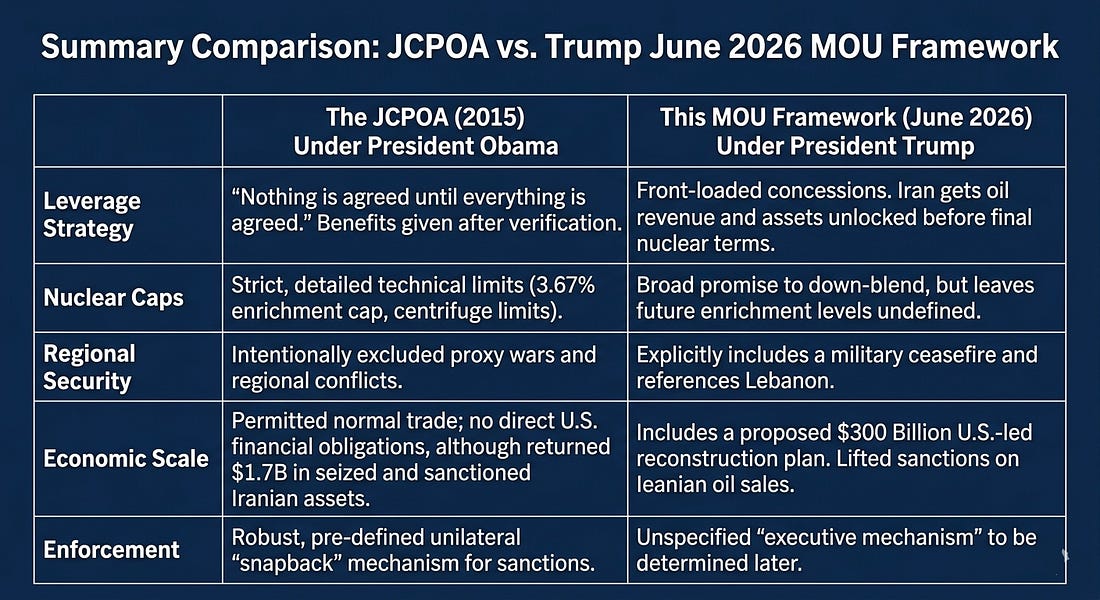
This framework is a stunning document that outlines an immediate standstill and de-escalation of the current conflict. To understand its true gravity, we must analyze what it includes, what it dangerously leaves out, and how it measures up against Obama’s 2015 Joint Comprehensive Plan of Action (JCPOA).
 |
What It Includes vs. What It Leaves Out
On paper, this MOU stops active military operations, lifts the U.S. naval blockade, grants immediate sanctions waivers for Iranian oil, and unlocks all frozen Iranian assets. However, what it doesn’t include is any meaningful oversight or monitoring. Unlike the highly restrictive JCPOA—which enforced a strict 3.67% uranium enrichment cap, dismantled two-thirds of Iran’s centrifuges, and established a unilateral “snapback” mechanism for sanctions—this MOU relies on a vague promise to down-blend materials. It completely fails to cap long-term enrichment levels, ban advanced centrifuges, or lay out clear verification measures, kicking those critical issues down the road—all while rewarding Iran in the form of lifted sanctions, the ability to sell oil on the free market, and handing over a $300B reconstruction fund.
A Rushed Timeline
The structural weakness of this agreement is a direct result of how it was made. The original JCPOA took nearly two years of painstaking, highly technical negotiations by international experts to finalize. By contrast, this MOU was thrown together in a few days, imposing an unrealistic 60-day deadline to finalize a definitive treaty.
The Cost of Amateur Diplomacy
All of the terms in this agreement are undeniably great for Iran, but make no mistake: this is Trump’s surrender to Iran to end the war.
Amateurs negotiated this MOU instead of seasoned diplomats and professionals in serious positions who actually know how to negotiate on behalf of American interests. Because of this strategic failure, Americans are left holding the bag—burdened by billions of dollars spent on an unnecessary war, a closed major waterway vital for global trade, soaring gas and food prices, a crumbling economy, crucial American military bases in the Middle East, and the tragic loss of 13 American lives.
Instead of eliminating any threat of building a nuclear program, accomplishing a regime change or ending the threat by Iranian proxy groups, we are handed a framework that gives Iran all of the necessary resources to rebuild and rearm.
Read the full text below to see exactly how this deal was structured and where it falls short.
Item 1: Termination of Military Operations
Original Text: 1 — The United States of America and the Islamic Republic of Iran and their allies in the current war are signing this MOU to declare the immediate and permanent termination of military operations on all fronts, including in Lebanon, and undertake from now on not to initiate any war or any military operation against each other, and to refrain from the threat or use of force against each other, and ensuring the territorial integrity and sovereignty of Lebanon. The final deal will confirm the permanent termination of the war on all fronts, including in Lebanon and other provisions of this paragraph.
What it doesn’t accomplish / Will result in: It establishes an immediate ceasefire but fails to define verification mechanisms or what constitutes a “breach” by proxy forces (e.g., Hezbollah, Houthis). By binding “allies in the current war,” it risks collapsing the moment an autonomous or loosely aligned militia fires a rocket, as there is no clear enforcement structure to referee localized violations.
JCPOA Comparison: The JCPOA was strictly a non-proliferation agreement; it intentionally avoided regional security dynamics, ceasefires, or proxy warfare. This MOU directly links regional military operations to the diplomatic framework.
Item 2: Respecting Sovereignty & Non-Interference
Original Text: 2 — The United States of America and the Islamic Republic of Iran undertake to respect each other’s sovereignty and territorial integrity and to refrain from interfering in each other’s internal affairs.
What it doesn’t accomplish / Will result in: This is standard, broad diplomatic prose. It does nothing to stop cyber warfare, covert intelligence operations, or state-sponsored asymmetric influence, which both sides traditionally view as distinct from overt physical “interference.”
JCPOA Comparison: Identical in spirit to standard international norms, but the JCPOA had zero explicit clauses attempting to police internal affairs or broader regional statecraft.
Item 3: 60-Day Deadline for Final Deal
Original Text: 3 — The United States of America and the Islamic Republic of Iran commit to negotiating and achieving the final deal in maximum 60 days, extendable with mutual consent.
What it doesn’t accomplish / Will result in: 60 days is a dangerously brief window for complex international diplomacy. Because the timeline is extendable, this will almost certainly result in rolling extensions, leaving the “temporary” concessions granted in this MOU functioning as a semi-permanent status quo.
JCPOA Comparison: The JCPOA took nearly two years of intense, highly technical negotiations to finalize. Setting a 60-day deadline for a broader deal (nuclear + regional war + $300B fund) is structurally unrealistic.
Item 4: Removal of U.S. Naval Blockade & Force Reduction
Original Text: 4 — Immediately upon the signing of this MOU, the United States of America will begin the removal of its naval blockade and any disturbances or impediments against the Islamic Republic of Iran, and will fully end the naval blockade within 30 days. During this period, the traffic of vessels will be in proportion to the numbers of pre-war traffic being restored by the Islamic Republic of Iran. The United States of America further undertakes to remove its forces from the proximity of the Islamic Republic of Iran within 30 days after the final deal.
What it doesn’t accomplish / Will result in: This is a major, immediate, and irreversible U.S. concession. Ending a naval blockade within 30 days—before a final deal is signed—permanently forfeits U.S. military leverage. Re-imposing a blockade later if negotiations fail would be legally and logistically difficult.
JCPOA Comparison: The JCPOA did not involve lifting military blockades or committing to U.S. troop withdrawals. U.S. military posture in the Persian Gulf remained entirely separate from nuclear compliance.
Item 5: Safe Passage & Strait of Hormuz Administration
Original Text: 5 — Upon the signing of this MOU, the Islamic Republic of Iran will make arrangements using its best efforts for the safe passage of commercial vessels with no charge, for 60 days only, from the Persian Gulf to the Sea of Oman and vice versa. The traffic of commercial vessels will immediately start, and considering the need for removing the technical and military obstacles, and demining by the Islamic Republic of Iran will be instated within 30 days. The Islamic Republic of Iran will conduct dialog with the Sultanate of Oman to define the future administration and maritime services in the Strait of Hormuz in discussion with other Persian Gulf littoral states in line with the applicable international law and the sovereign rights of coastal states of the Strait of Hormuz.
What it doesn’t accomplish / Will result in: Iran only guarantees free passage for 60 days. After that, it has the explicit right to alter the rules. Furthermore, inviting Iran and Oman to “define the future administration” of the Strait of Hormuz effectively legitimizes Iran’s claim to police a critical international choke point, bypassing standard international maritime law (UNCLOS).
JCPOA Comparison: The JCPOA never touched maritime law, freedom of navigation, or the administration of the Strait of Hormuz.
Item 6: $300 Billion Reconstruction Fund
Original Text: 6 — The United States of America undertakes with regional partners to develop a definitive, mutually agreed plan with at least USD 300 billion for the reconstruction and economic development of the Islamic Republic of Iran. The mechanism for the implementation of this plan will be finalized as part of a final deal within 60 days. All required licenses, waivers and permissions needed for the relevant financial transactions will be granted by the United States of America.
What it doesn’t accomplish / Will result in: It binds the U.S. to “develop a plan” for a massive financial injection ($300B) without attaching any domestic political feasibility. It does not dictate where the money comes from (U.S. taxpayers vs. international partners) and will likely face insurmountable opposition in the U.S. Congress, threatening the viability of the whole MOU.
JCPOA Comparison: The JCPOA provided zero reconstruction or development funds to Iran. It simply allowed Iran access to its own money by lifting sanctions.
Item 7: Schedule for Terminating Sanctions
Original Text: 7 — The United States of America undertakes to terminate all types of sanctions against the Islamic Republic of Iran, including the United Nations Security Council resolutions, IAEA Board of Governors resolutions, and all unilateral US sanctions, primary and secondary, in an agreed upon schedule as part of the final deal. The Islamic Republic of Iran and the United States of America acknowledge the critical importance of the sanctions termination issue above mentioned, and expressed their intentions to immediately address these issues in the negotiations in order to achieve mutual agreement on them.
What it doesn’t accomplish / Will result in: It kicks the entire schedule to future negotiations (”an agreed upon schedule as part of the final deal”) but notes that all types of sanctions are on the table. It completely fails to establish a “snapback” mechanism if Iran violates the terms later.
JCPOA Comparison: The JCPOA featured a meticulously detailed, multi-year phase-out schedule (Implementation Day, Transition Day, Termination Day) and included a historic “snapback” mechanism (UNSC Resolution 2231) allowing the U.S. to unilaterally restore UN sanctions if Iran cheated. This MOU lacks that safety net.
 |
Item 8: Nuclear Procurement & Down-blending
Original Text: 8 — The Islamic Republic of Iran reaffirms that it shall not procure or develop nuclear weapons. The United States of America and the Islamic Republic of Iran have agreed to resolve the disposition of stockpiled enriched material pursuant to a mechanism that will be mutually agreed upon in accordance with the schedule mentioned in paragraph seven, with the minimum methodology to be down blended on site under the supervision of the IAEA. The two parties also agreed to discuss the issue of enrichment and other mutually agreed matters related to the Islamic Republic of Iran’s nuclear needs, based on a satisfactory framework being agreed upon in the final deal. The final deal will confirm the provisions of this paragraph. The United States of America and the Islamic Republic of Iran acknowledge the critical importance of the nuclear issues above mentioned. They express their intention to immediately address these issues in the negotiations in order to achieve mutual agreement on them.
What it doesn’t accomplish / Will result in: This is the weakest nuclear clause in the text. It uses the vague phrase “minimum methodology to be down blended on site” but fails to cap enrichment levels (e.g., 3.67%), ban advanced centrifuges, or seal underground facilities (like Fordow). It kicks the core framework of Iran’s nuclear limits down the road to be discussed later.
JCPOA Comparison: The JCPOA was a technical masterpiece of restrictions. It strictly capped enrichment at 3.67%, limited the stockpile to 300kg, slashed centrifuge counts by two-thirds, converted Fordow into a physics center, and mandated a 20-year intensive IAEA inspection regime. This MOU relies mostly on vague promises.
Item 9: Maintaining the Nuclear Status Quo
Original Text: 9 — Pending the final deal, the United States of America and the Islamic Republic of Iran agree to maintain the status quo. The Islamic Republic of Iran will maintain the current status quo of its nuclear program, and the United States of America will not impose any new sanctions and will not deploy additional forces in the region.
What it doesn’t accomplish / Will result in: “Current status quo” freezes Iran’s program exactly where it is today. If Iran is already holding highly enriched fissile material (e.g., 60% or near-weapons grade), this item legitimizes them keeping that highly advanced baseline during the talks.
JCPOA Comparison: The JCPOA forced Iran to drastically roll back its existing capabilities, shipping out 98% of its enriched uranium stockpile before receiving a dime of sanctions relief.
Item 10: Immediate U.S. Oil Waivers
Original Text: 10 — The United States of America undertakes that immediately upon the signing of this MOU and until the termination of sanctions, US Department of Treasury will issue waivers for the export of Iranian crude oil, petroleum products and derivatives, and all associated services, including banking transactions, insurances, transportation, etc.
What it doesn’t accomplish / Will result in: The U.S. agrees to immediately permit the export of Iranian crude oil and provide full banking/insurance services prior to a final deal. This provides Iran with immediate, massive financial relief, vastly reducing their economic incentive to make tough concessions during the 60-day final deal negotiations.
JCPOA Comparison: Under the JCPOA, oil sanctions were only lifted after the IAEA formally verified that Iran had dismantled its nuclear infrastructure (Implementation Day).
Item 11: Release of Frozen Assets
Original Text: 11 — The United States of America undertakes to make fully available for use the frozen or restricted funds and assets of the Islamic Republic of Iran upon the implementation of this MOU. The United States of America and the Islamic Republic of Iran will mutually agree on the procedures related to the release of these funds during negotiations. Such funds, whether retained in the original account or transferred, shall be made fully usable for payment to any ultimate beneficiary designated by the Central Bank of the Islamic Republic of Iran. The United States of America undertakes to issue all necessary licenses and authorizations accordingly.
What it doesn’t accomplish / Will result in: It makes all restricted Iranian assets fully available immediately. Because the funds are designated “fully usable for payment to any ultimate beneficiary,” the U.S. loses the ability to track or restrict these funds to humanitarian goods (food/medicine), meaning they can be used for state or military expenditures.
JCPOA Comparison: While the JCPOA unfroze tens of billions in Iranian assets, it did so only after structural nuclear rollbacks were completed, and many transactions remained bound to rigorous banking compliance channels.
Item 12: Executive Monitoring Mechanism
Original Text: 12 — The United States of America and the Islamic Republic of Iran agree that an executive mechanism will be established to monitor the successful implementation of this MOU and the future compliance of the final deal.
What it doesn’t accomplish / Will result in: It states a mechanism “will be established” but gives no details. Without explicit wording guaranteeing “anytime, anywhere” access for inspectors, this item provides no immediate verification utility.
JCPOA Comparison: The JCPOA explicitly detailed the Joint Commission framework and granted the IAEA unprecedented access rights, including specific timelines to resolve access disputes within 24 days.
Item 13: Bifurcated Negotiation Strategy
Original Text: 13 — After signing this MOU, and subject to the beginning of the implementation of paragraphs 1, 4, 5, 10 and 11 of this MOU, and the continuing implementation of these measures, the United States of America and the Islamic Republic of Iran will start negotiations regarding the final deal exclusively on the other paragraphs.
What it doesn’t accomplish / Will result in: This clause isolates items 1, 4, 5, 10, and 11 as immediate prerequisites. Essentially, Iran receives its core objectives first (ceasefire, blockade lifted, oil waivers, frozen funds) just to start negotiating the final terms of the other pieces (like long-term nuclear caps and sanctions schedules). It strips the U.S. of nearly all transactional leverage.
JCPOA Comparison: The JCPOA operated under the strict diplomatic principle that “nothing is agreed until everything is agreed.” No single benefit was paid out early.
Item 14: Binding UNSC Resolution
Original Text: 14 — The final deal will be endorsed by a binding UNSC resolution.
What it doesn’t accomplish / Will result in: While a UNSC resolution makes the final deal part of international law, history (including the U.S. withdrawal from the JCPOA in 2018) shows that domestic political shifts can still tank these agreements regardless of UN backing.
JCPOA Comparison: Identical strategy. The JCPOA was codified under UNSC Resolution 2231 to give it international legal permanence, though it ultimately could not prevent a signatory from walking away.
*********
Ultimately, Lincoln Square wants our subscribers to understand the full depth of this MOU. We are deeply committed to the facts, and we believe it is our duty to inform disengaged Americans of the harsh truth: this agreement represents an absolute surrender by the President. Financially, this deal will cost us even more than what we already spent on the war, while severely weakening our national security. It positions the United States as weak on the global stage and leaves Iran significantly stronger.
Please subscribe to Lincoln Square right now to help us amplify these facts to disengaged Americans. They need to know that Trump’s decisions as President are harmful and amateur—and that we must deliver a devastating defeat in November to every MAGA politician who enabled these reckless decisions to go to war.
The mainstream, corporate media is too scared to report the real consequences of Trump’s MOU with Iran, but we aren’t. We’re committed to bringing America the real facts that the mainstream media misses. But we can’t do it without you. Your support for independent media like Lincoln Square is an investment in preserving the facts and truths needed to defend our democracy.
Support independent journalism for less than the cost of a fancy cup of coffee. Subscribe today and take advantage of our limited-time 40% discount—just $6/month, or under 16 cents a day. Can we count on your support to keep amplifying the facts?
It will take every single one of us to win the war on the First Amendment, replace the Trump regime, and restore accountability. Together, we can reclaim our democracy and bring civility back to our nation.
Sincerely,
Lincoln Square.


