Feds Just Admitted It—They Can Take Your Cash
The Department of Justice just argued in court that cash isn't legally your property. Read that again. Washington now believes it can freeze, seize, or drain your accounts whenever it chooses. Your savings, your retirement, your financial future, all suddenly under their control. This isn't a theory. It's happening right now. But you don't have to be their next target. Smart Americans are already moving their wealth far beyond Washington's reach today.
Get Your Free Wealth Defense Guide Now
P.S. Once the trap snaps shut, it will surely be too late. Greece raided pensions, Cyprus drained bank accounts, Poland seized retirement funds. Every time, people swore it couldn't happen here. Every time, they were wrong.

Get your free Wealth Defense Guide now
Uranium Energy Corp Melts Down—Nuclear Opportunity at Hand
Reported by Thomas Hughes. Article Posted: 6/10/2026.

Key Points
- Uranium Energy Corp is on track to ramp production and build its stock pile.
- A vertical integration strategy also progresses, setting up future growth.
- Analysts and institutions provide support and limit downside in late Q2.
- Special Report: Elon’s “Hidden” Company
Uranium Energy Corp’s (NYSEAMERICAN: UEC) stock price melted down following its latest earnings release, sending shares down more than 15%. The move is ugly and leaves the market vulnerable to further weakness, but the downside looks limited at this point.
The near-term headwinds do not change the long-term opportunity; UEC is a long-term play. Uranium is a hot commodity, but it is unlikely to see a substantial increase in demand for at least another year. After that, nuclear operators such as start-up Oklo (NASDAQ: OKLO) and established utilities like Constellation Energy Group (NASDAQ: CEG) should begin deploying new nuclear projects, opening the floodgates to rapid proliferation of nuclear power and demand for uranium-based fuel.
Risks Priced In—UEC Stock Falls to Buy Zone
Is SpaceX really worth 1.78 Trillion? (Ad)
With SpaceX approaching a near-$2 trillion valuation, most investors are focused on the IPO itself - but analyst Lance Ippolito says the real opportunity is elsewhere.
He's identified 5 dirt-cheap stocks at the forefront of this mega-IPO, including a space ticker that Goldman Sachs, BlackRock, and Morgan Stanley are all buying, a rare resource miner Elon's entire empire depends on, and the chip supplier Starlink satellites can't function without.
Access his free SpaceX Investing Blackbook before IPO day arrives.
Get the free SpaceX Investing Blackbook and see all 5 namesInstitutional activity is one reason downside appears limited this summer. Institutions own more than 60% of the stock and have been accumulating shares over the trailing 12 months. Buying slowed as price action reached its peaks in Q1 and Q2 2026, but it is likely to increase in late Q2 given the discount now on offer. At $10.50, UEC shares are about 50% below their highs and are trading at levels where institutional accumulation has been robust in the past.
The chart action suggests a trigger point has been reached, as the post-release drop pushed the market near a critical target that aligns with a prior rebound. The likely outcome is that price action tests this level, and may even briefly move below it before buyers step in and drive a rebound later this year. Other signs of strong support near $10 include divergences in stochastic and MACD, which suggest underlying market strength despite the recent price drop.
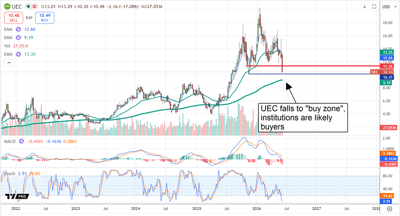
Analyst sentiment also supports the idea of strong support near $10. While coverage is limited, with only nine analysts tracked, it is still enough to provide some confidence in the Moderate Buy rating. The group bias is bullish, with 78% rating the stock a Buy, and the price targets are encouraging. The low end of the range is $10.50, above the critical support target, and consensus is $17.65, which implies nearly 70% upside from that level. The takeaway is that UEC’s market is overreacting to the latest earnings release, creating a value opportunity that institutions are likely to seize.
UEC: A Long-Term Play on Uranium and Vertical Integration
UEC’s strategy is two-fold, based on spot uranium prices and vertical integration. The company is holding onto resources as they are produced, waiting for spot prices to increase or for its vertical integration strategy to reach the endgame. As it stands, the company is operational with over $127 million in mineral assets.
Production recently began at the Burke Hollow mine, the company’s long-term growth driver. It is the United States' largest greenfield mine and part of an existing hub-and-spoke framework. Resources are funneled from Burke Hollow and other local mine sites to a processing plant, where raw uranium is turned into yellowcake. Yellowcake is an easily transportable precursor for uranium processing, destined for fuel rods and other applications. Burke Hollow resources are estimated at $950 million in the ground and up to $2 billion when fully processed.
UEC’s vertical integration is also moving forward. While still in its early stages, a subsidiary is advancing plans to build a conversion facility to produce uranium hexafluoride. Uranium hexafluoride is the primary feedstock for final enrichment. The plan is to end integration at this point, focusing on core strengths rather than costly enrichment facilities.
Balance Sheet Strength Carries the Day
While UEC remains a pre-revenue company, it is in little danger of failure. The balance sheet is rock solid, with nearly $500 million in cash and $800 million in liquidity, which is sufficient to fund operations as planned. Other details include zero debt and a growing uranium pile that can be liquidated if needed. In this scenario, all Uranium Energy Corp needs to do is continue executing its strategy. That includes a 100% unhedged uranium position, aiming to capitalize on price increases. Hovering in the $80 to $100 range today, the spot uranium price is expected to increase by 50% by the end of the decade.
The company’s biggest risk is ramping production, but that appears to be going smoothly. New mines and expanded production are funneling into existing processing plants, helping reduce execution risk and keep costs low. Low cost is another critical factor, as UEC sustains margins well below 50% and expects to lower them as production increases. Catalysts include a property in Paraguay deemed globally significant for its titanium and vanadium reserves, valued at up to $1.5 billion. Also in the early phases, initial project plans are underway, but there is no official timeline for operational start.
Are the 3 Newest Members of the $1 Trillion Market Cap Club the Latest Sign of an AI Bubble?
Authored by Jessica Mitacek. Date Posted: 6/1/2026.

Key Points
- AI-driven demand for high-bandwidth memory has propelled Samsung, SK Hynix, and Micron into the $1 trillion market cap club.
- Samsung and SK Hynix now represent 50% of South Korea's KOSPI market capitalization, raising significant concentration risk for the benchmark index.
- The global HBM shortage is projected to last through at least 2027, with all three major suppliers already sold out of their full-year production capacity.
- Special Report: Elon’s “Hidden” Company
As the world’s insatiable appetite for artificial intelligence (AI) continues to drive a global memory chip shortage, a handful of companies are seeing gains so outsized that they have revived some investors’ concerns about a looming AI bubble.
Last month, the number of publicly traded companies in the $1 trillion market cap club grew from 10 to 13.
Is SpaceX really worth 1.78 Trillion? (Ad)
With SpaceX approaching a near-$2 trillion valuation, most investors are focused on the IPO itself - but analyst Lance Ippolito says the real opportunity is elsewhere.
He's identified 5 dirt-cheap stocks at the forefront of this mega-IPO, including a space ticker that Goldman Sachs, BlackRock, and Morgan Stanley are all buying, a rare resource miner Elon's entire empire depends on, and the chip supplier Starlink satellites can't function without.
Access his free SpaceX Investing Blackbook before IPO day arrives.
Get the free SpaceX Investing Blackbook and see all 5 namesThe first new member came when Samsung Electronics (OTCMKTS: SSNLF) surpassed the landmark valuation, becoming the second Asian company to do so, following Taiwan Semiconductor Manufacturing Company (NYSE: TSM), which crossed $1 trillion in July 2025.
Shortly thereafter, two companies whose stocks have surged over the past year joined the club: Micron Technology (NASDAQ: MU) and South Korean semiconductor company SK Hynix, which does not trade directly on major U.S. exchanges.
With the memory chip shortage projected to last for at least another year, if not longer, any shock to other parts of the AI trade could have severe consequences for companies in the high-bandwidth memory (HBM) space.
HBM Demand Is Raising Concentration Risk for South Korea’s Stock Market
Shares of SK Hynix have gained more than 1,000% over the past year, making Samsung’s gain of more than 458% over the same period look modest by comparison. Their combined market caps now stand at nearly $2.5 trillion.
As of May 27, those two companies together accounted for an unprecedented and deeply concerning 50% of the entire market capitalization of South Korea’s benchmark Korea Composite Stock Price Index (KOSPI). For context, at the end of May, the Magnificent Seven accounted for roughly one-third of the S&P 500.
By itself, that degree of concentration risk is worrisome. But adding a layer of extreme AI-driven and increasingly codependent revenue growth compounds those concerns.
To illustrate how sharp that growth has been, Samsung saw overall revenue grow by nearly 37% from 2018 to 2025. However, its Device Solutions division—the company’s business unit responsible for its global semiconductor and component operations—has seen revenue grow by more than 95% since 2023.
Investor flows tied to short- and long-term trends in HBM can have an outsized effect on the broader index. That concentration means HBM-driven inflows or outflows can disproportionately influence the performance of the other 836 companies in the benchmark.
Metrics Suggest Micron Is Financially Healthy and Still Undervalued
Despite a nearly 1,000% gain over the past year, Micron is trading at a trailing 12-month price-to-earnings (P/E) ratio of about 45 and a forward P/E ratio of around 17.
That makes the stock cheap by most Wall Street standards, regardless of its incredible run since the start of April 2025, when it was trading for roughly 1,400% less than where shares are changing hands today.
Meanwhile, the company's debt-to-equity (D/E) ratio supports that view. Generally, a D/E ratio below two indicates a company with financial stability and conservative management. The S&P 500’s average D/E ratio is 0.65, while Micron’s is only 0.13.
That, among other factors, has kept Micron in analysts’ good graces. The 39 analysts currently covering MU have given the stock a consensus Buy rating.
UBS, for example, recently issued a structural upgrade, raising its one-year price target for Micron from $535 to a Wall Street high of $1,625.
The central argument is that Micron is forecast to generate over $400 billion in free cash flow from 2027 to 2029.
Still, from an earnings per share (EPS) perspective, there are reasons for caution. After EPS contracted by nearly 169% in 2023, it grew by more than 113% in 2024 and over 984% in 2025, even as revenue growth slowed from nearly 62% in 2024 to around 49% in 2025.
That’s largely attributable to the company’s record margins. Micron’s guidance projects gross margin targets of an unheard-of 81%, with Q2 adjusted free cash flow having reached $6.9 billion.
For Now, the Memory Chip Shortage Has Legs
The global HBM deficit is projected to last at least through 2027, with many forecasts indicating it could stretch into the 2030s.
While the recent performances of Samsung, SK Hynix, and Micron leave the companies looking ripe for a correction, the macro reality suggests the trend is sustainable given the extent of the supply shortage.
Together, those three companies supply an estimated 95% of the world’s memory chips. And despite it still being the first half of 2026, all three companies have said their production capacity for the entire year is already sold out, meaning they can charge a premium for their products and further expand their margins.
SK Hynix’s management has warned that an HBM wafer shortage could last as long as five years. And all three companies have pivoted production to satisfy existing demand, leaving shortages for consumer electronics such as laptops and smartphones, which are facing supply constraints and price hikes.
Much of that is being driven by hyperscalers like Alphabet (NASDAQ: GOOGL), Meta Platforms (NASDAQ: META), and Microsoft (NASDAQ: MSFT), which have secured much of the HBM production capacity through long-term contracts with Samsung, SK Hynix, and Micron.
This email is a sponsored email for Priority Gold, a third-party advertiser of The Early Bird and MarketBeat.
This is an advertisement.
If you no longer wish to receive promotional messages from this advertiser, please click here: Unsubscribe. Or write to: 5005 Lyndon B. Johnson Fwy. Suite 350 Dallas, TX 75244
Copyright © 2026 Priority Gold. All Rights Reserved.
If you have questions or concerns about your account, feel free to email MarketBeat's South Dakota based support team at [email protected].
If you no longer wish to receive email from The Early Bird, you can unsubscribe.
© 2006-2026 MarketBeat Media, LLC.
345 North Reid Place, Sixth Floor, Sioux Falls, SD 57103-7078. United States of America..