The SpaceX IPO playbook most investors will get wrong 
NVIDIA’s Outlook Gains Momentum: Stock Price to Follow Written by Thomas Hughes on June 11, 2026 
Key Points- NVIDIA's business continues to gain momentum, and catalysts are rolling down the pipe for delivery in Q3.
- Analysts' sentiment trends have strengthened, pointing to a $500 price target and 150% upside.
- Valuation metrics suggest this stock could top $1000 again within a few years.
- Special Report: A tiny supplier at the center of Elon's AI infrastructure

Investors concerned that NVIDIA’s (NASDAQ: NVDA) May 2026 price peak is a market top can lay their fears to rest. The signs pointing to higher prices only strengthened in early June, suggesting a robust upside both near and long-term. Especially in light of the comments and announcements at the Taiwan Computex conference, NVIDIA’s future looks not only bright, but assured. With SpaceX approaching a near-$2 trillion valuation, most investors are focused on the IPO itself - but analyst Lance Ippolito says the real opportunity is elsewhere.
He's identified 5 dirt-cheap stocks at the forefront of this mega-IPO, including a space ticker that Goldman Sachs, BlackRock, and Morgan Stanley are all buying, a rare resource miner Elon's entire empire depends on, and the chip supplier Starlink satellites can't function without.
Access his free SpaceX Investing Blackbook before IPO day arrives. Get the free SpaceX Investing Blackbook and see all 5 names Datacenters: They Keep Building Them, Using NVIDIA ProductsEvidence of demand is visible in Nebius Group’s (NASDAQ: NBIS) move to expand in the UK. The company plans to spend approximately $2.275 billion on several next-gen facilities, powering the system with NVIDIA’s Vera Rubin products.
Other evidence lies in a partnership with SK Telecom. The partnership aims to construct an AI-capable cloud in South Korea to power training and inference. Inference is crucial to the outlook, as it is the application of AI and a much larger market segment than infrastructure and training. In the words of CEO Jenson Huang, telecom networks are national AI infrastructure—a valuable commodity worth $2.25 trillion globally.
Analysts left the conference with a reinvigorated outlook on NVIDIA. Wedbush and UBS analysts are aligned: GPU demand is rising, while capacity continues to lag, setting the stage for continued strength in the coming quarters. Wedbush thinks the upgrade cycle may also be accelerating, as Blackwell demand remains robust later in the cycle than expected. In this scenario, NVIDIA’s cloud business will remain strong, with upcoming results outpacing already robust consensus forecasts.
MarketBeat tracked five analyst updates for NVDA in the first week of June, including coverage initiations and several reiterated ratings with above-consensus price targets. As it stands, there are an impressive 54 analysts covering the stock; coverage continues rising, and sentiment is firming. The bias is approximately 95% in favor of Buy, with a consensus price target forecasting a 50% upside. The 50% upside is likely a minimum target, as the trend leads to levels well above it. The high end, set by analysts at Robert W. Baird in late May, tops out at $500, approximately 150% upside from the critical support target.
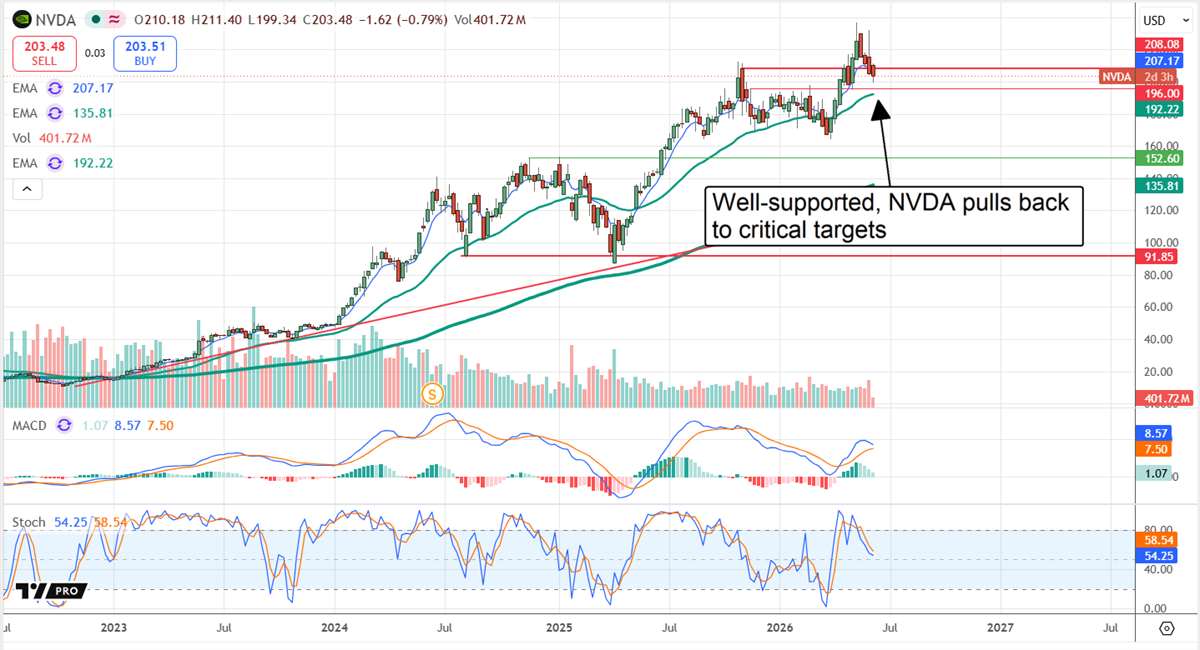
NVIDIA Pulls Back in Retest of Support: Rebound Is the Likely OutcomeCritical support is in the range of $195 to $210, aligning with prior highs broken in late April and early May. The retest is not surprising, as most markets tend to move in a similar direction following significant breakouts. What comes next is a likely rebound. Rebounding from this level would confirm support advanced from prior levels to the breakout point, showing increased confidence in the forecasts. NVIDIA shares will likely retest the all-time high in this scenario, and then break out to new highs and continue rallying as the year progresses.
Catalysts for the move include NVIDIA’s strengthened supply chain. NVIDIA is using its massive cash flow and cash balance to invest not only in future technology, but also in current and future capacity. While constraints exist, the talk is that NVIDIA remains the best-positioned and least likely to experience delays and setbacks.
The most recent acquisition is Kumo AI. It is an enterprise-quality predictive agent forecasting warehouse needs based on customer data. The tuck-in not only provides near-term revenue as part of the enterprise software portfolio, but is an integral part of the long-term physical AI strategy. Kumo AI can serve as the brain for physical AI, including warehouse automation applications. The SpaceX IPO is drawing near, but the real opportunity may lie in 5 lesser-known companies providing the critical infrastructure SpaceX depends on to operate.
Goldman Sachs and Morgan Stanley are reportedly already building positions in one of these names. Another is a resource miner that Elon Musk's broader empire - including Tesla - relies on. Lance Ippolito has detailed all five inside his free SpaceX Investing Blackbook. Download the free SpaceX Investing Blackbook before these names go mainstream NVIDIA Market Is Just Waiting to Be TriggeredA visible trigger for this move is the company's upcoming Q2 earnings report, scheduled for mid-August, but other triggers may emerge. Among them are releases from AI-centric names affirming that demand remains hot, follow-through on data center spending, and forecasts for sustained strength.
As robust as the near-term stock price is, the long-term outlook is exponentially so. A deep value today, with the stock trading at an approximate 50% discount to its historical P/E ratio, the forward outlook is far superior. Estimates suggest a 6X multiple relative to the 10-year outlook, a deep-value opportunity with the potential for a 400% return relative to the current-year valuation, and up to 600% if NVIDIA can regain its premium. Either way, NVIDIA is underpriced as of mid-Q2 2026.
The group that needs to be triggered is retail investors. MarketBeat data show institutions own more than 60% of the stock and have been buying aggressively over the trailing 12 months. They run a $ 3-to-$1 pace, providing strong support and limiting downside risk for investors.
Read this article online › Read More 
Did you learn something from this article?  
| 