Microsoft's Build 2026 conference outlined its agentic AI strategy and gave investors three key dates to show if Copilot can justify the... ͏ ͏ ͏ ͏ ͏ ͏ ͏ ͏ ͏ ͏ ͏ ͏ ͏ ͏ ͏ ͏ ͏ ͏ ͏ ͏ ͏ ͏ ͏ ͏ ͏ ͏ ͏ ͏ ͏ ͏ ͏ ͏ ͏ ͏ ͏ ͏ ͏ ͏ ͏ ͏ ͏ ͏ ͏ ͏ ͏ ͏ ͏ ͏ ͏ ͏ ͏ ͏ ͏ ͏ ͏ ͏ ͏ ͏ ͏ ͏ ͏ ͏ ͏ ͏ ͏ ͏ ͏ ͏ ͏ ͏ ͏ ͏ ͏ ͏ ͏ ͏ ͏ ͏ ͏ ͏ ͏ ͏ ͏ ͏ ͏ ͏ ͏ ͏ ͏ ͏ ͏ ͏ ͏ ͏ ͏ ͏ ͏ ͏ ͏ ͏ |
| | Written by Chris Markoch 
Microsoft Corporation (NASDAQ: MSFT) turned heads at its Build 2026 conference in June by introducing an ambitious platform vision. Specifically, the company is reframing Copilot as a multi-layered agentic system spanning productivity, development tools, and enterprise knowledge.
Analysts have been waiting for Microsoft to map out a vision for Copilot beyond a chatbot in its productivity suite. But the initial reaction from investors is skepticism. MSFT is down almost 10% since the conference, and the stock is in the same general downtrend that’s been in place since October 2025.
There isn’t one single reason for the stock’s slide. But Copilot is part of it. When Microsoft reported Q3 fiscal year 2026 (FY2026) earnings on April 29, the company disclosed that paid Microsoft 365 Copilot seats had crossed 20 million. That was up from 15 million just one quarter earlier.
The stock still fell. Investors aren't waiting for more features. They want proof that the company’s record capital expenditure, now projected at $190 billion for FY2026, is translating into durable revenue. Build 2026 gave them investors a calendar to follow. Here are the three dates that will tell them whether it's working.
Date #1: Q4 FY2026 Earnings (July 29, 2026)CFO Amy Hood was explicit on the Q3 call: Copilot seat growth will accelerate again in the September quarter, and GitHub is where management expects revenue growth rates and consumption models to produce visible top-line acceleration.
Microsoft is expected to deliver Q3 FY2026 earnings on July 29. The number worth watching is average revenue per user (ARPU) in M365 Commercial Cloud. Microsoft 365 Copilot has driven ARPU higher through E5 seat upsells, but that lever has limits.
If usage credits, which are the consumption layer on top of seats, begin contributing meaningfully to ARPU in Q4, it signals that the agentic model is monetizing on schedule. If ARPU is flat despite continued seat adds, the consumption thesis has not yet proven itself.
Investors will also want to watch for any agent-specific revenue disclosure. Management has not yet separated Copilot Studio or agent-workflow revenue in public guidance. An initial breakout would be a significant signal.
Date #2: Microsoft Ignite, November 17–20, 2026Ignite is where Microsoft's enterprise product announcements get priced and deployed. Build tells developers what the platform is becoming. Ignite tells IT departments and their procurement teams what it will cost and when it ships. For investors, three specific disclosures would move the thesis:
Frontier Tuning GA date and pricing. Private preview at Build means enterprise sales teams can't close deals on it yet. A GA announcement at Ignite, with pricing, converts pipeline into bookings.
Copilot Studio agent billing structure. Agents built in Copilot Studio currently consume message credits. How Microsoft evolves this toward outcome-based or consumption pricing will determine margin structure for the agentic layer.
Microsoft IQ enterprise tier pricing. Work IQ, Fabric IQ, and Web IQ are live, but large enterprises will need defined pricing tiers and data residency commitments before deploying at scale.
Historically, Ignite has produced the most impactful enterprise pricing news Microsoft releases all year. In an agentic AI cycle, 2026's conference may be the most consequential since the original M365 Copilot launch.
Date #3: Q1 FY2027 Earnings (~October 2026)This is the first earnings report in which Build 2026 features could meaningfully register in revenue. The September quarter (ending Sept. 30, 2026) will include a full quarter of Microsoft IQ's general availability. More importantly, it will be the first quarter where Copilot seat acceleration is reported rather than guided.
Analyst forecasts have agentic AI revenue exceeding Copilot assistant revenue by Q2 FY2027. Q1 FY2027 earnings will be the first test of that prediction. If consumption revenue is beginning to separate from seat-based M365 Copilot revenue in the disclosures, the structural shift is underway. GitHub Copilot's revenue line will also be worth watching because management specifically named it as a leading indicator.
The Risk That Doesn't Go AwayEven if Microsoft meets all those milestones, the company’s CapEx trajectory may be an unavoidable counterweight to the Copilot platform story. At $190 billion for FY2026, the company has committed to infrastructure at a scale that requires durable AI revenue.
The Noise May Be an OpportunityLike many technology stocks, MSFT is down as investors begin to rethink their exposure to tech for a variety of reasons. Most of those reasons are likely just noise. These calendar dates are tangible benchmarks for investors to consider.
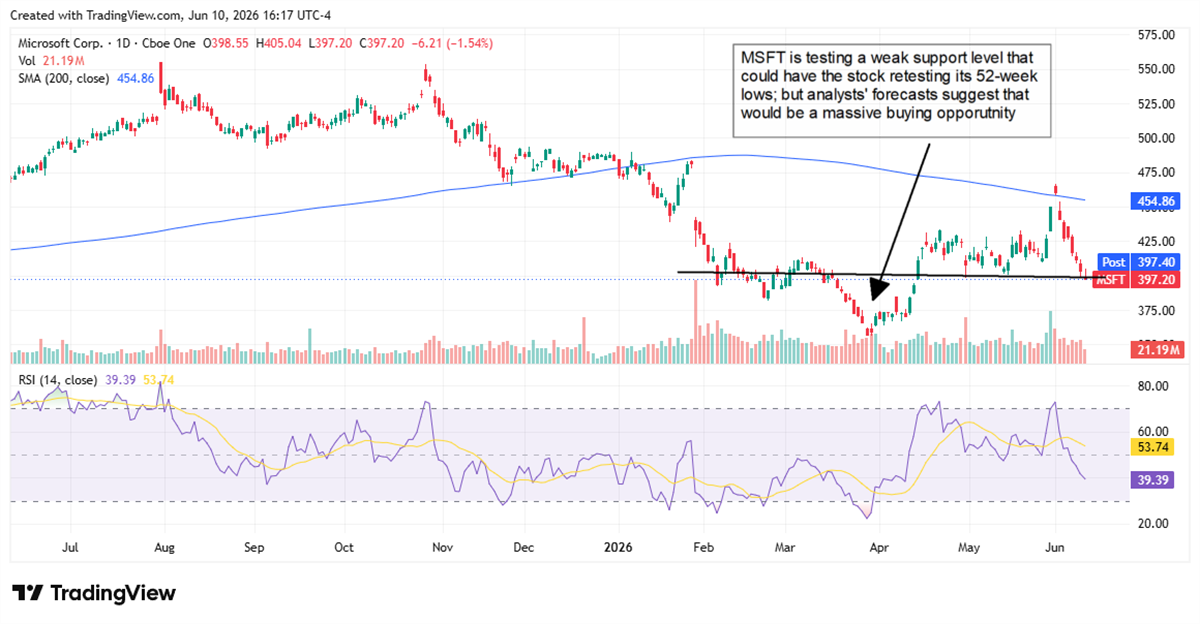
That said, the short-term bad news is that MSFT could test its 52-week low as selling pressure increases. The good news is that, because the current sell-off is sector-driven and not isolated to Microsoft, there's a strong possibility of a bullish correction. The stock is trading over 41% below its consensus price target of $561.20. If the stock were to hit that level, it would mark a new all-time high.
 Read This Story Online Read This Story Online |  When the SpaceX IPO launches, most retail investors will be locked out. The banks, funds, and insiders get in early - while everyone else waits on the sidelines.
But one small infrastructure supplier - a critical piece Musk can't scale the Colossus network without - is still trading well under institutional radar. A new briefing reveals the name and ticker at no cost. Get the SpaceX infrastructure stock name and ticker here |
| Written by Thomas Hughes 
Investors concerned that NVIDIA’s (NASDAQ: NVDA) May 2026 price peak is a market top can lay their fears to rest. The signs pointing to higher prices only strengthened in early June, suggesting a robust upside both near and long-term. Especially in light of the comments and announcements at the Taiwan Computex conference, NVIDIA’s future looks not only bright, but assured.
Datacenters: They Keep Building Them, Using NVIDIA ProductsEvidence of demand is visible in Nebius Group’s (NASDAQ: NBIS) move to expand in the UK. The company plans to spend approximately $2.275 billion on several next-gen facilities, powering the system with NVIDIA’s Vera Rubin products.
Other evidence lies in a partnership with SK Telecom. The partnership aims to construct an AI-capable cloud in South Korea to power training and inference. Inference is crucial to the outlook, as it is the application of AI and a much larger market segment than infrastructure and training. In the words of CEO Jenson Huang, telecom networks are national AI infrastructure—a valuable commodity worth $2.25 trillion globally.
Analysts left the conference with a reinvigorated outlook on NVIDIA. Wedbush and UBS analysts are aligned: GPU demand is rising, while capacity continues to lag, setting the stage for continued strength in the coming quarters. Wedbush thinks the upgrade cycle may also be accelerating, as Blackwell demand remains robust later in the cycle than expected. In this scenario, NVIDIA’s cloud business will remain strong, with upcoming results outpacing already robust consensus forecasts.
MarketBeat tracked five analyst updates for NVDA in the first week of June, including coverage initiations and several reiterated ratings with above-consensus price targets. As it stands, there are an impressive 54 analysts covering the stock; coverage continues rising, and sentiment is firming. The bias is approximately 95% in favor of Buy, with a consensus price target forecasting a 50% upside. The 50% upside is likely a minimum target, as the trend leads to levels well above it. The high end, set by analysts at Robert W. Baird in late May, tops out at $500, approximately 150% upside from the critical support target.
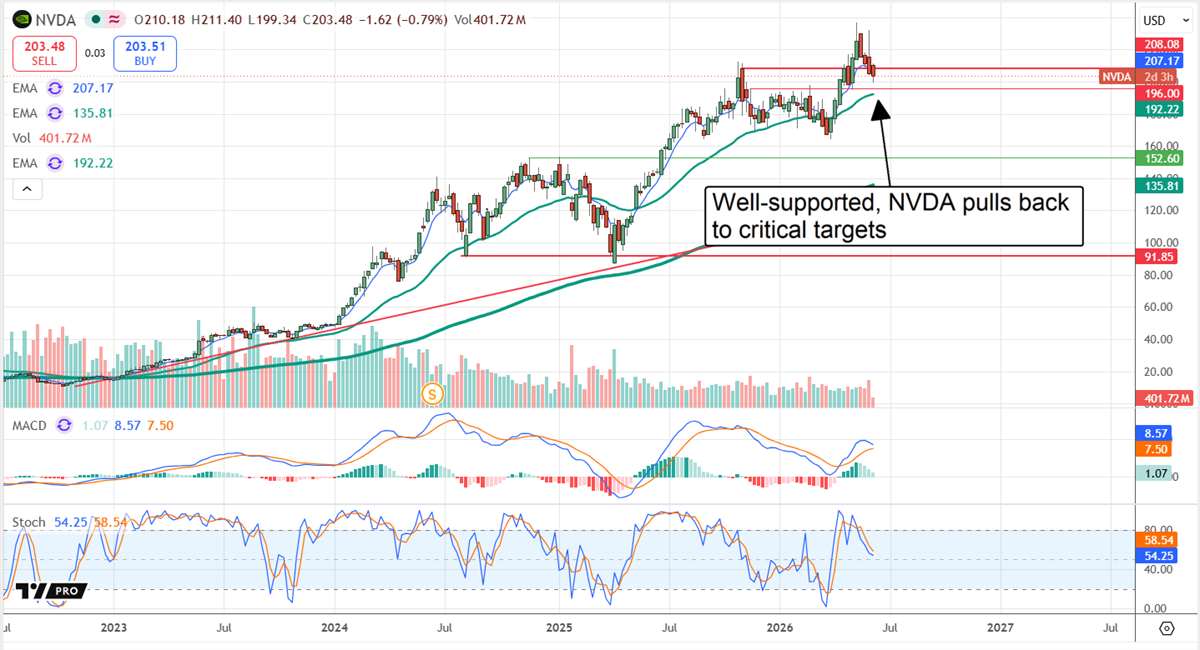
NVIDIA Pulls Back in Retest of Support: Rebound Is the Likely OutcomeCritical support is in the range of $195 to $210, aligning with prior highs broken in late April and early May. The retest is not surprising, as most markets tend to move in a similar direction following significant breakouts. What comes next is a likely rebound. Rebounding from this level would confirm support advanced from prior levels to the breakout point, showing increased confidence in the forecasts. NVIDIA shares will likely retest the all-time high in this scenario, and then break out to new highs and continue rallying as the year progresses.
Catalysts for the move include NVIDIA’s strengthened supply chain. NVIDIA is using its massive cash flow and cash balance to invest not only in future technology, but also in current and future capacity. While constraints exist, the talk is that NVIDIA remains the best-positioned and least likely to experience delays and setbacks.
The most recent acquisition is Kumo AI. It is an enterprise-quality predictive agent forecasting warehouse needs based on customer data. The tuck-in not only provides near-term revenue as part of the enterprise software portfolio, but is an integral part of the long-term physical AI strategy. Kumo AI can serve as the brain for physical AI, including warehouse automation applications.
NVIDIA Market Is Just Waiting to Be TriggeredA visible trigger for this move is the company's upcoming Q2 earnings report, scheduled for mid-August, but other triggers may emerge. Among them are releases from AI-centric names affirming that demand remains hot, follow-through on data center spending, and forecasts for sustained strength.
As robust as the near-term stock price is, the long-term outlook is exponentially so. A deep value today, with the stock trading at an approximate 50% discount to its historical P/E ratio, the forward outlook is far superior. Estimates suggest a 6X multiple relative to the 10-year outlook, a deep-value opportunity with the potential for a 400% return relative to the current-year valuation, and up to 600% if NVIDIA can regain its premium. Either way, NVIDIA is underpriced as of mid-Q2 2026.
The group that needs to be triggered is retail investors. MarketBeat data show institutions own more than 60% of the stock and have been buying aggressively over the trailing 12 months. They run a $ 3-to-$1 pace, providing strong support and limiting downside risk for investors.
Read This Story Online |  The SpaceX IPO is set for June 12 - and analyst Jeff Brown has identified three small-cap stocks he believes are directly tied to SpaceX's growth and the broader space economy.
Each of these picks is at least 145 times smaller than SpaceX, which Brown argues means significantly more upside potential before and after the listing date. See all three SpaceX-linked stock picks before the June 12 IPO |
| Written by Chris Markoch 
Investors have had many headlines to consider in the last month, and the start of the FIFA World Cup may be another. This will be the first in-nation World Cup in history, spanning the United States, Canada, and Mexico. It’s projected to inject $41 billion to the global gross domestic product (GDP).
That’s enough to pique investor interest. But where should they look?
In the last 10 years at least, there’s been no such thing as a World Cup catalyst for the broader market. But the event has been a boost for some sector-specific stocks. Not surprisingly, Nike Inc. (NYSE: NKE) has been one of those names. The company will have its iconic swoosh prominently displayed again this year.
Nike could use the catalyst. However, there are two other names that have had a history of strong outperformance during the World Cup. More on that in later.
This will be the first World Cup when sports betting is legal in much of the United States. That has the opportunity to give one gaming stock an asymmetric advantage that could be a profitable lead-in to the heavily betted football season.
Can KO Stock Keep Climbing After Its Strong 2026 Rally?The Coca-Cola Company (NYSE: KO) doesn't just sponsor the World Cup—it practically co-owns the brand equity around it. Coca-Cola has been a FIFA partner for nearly 50 years and is back as the official non-alcoholic beverage sponsor of the FIFA World Cup 2026.
In 2026, Coca-Cola is running three television campaigns, a global Trophy Tour, a Panini sticker partnership with exclusive bottle labels, and fan experiences across all 16 host cities. The company also launched a social content series featuring a José Mourinho AI digital twin. This shows how the company is leaning into both football culture and emerging technology to keep the brand relevant to younger audiences.
The risk is that growth may already be priced in. KO is up about 19% in 2026, with much of that move in the last three months. That puts the stock roughly 4% above its consensus price target of $86.87. However, there’s a reason to own KO beyond near-term capital gains. Many investors are looking at dividend stocks as part of a flight to safety from an overheated tech trade. Coca-Cola is a Dividend King that has increased its dividend for 64 consecutive years.
Is There Still Upside Left in BUD Stock?The beer sponsorship at this World Cup is a two-brand story under one parent. Anheuser-Busch InBev (NYSE: BUD) owns both Michelob Ultra and Budweiser, the tournament's official beer sponsors, with Michelob Ultra leading the company's World Cup push. The nearly 40-year relationship between AB InBev and FIFA is one of the longest active corporate partnerships in international sports.
Anheuser-Busch has made a strong recovery from a much-publicized marketing event with its Bud Light brand that correlated with a decline in alcohol consumption among millennials and Gen-Z consumers. BUD is up 28% in 2026, which, like for Coca-Cola, may raise questions about whether the upside is limited.
The fundamentals offer some support. BUD carries a consensus "Buy" rating with a consensus price target of $93.42, which still provides about 13% upside. Wells Fargo and JPMorgan have both issued "overweight" ratings since the company’s Q1 2026 earnings report.
The risk is that any controversy around alcohol and major sporting events, which has been a recurring narrative at prior World Cups, can reverse investor sentiment. However, after cuts to the dividend in 2019 and 2020, largely fueled by debt concerns, Anheuser-Busch has started to raise its dividend again, which could make the stock attractive to long-term investors.
Flutter: A Contrarian Play With Deep RootsThe World Cup is the single largest global betting event, even bigger than the Super Bowl. It’s a testament to the fact that soccer is an international sport. That’s where the case for Flutter Entertainment plc (NYSE: FLUT) starts.
Strictly based on fundamentals, there are reasons to like Flutter. The parent company of FanDuel has a forward price-to-earnings (P/E) ratio of around 23x. That's below the consumer discretionary sector average. Analysts are also forecasting nearly 70% earnings growth in the next 12 months. FLUT is also trading about 68% lower than its consensus price target of $189.26.
But there’s another reason that investors should consider, and it speaks to the company’s roots.
Flutter is based in Ireland, and it started as a merger between Paddy Power and Betfair. These companies were built largely on Premiere League and Champions League betting.
Some may dismiss that as anecdotal, but Flutter is the dominant sports betting app in the United States and has the operational playbook from running the premier football-betting brands in Europe to capture American and Canadian bettors who are newer to the sport.
Read This Story Online |  With SpaceX approaching a near-$2 trillion valuation, most investors are focused on the IPO itself - but analyst Lance Ippolito says the real opportunity is elsewhere.
He's identified 5 dirt-cheap stocks at the forefront of this mega-IPO, including a space ticker that Goldman Sachs, BlackRock, and Morgan Stanley are all buying, a rare resource miner Elon's entire empire depends on, and the chip supplier Starlink satellites can't function without.
Access his free SpaceX Investing Blackbook before IPO day arrives. Get the free SpaceX Investing Blackbook and see all 5 names |
| More Stories |
| |
|
|