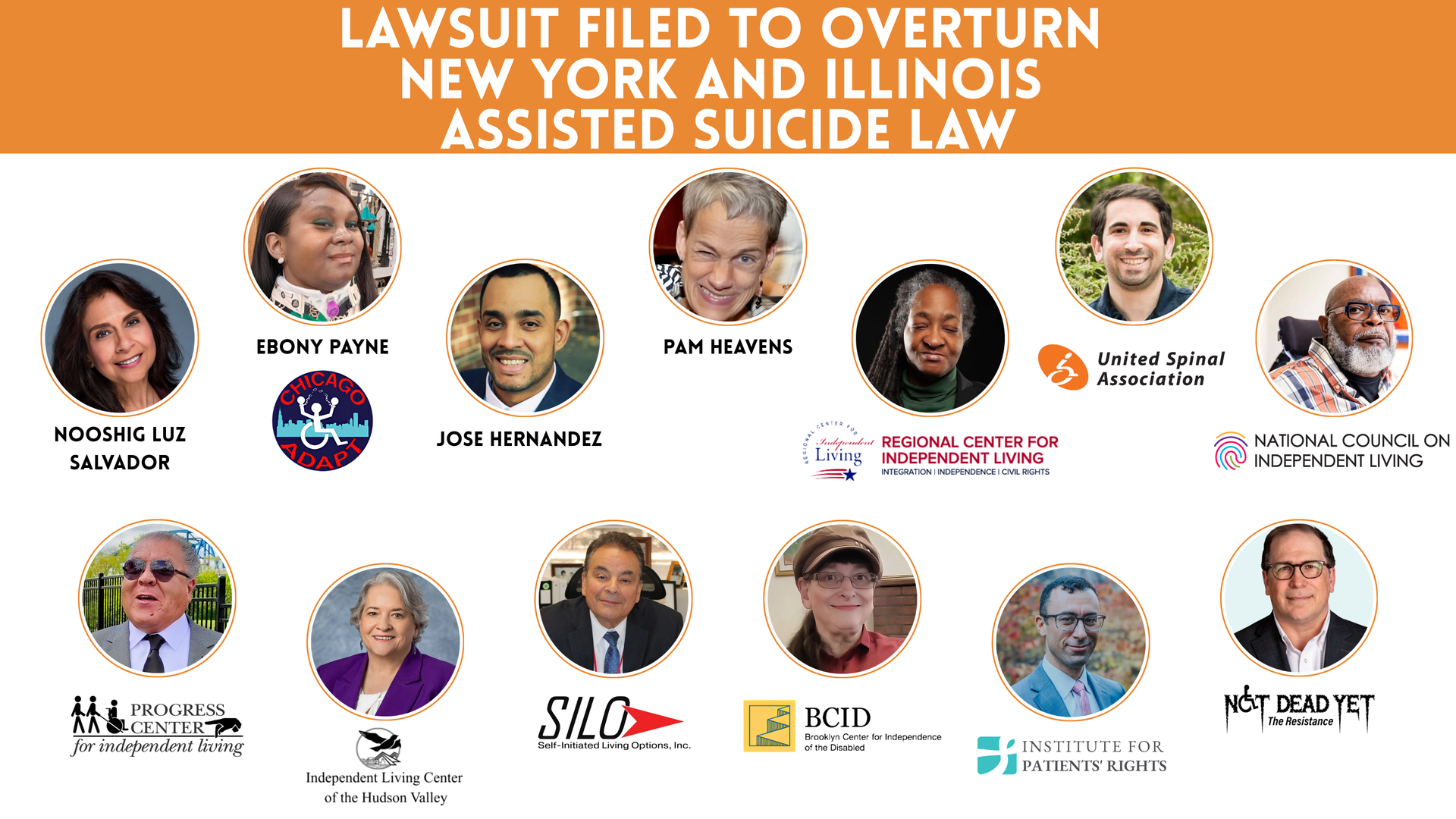
The Institute for Patients' Rights joined two federal lawsuits, one in New York and one in Illinois, with a coalition of national and state-based disability and patient advocacy organizations. For both states, Not Dead Yet, United Spinal Association, and the National Council on Independent Living, are organizational plaintiffs.
For New York, other organizational plaintiffs include: Brooklyn Center for Independence of the Disabled, Independent Living Center of the Hudson Valley, Regional Center for Independent Living, and Self-Initiated Living Options, Inc. Two individuals are named plaintiffs as well, Anita Cameron and Jose Hernandez.
In Illinois, the individual plaintiffs are Ebony Payne, Pam Heavens, and Nooshig Luz Salvador. Joining them are additional organizational plaintiffs: Progress Center for Independent Living, and Chicago ADAPT.
Both lawsuits state assisted suicide law violates core protections under the U.S. Constitution and federal civil rights laws, including the Americans with Disabilities Act (ADA), and Section 504 of the Rehabilitation Act.
The suit argues that the assisted suicide statutes in New York and in Illinois will single out people with disabilities and other vulnerable individuals, placing them at risk of premature death rather than ensuring access to care, support and suicide prevention services.
“Assisted suicide laws in New York and Illinois create a separate and unequal system in which people with life-threatening disabilities are offered death instead of the support programs everyone else gets,” said Matt Vallière, president/executive director of plaintiff organization Institute for Patients' Rights. “These legal actions are about affirming that every person has inestimable value and dignity, regardless of age, disability, or prognosis, and ensuring that no one is treated as disposable under the law.”
José Hernández, an individual plaintiff for New York, a person with disabilities, and a member of plaintiff organization United Spinal Association, spoke about how America once cared about preserving lives and prioritizing treatment to extend life. His mother was diagnosed with Stage IV ovarian cancer when she was 28 years old and he was only eight. Doctors estimated she would live for only six months.
“At the time, assisted suicide was not available, and thankfully so,” Hernández said. “Doctors did everything they could, her insurance paid for life-saving treatment, and my mother survived for 13 years. If she had chosen to end her life, I would have missed out on 13 years of goodnight kisses, home-cooked meals, and the opportunity to be raised by a mother who made me the strong man I am today.”
Representing the Illinois plaintiffs, Ebony Payne said, “I joined the lawsuit because of personal experiences that brought me really close to death and the people who I leaned on to do the right thing became the people to do the opposite. The Illinois law is a trainwreck and is not what you expect from people who are obligated to do no harm.”
These are the 4th and 5th lawsuits in the federal court system. These lawsuits put us one step closer to the Supreme Court and total victory over a eugenic public policy that undermines the inestimable value and dignity of each one of us. Onward and upward!