
|
 |
We need to find other ANGRY DEMOCRATS. Please consider sharing and subscribing to fuel the ANGER for change.
Part 2: How They Closed the Courts
How four United States Supreme Court rulings dismantled voter protections over fifty years.
|

| |||||||||||||||


Before the 1970s, American voters had a reasonable claim on three protections against political capture.
The first was a meaningful limit on how much money any person, corporation, or union could spend influencing an election.
The second was a federal court system willing to intervene when state legislatures drew maps designed to silence voters.
The third was a body of voting rights law that could stop maps designed to dilute the political power of Black voters and other voters of color.
Today, voters have none of these protections in federal court.
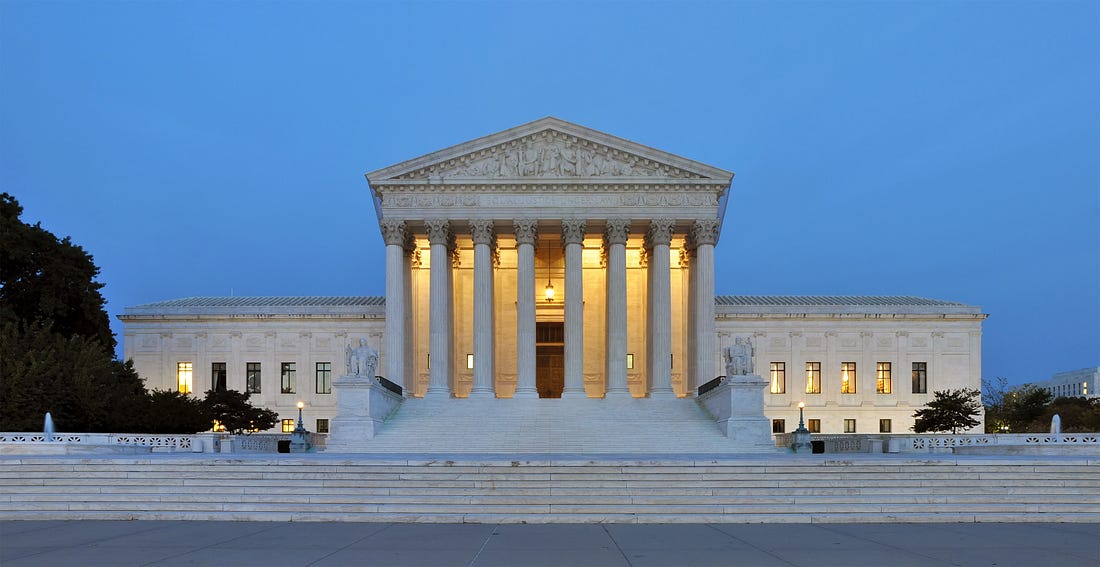
Each was removed by the United States Supreme Court — by specific cases, decided by specific majorities, over warning dissents. The cases span fifty years. Together they form the legal architecture of the rigged map: the doctrinal scaffolding that lets money flow into politics without limit, and lets gerrymandered maps stand without remedy.
 |
The story we told in Part 1 — REDMAP, PA-7, the closed-door drawing of district lines for the 2010s — happened inside this legal architecture. The four rulings are not the prequel to REDMAP. They are its precondition and its protection — though whether each was intended to enable what it later did is a different answer in each case. Buckley in 1976 was decided on a sincere free-speech theory by a cross-ideological coalition. Citizens United in 2010 was decided over a 90-page dissent that warned in detail of the corporate domination that did in fact follow. Rucho and Callais, more recently, were decided over dissents that named the political consequences and were ignored. The legal story and the operational story are one story, told from two angles.
Each ruling came from a Republican-appointed majority. The first was issued by a court Nixon had largely built — four of his appointees sat on the bench that struck down the post-Watergate reforms Congress had passed in response to Nixon’s own campaign-finance abuses. The most recent came from a six-justice conservative majority, the product of a fifty-year Federalist Society project to capture the federal judiciary. The dissenters in every case were Democratic appointees, and they were always outnumbered.
Buckley v. Valeo (1976)
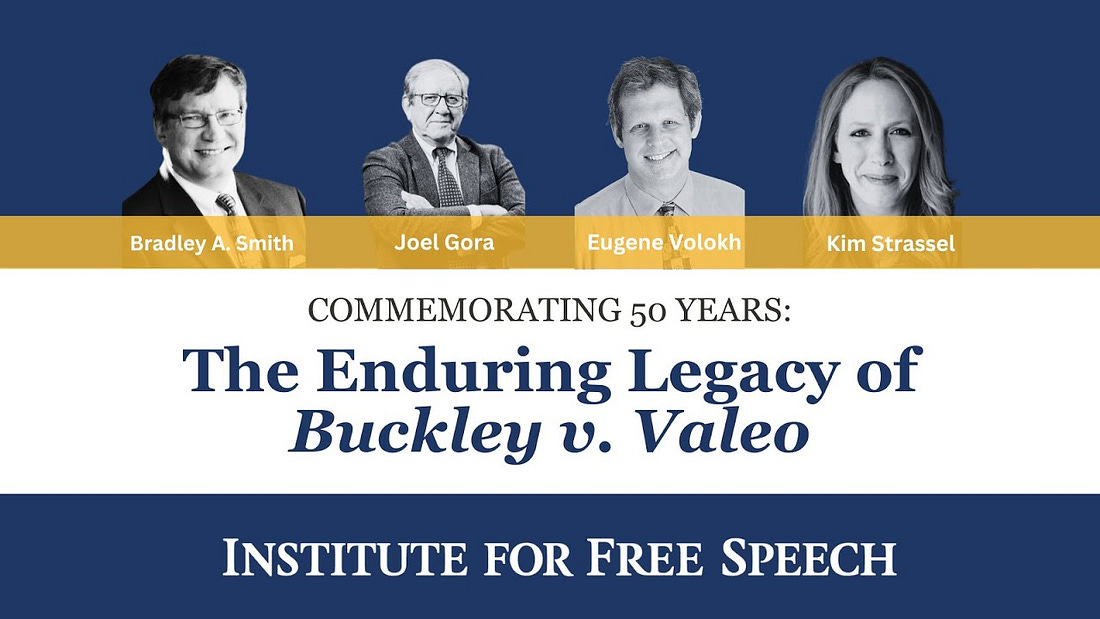
In the years after Watergate, Congress passed the most ambitious campaign finance law in American history. The Federal Election Campaign Act, as amended in 1974, capped what individuals could give to candidates, what candidates could spend on themselves, what outside groups could spend independently, and what campaigns could spend overall. The post-Watergate consensus was that the right to free speech did not include a right to drown out other people’s speech.
In 1976, in Buckley v. Valeo, the Supreme Court ruled that consensus was wrong.
The case was decided per curiam by a six-to-two Republican-appointed bench. The justices upheld FECA’s contribution limits but struck down every other cap — on candidate self-financing, on overall campaign spending, on independent expenditures by outside groups. Spending money to communicate political ideas, the Court ruled, was itself protected First Amendment speech, and speech could not be limited just because some speakers had more of it than others.
The shorthand — “money is speech” — overstates the holding but captures the result. Before Buckley, money in politics was a regulated activity. After Buckley, it was a constitutional right. Every subsequent campaign finance decision rests on this foundation.
Buckley did not arrive as a corporate project. The lead plaintiff was Senator James Buckley, a Conservative from New York, joined by former Senator Eugene McCarthy, the Democrat whose 1968 anti-war insurgency had driven Lyndon Johnson out of the presidential race.
The American Civil Liberties Union was a plaintiff, and its lawyer Joel Gora argued the case. The coalition’s argument was that FECA was an incumbents’ protection act: capping campaign spending froze the playing field in favor of officeholders with built-in name recognition, and outsider candidates needed to raise and spend big money to be heard.
Both Buckley and McCarthy had built insurgent campaigns on large seed-money contributions FECA would have made illegal — and both said they could not have done so under the new law.
The doctrine they argued, political spending is political speech, and cannot be capped was, in 1976, a populist argument. Districts were broadly competitive, outside spending was modest, and capping spending in those conditions did freeze the playing field against insurgent challengers.
That system has since been deliberately dismantled by gerrymandering that took away district competitiveness. Also, by the unlimited outside spending Buckley and its successors made possible. The doctrine designed to liberate outsiders from incumbent protection became, in time, the doctrine that built a different and more durable kind of incumbent protection.
Buckley‘s ACLU lawyers in 1976 imagined a world where Eugene McCarthy could raise seed money from a handful of supporters and challenge a sitting president. The world Buckley helped produce is one where McCarthy could raise that money, but no district would be competitive enough for it to matter, and no primary safe from the PAC money that would arrive to defend the establishment. The terms of the trade have flipped.
Buckley‘s architects did not intend this. Their foresight was limited; the rulings that followed did not share that limitation.
Citizens United v. FEC (2010)
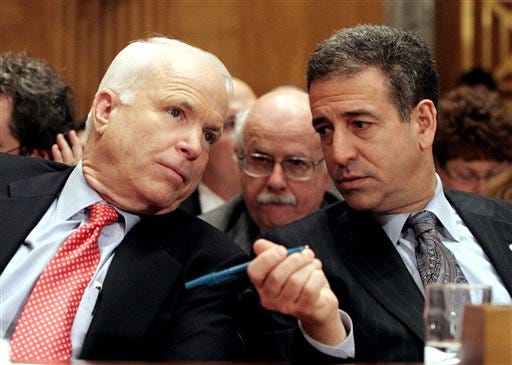
By the early 2000s, billions of dollars in corporate and union treasury funds were available to influence elections, if a legal route opened. The 2002 Bipartisan Campaign Reform Act — McCain-Feingold — barred corporations and unions from using treasury funds for political ads naming a candidate in the weeks before an election. The premise was that a single CEO should not outspend an entire grassroots operation in the final stretch.
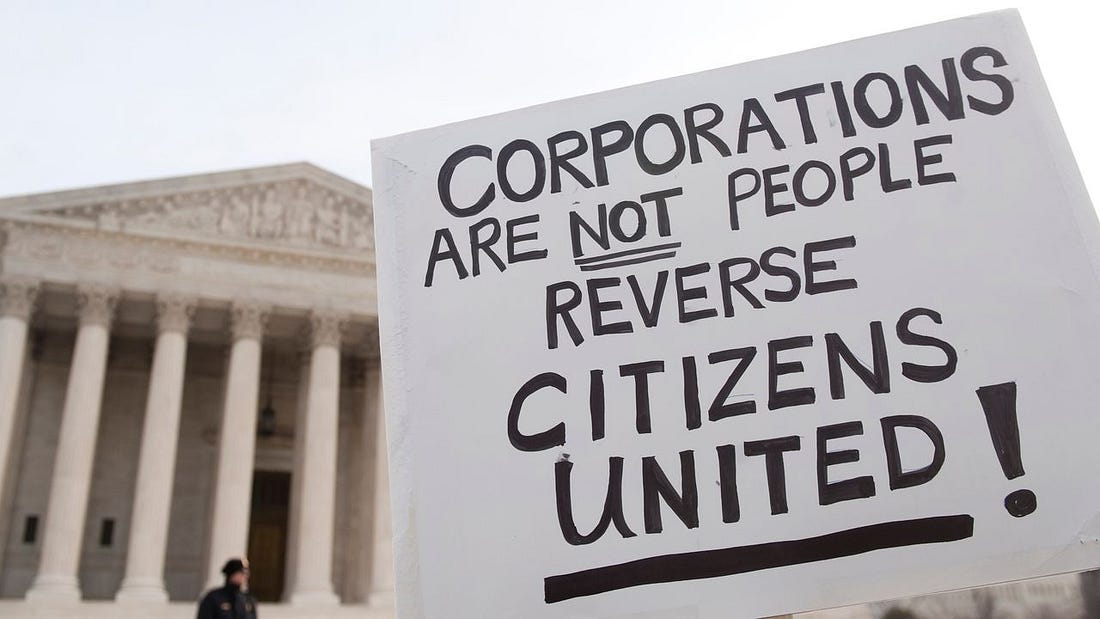 |
In 2010, in Citizens United v. Federal Election Commission, a 5-4 majority struck down the corporate spending restriction entirely.
The plaintiff was a conservative nonprofit that had produced a documentary critical of Hillary Clinton during the 2008 primary; broadcasting the film close to the primary was illegal under McCain-Feingold.
 |
The Court could have ruled narrowly. Instead, Justice Kennedy’s majority opinion declared that the government had no constitutional authority to limit independent political spending by corporations or unions at all. Corporations, the Court ruled, possess First Amendment political-speech rights essentially identical to those of individual citizens.
The final opinion bore Kennedy’s name, but the broader ruling was, by most credible reconstructions of the Court’s internal deliberations, Roberts’s project. He withdrew his own narrower opinion to let Kennedy’s expansive draft become the majority, then orchestrated a reargument that gave the eventual ruling a clean procedural record on broad constitutional questions the parties had not originally briefed.
This was not a ruling that produced unforeseen consequences. Justice Stevens wrote a ninety-page dissent, joined by Ginsburg, Breyer, and Sotomayor, that anticipated in detail the corporate domination of electioneering that did in fact follow. An earlier dissent draft by Justice Souter — circulated within the Court but later withdrawn — accused the majority of having manipulated Court procedures to reach an expansive result on issues neither party had raised. Four justices saw what was coming. Five chose to proceed anyway.
Within months, a federal appeals court ruling — SpeechNow.org v. FEC — extended Citizens United to political action committees, giving birth to the super PAC: unlimited fundraising and spending, conditional on a non-coordination requirement that turned out to be largely theoretical.
The effect was immediate and durable. In 2008, the last cycle before Citizens United, outside groups spent roughly $338 million on federal elections; by 2024, more than $4.5 billion. Most flows through 501(c)(4) “social welfare” organizations that need not disclose donors. Money once raised in capped contributions from named individuals now flows in unlimited sums from sources voters cannot see — to candidates of both parties.
Rucho v. Common Cause (2019)
For decades after Buckley, voters challenging gerrymandered maps had at least a theoretical federal-court path. When a legislature drew lines specifically to entrench one party’s power regardless of how voters voted, the maps violated the Equal Protection Clause and the First Amendment’s guarantee of meaningful political association. Lower federal courts had developed workable standards for distinguishing extreme partisan gerrymanders from ordinary political map-drawing. The Supreme Court had indicated that, with such a standard, federal judges could step in.
In 2019, in Rucho v. Common Cause, the Court ruled that no such standard existed and never would.
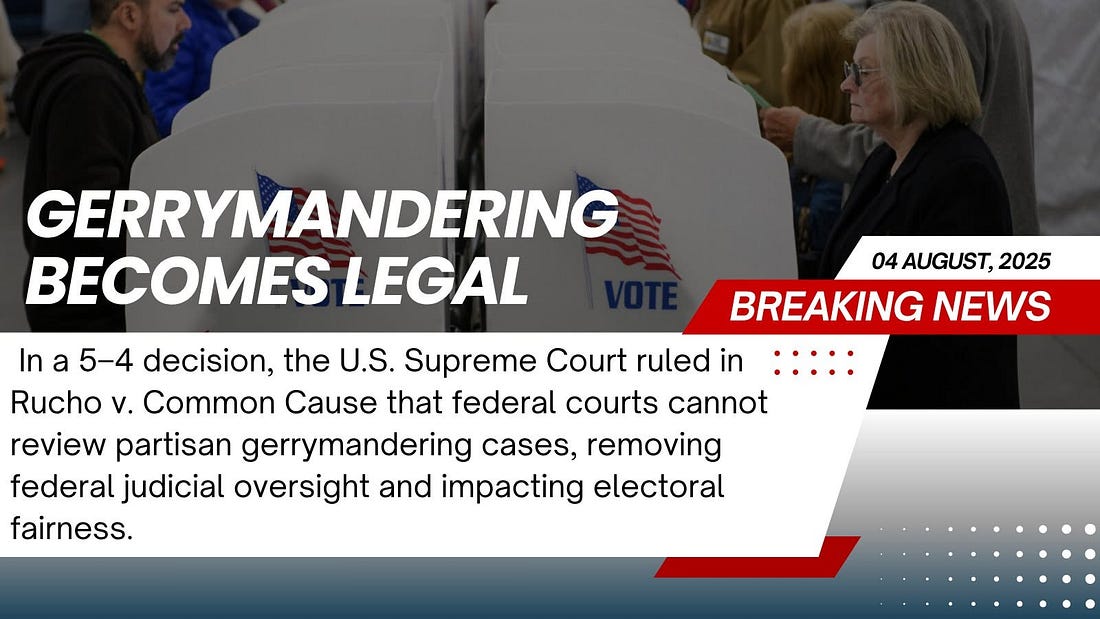 |
The case combined a Republican gerrymander in North Carolina, designed to lock in a 10-3 congressional advantage in a 50-50 state, with a Democratic gerrymander in Maryland, designed to flip a long-held Republican seat. Both parties had gerrymandered; both sets of plaintiffs argued the maps violated the Constitution. Chief Justice Roberts’s 5-4 majority opinion held that partisan gerrymandering claims presented “political questions beyond the reach of the federal courts.”
This was a chosen result, not a forced one. Lower federal courts had been developing the very standards Roberts’s opinion claimed could not exist. Justice Kagan’s dissent named what the majority was doing: “For the first time ever, this Court refuses to remedy a constitutional violation because it thinks the task beyond judicial capabilities.” The “first time ever” is the operative phrase. The Court did not lack the tools. It declined to use them.
Rucho closed the federal courthouse to every voter, in every state, who believed their map had been drawn to silence them. North Carolina’s gerrymander stood. Maryland’s gerrymander stood.
So did Wisconsin’s, where the Republican gerrymander produced a 64-35 GOP supermajority in the State Assembly in a state that votes near 50-50 in statewide races. So did Texas’s.
So did Florida’s. So did Tennessee’s, where the 2022 Republican-drawn congressional map split Nashville across three districts to dilute its Democratic majority, shifting the state’s delegation from 7-2 Republican to 8-1.
So did Ohio’s, where the state Supreme Court struck down the Republican-drawn maps as unconstitutional partisan gerrymanders and was ignored by Republican map drawers who used the rejected maps anyway.
The only path left for voters facing a rigged map was state court under a state constitution, decided by a state supreme court, in one of the small number of states where that path even exists.
It was the path Pennsylvania took, in 2018, to undo the PA-7 gerrymander we traced in Part 1.
The Rigged Map --Part 1: How They Drew the Map | ||||||
| ||||||
 | ||||||
Before 2011, Pennsylvania’s 7th congressional district was a place where elections actually mattered. The district covered most of Delaware County, the Philadelphia suburbs west and south of the city. From the mid-1970s through the late 1980s it elected a Democrat; from then through the mid-2000s, a Republican, Curt Weldon. In 2006, Navy vice admiral Jo… | ||||||
|
Louisiana v. Callais (2026)
For sixty years, voters of color had one tool federal courts could not refuse: Section 2 of the Voting Rights Act of 1965. Where state legislatures drew maps that diluted the political power of Black, Latino, or Asian American voters — packing them into one district to waste their votes, or splitting them across many to neutralize them — Section 2 let those voters sue in federal court. The provision had been used successfully in Alabama, Louisiana, Georgia, Mississippi, Texas, and dozens of other states. As recently as 2023, the Roberts Court had reaffirmed Section 2 in Allen v. Milligan, ruling for Black voters in Alabama.
Three years later, on April 29, 2026, in Louisiana v. Callais, the Court reversed course.
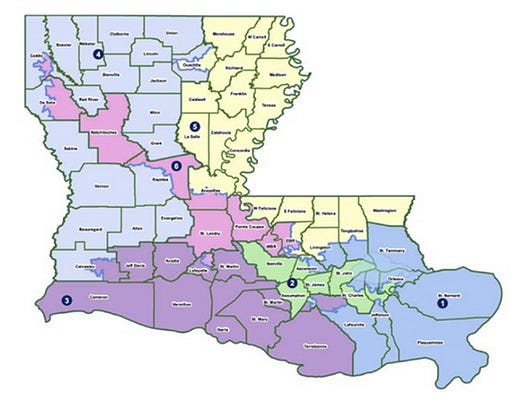
The case was about a Louisiana congressional map that contained a second majority-Black district, drawn under a prior federal court order. A group of “non-Black voters” challenged the map, arguing the Black-opportunity district itself constituted unconstitutional racial discrimination. Justice Alito’s 6-3 majority opinion agreed and narrowed Section 2 so dramatically that Justice Kagan, in dissent, wrote that the provision was now “all but a dead letter.”
The Court did not formally overturn Section 2. It made it functionally unenforceable through three doctrinal changes: plaintiffs must submit sample maps meeting all of a state’s political objectives, must disentangle racial bloc voting from ordinary partisan preference, and must prove “present-day intentional racial discrimination” — with historical patterns entitled to “much less weight.” Each requirement is plausible alone. Together, they raise the bar so high that most cases that succeeded under Section 2 over forty years would now fail.
Of the four rulings, Callais is the one whose consequences were not just foreseen but procedurally facilitated. The Court finalized its judgment in five days instead of the standard thirty-two, allowing states to redraw maps before the 2026 elections. Louisiana suspended its May 16 primary mid-election. Alabama filed an emergency motion the day after the ruling, asking the Court to reinstate the very maps it had struck down three years earlier. Analysts have estimated that up to a quarter of the Congressional Black Caucus could lose their seats to map redrawing in years ahead. The reversal of Allen v. Milligan after only three years, the doctrinal changes designed to make Section 2 unenforceable, and the compressed schedule — none of these was accidental.
What’s Left
Fifty years after Buckley, the legal protections American voters once had against political capture have been systematically removed. Money in politics cannot be capped. Partisan gerrymandering cannot be challenged in federal court. Racial vote dilution can no longer be effectively challenged either.
The doctrine Senator Buckley and his coalition argued for in 1976 — that free political spending would liberate outsider voices against entrenched incumbent power — has produced its inversion. Outside spending is free, but the voices it amplifies belong overwhelmingly to interests far better resourced than any insurgent candidate. The conditions that made Buckley‘s argument plausible have been destroyed by the legal architecture the doctrine made possible. The 1976 trade was sincere. It was not what it appeared to be. After 1976, the warnings became more specific; by 2026, dissents described the consequences in operational detail. The majorities proceeded anyway.
What remains is the state court path Pennsylvania used to undo PA-7: a state constitution, a willing state supreme court, and a political coalition capable of building and sustaining that court’s majority. That path exists in roughly a dozen states. It is itself under sustained, well-funded attack — by the same actors who built the strategy that produced PA-7 in the first place.
In Part 3, we follow where the money has gone, and what it has bought.
Stay Angry
Sources — The Rigged Map: Part 2
Buckley v. Valeo, 424 U.S. 1 (1976). Per curiam decision of the U.S. Supreme Court.
Joel Gora, “Celebrating Buckley v. Valeo: A Landmark of Political Freedom,” Institute for Free Speech, January 2026. Retrospective by the ACLU lawyer who argued Buckley.
Brooklyn Law School. “Professor Joel Gora Looks Back at His Role in Supreme Court Case Buckley v. Valeo 50 Years Later.” January 30, 2026.
Citizens United v. Federal Election Commission, 558 U.S. 310 (2010). Majority opinion by Justice Anthony Kennedy; dissent by Justice John Paul Stevens, joined by Justices Ginsburg, Breyer, and Sotomayor.
SpeechNow.org v. Federal Election Commission, 599 F.3d 686 (D.C. Cir. 2010).
Rucho v. Common Cause, 588 U.S. 684 (2019). Majority opinion by Chief Justice John Roberts; dissent by Justice Elena Kagan, joined by Justices Ginsburg, Breyer, and Sotomayor.
Louisiana v. Callais, 608 U.S. ___ (2026), No. 24-109. Majority opinion by Justice Samuel Alito; dissent by Justice Elena Kagan, joined by Justices Sotomayor and Jackson. Decided April 29, 2026.
Allen v. Milligan, 599 U.S. 1 (2023).
Federal Election Campaign Act of 1971, as amended 1974, Public Law 92-225; 88 Stat. 1263.
Bipartisan Campaign Reform Act of 2002 (McCain-Feingold), Public Law 107-155.
Voting Rights Act of 1965, 52 U.S.C. § 10301 et seq.
Constitutional Accountability Center. “The Highlight Reel from Justice Stevens’ Citizens United Dissent.”
Jeffrey Toobin, “Money Unlimited: How Chief Justice John Roberts orchestrated the Citizens United decision,” The New Yorker, May 21, 2012.
Wisconsin Examiner. “Republican Assembly lawmakers fighting to keep their seats as Democrats test new maps.” October 2024.
Tennessee Lookout. “Federal court upholds Tennessee’s U.S. House map, rules it’s gerrymandered but not racially.” August 2024.
Brennan Center for Justice. Redistricting Litigation Roundup. On the Ohio Supreme Court striking down Republican maps and the Republican Redistricting Commission’s refusal to comply.
OpenSecrets. Outside spending totals by election cycle, 2008–2024.
SCOTUSblog. Coverage of Louisiana v. Callais, April–May 2026.
Brennan Center for Justice. “Louisiana v. Callais.” Case page and analysis.
NAACP Legal Defense Fund. Statement on Louisiana v. Callais decision, April 29, 2026.
Campaign Legal Center. “The U.S. Supreme Court Has Eviscerated the Voting Rights Act — What’s Next?” May 2026.
ABC News. “5 things to know about the Supreme Court’s landmark decision on the Voting Rights Act.” April 30, 2026.
Center for American Progress. “The Supreme Court’s Callais Decisions Undermine the Voting Rights Act and Sow Election Chaos.” May 2026.
Join other ANGRY DEMOCRATS by support Matt’s work. Subscribe and Share!
| ||||||||||


