Dear Reader,
In 182 days, the world as we know it could change, forever.
Why do I say that?
Because AI will be twice as powerful as it is right now.
As we speak… it’s doubling in strength every 6 months.
And the implications for investors are staggering.
I’ve spent 41 years watching for exactly this kind of moment.
You don’t want to wait until this window closes. But whatever you do, don’t buy or hold the leading “AI Stocks.”
Click here to watch my short presentation – before it’s too late.
Good Investing,
Alexander Green
Chief Investment Strategist, The Oxford Club
MongoDB Is the Latest SaaS Apocalypse Victim to Say "Not Today"
By Sam Quirke. Article Published: 6/3/2026.

Key Points
- MongoDB shares are surging after last week’s blowout earnings report, adding to a recovery that has already seen the stock climb nearly 40% from pre-earnings levels.
- The results were stellar across the board, with all key metrics coming in well ahead of expectations, silencing fears that AI would undermine its growth.
- A wave of analyst price target increases has since followed, with some calling for as much as 20% in additional upside from current levels.
- Special Report: Elon Musk: This Could Turn $100 into $100,000
A pattern is emerging in the software sector right now, and MongoDB Inc (NASDAQ: MDB) is the latest company to fit it. A stock gets crushed on fears that AI will disrupt its business model. The selloff goes further than anyone expected. Then the company reports earnings, the numbers don't just hold up but accelerate, and the market scrambles to reprice. Snowflake (NYSE: SNOW) did it. ServiceNow (NYSE: NOW) did it. HubSpot (NYSE: HUBS) looks like it’s starting to do it.
Now MongoDB, which had shed more than 40% from the start of January through April, is doing it too, with shares surging after last week’s earnings report left little room for the bears to argue. The stock’s recovery was already beginning to take shape before the update, but the report itself was the confirmation bulls had been waiting for.
Don't download this book (Ad)
Bill Poulos is giving away his 'Simple Options Trading For Beginners' book at no cost - normally $29.97. It outlines the approach he developed after losing a small fortune on complex strategies.
The book covers a straightforward technique that he says consistently outperforms complicated methods, including how to evaluate any trade in under 10 minutes.
Download your free copy before it returns to $29.97For those on the sidelines, that opens up a compelling recovery play in a company the market had treated like a SaaSpocalypse casualty, but that has now delivered one of the more impressive beats in the software sector this reporting season. Wall Street has wasted no time responding—let's jump in and see just how good this opportunity could be.
The Selloff Was Getting Harder to Justify
The main bear case against MongoDB centered on a thesis that will have been familiar to investors in many software stocks over the past year. The rise of artificial intelligence (AI), the argument went, would reduce demand for traditional platforms by enabling developers to build faster and with fewer resources, effectively undercutting central pillars of MongoDB’s and its peers' go-to-market strategies. The stock's brutal decline from last December’s peak is proof that the market took that argument very seriously.
However, what’s made the selloff increasingly hard to defend in recent weeks is the growing disconnect between that fear and the company’s actual business trajectory. As last week’s report showed, MongoDB hasn’t been losing customers, and demand hasn’t crumbled.
In other words, it’s looking more and more like the market priced in deterioration that the fundamentals never really delivered, which is precisely why the post-earnings reaction has been so sharp.
The Earnings Report Changed the Conversation
In terms of the key metrics, MongoDB’s Q1 earnings per share and revenue both came in ahead of expectations, while full-year guidance was raised well above what the Street had been modeling. Coming after a multi-month selloff, this is the kind of guidance update that gets investors particularly excited.
Atlas, the cloud-hosted version of MongoDB's database that now accounts for the large majority of subscription revenue, grew strongly year over year and also saw its guidance range lifted. The forward pipeline metric, which captures contracted future revenue over the next 12 months, surged dramatically, pointing to a business with robust demand visibility that the pre-earnings share price was not reflecting.
All told, it was a stellar report across the board. Considering the bears had already been under pressure to keep the stock down in the week beforehand, it’s no surprise that MongoDB’s shares have surged in the sessions since the results came out.
The AI Angle Is a Tailwind, Not a Headwind
In the context of the wider shift we’re now seeing in the software space, arguably the most important narrative embedded in these results is the reframing of AI from threat to opportunity. Wedbush's Dan Ives, a long-term MongoDB bull, described MongoDB as the “essential database for AI,” citing a surge in customers using the platform to modernize legacy applications and scale AI workloads.
That framing is powerful because it largely negates the bear case. The technology that was supposed to replace MongoDB is actually turning into a meaningful driver of demand for it.
Legacy modernization is a particularly important angle here. As enterprises race to build AI-ready infrastructure, they need databases capable of handling the unstructured, high-volume data generated by modern AI workloads. MongoDB's document-based architecture is well suited to that requirement in ways older relational databases are not, and the results suggest that enterprises are beginning to act on that recognition at scale.
The Analyst Response Tells Its Own Story
It can’t quite be argued that those getting involved in MongoDB at current levels are getting in on the ground floor of the recovery, but it’s still not a bad entry point. Consider for a moment that the likes of Wedbush, Mizuho, Oppenheimer, and Guggenheim, to name just a few, all reiterated Buy or equivalent ratings in the immediate aftermath of last week’s report and set fresh price targets ranging up to $475.
Yes, it would have been ideal to have built a position in MongoDB when it was still trading below $250 at the start of May, but from current levels, that still suggests roughly 20% in upside to consider. Even so, with how quickly investor sentiment is shifting on software stocks, don't expect that opportunity to last too long.
The Market May Be Missing What’s Changing at BigBear AI
By Thomas Hughes. Article Published: 6/8/2026.
Key Points
- BigBear AI's stock price chart is bullish, showing a strong Head & Shoulders Reversal.
- Coverage and institutional interest remain light but will likely pick up as the year progresses.
- The company inflected in early 2026, and upcoming results will confirm it.
- Special Report: Elon Musk: This Could Turn $100 into $100,000
BigBear AI’s (NYSE: BBAI) price action suggests the bear market is not only over, but that a full reversal may be underway. The stock appears to have hit bottom earlier this year and completed a Head & Shoulders reversal pattern.
The company’s turnaround has it on track to grow and achieve profitability in the foreseeable future. As it stands, the pattern suggests this move is, at worst, only halfway complete, with a run toward $6 ahead.
NOT buy any SpaceX IPO shares until you read THIS (Ad)
SpaceX has confidentially filed for an IPO with the SEC, targeting a June 2026 listing at a valuation exceeding $1.75 trillion - potentially the largest IPO in history.
But one expert says buying shares directly may not be the smartest move. There is a lesser-known way to tap into this windfall that most investors haven't considered.
Discover the overlooked SpaceX IPO strategy before the June listing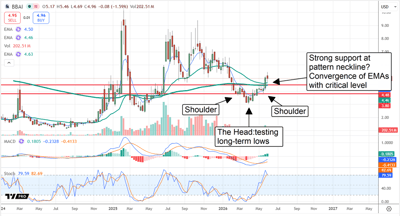
Dilution is the biggest risk, but it isn’t an immediate threat, and several catalysts are in play. Last year’s activity increased the share count by nearly 90%, which contributed to a steep decline in the stock price, but it also eliminated debt, improved capitalization, and supported restructuring and acquisitions that better position the company. As of mid-2026, the business is gaining traction in key markets, is on track to accelerate growth in the coming quarters, and has a modest capital runway. The question is whether it can ramp revenue and improve margins enough to sustain capitalization and reach true profitability without another capital raise.
Big Catalyst for BigBear
Upcoming catalysts include monetizing Ask Sage, converting its backlog into revenue, receiving a major technology affirmation, and meeting full-year guidance. Ask Sage is central to the outlook, supporting not only the revenue forecast but also margins. The acquisition is already driving better margins; the opportunity now is to sustain that improvement and drive additional growth through new clients, deeper penetration, and cross-selling.
The potential is substantial, as Ask Sage provides secure access to more than 150 AI models, including major platforms like ChatGPT, and carries high-level government clearances. FedRAMP High and Department of Defense Impact Level 5/6 classification allow the handling of classified and sensitive material, which is in demand. The company already supports more than 16,000 users across thousands of government and enterprise teams.
The backlog provides investors with some visibility. The Q1 2026 earnings release reported a 14% increase in backlog, bringing it to a record level. At approximately $290 million, it is nearly double the annual revenue forecast and is expected to continue growing. Not only are new contracts likely, but existing agreements, such as the one with the Air Force, also create potential for follow-on business.
BigBear’s transition from a government pure-play to a more diversified business is another theme central to the stock’s outlook. The company wants to expand its client base to include private enterprises in order to support growth and reduce the lumpiness of government contract revenue. Its move into Panama, in partnership with Panama Transshipment Group, puts it squarely in the sights of global operators. The opportunity here is for BigBear to expand to other operators, further embedding itself in global logistics and security workflows.
Achieving its guidance would mark an inflection point for the company. BigBear’s target range has a midpoint of $150 million, representing a double-digit year-over-year increase and more than 10% above the consensus analyst forecast. The risk is that revenue growth could come in slower than expected, leaving the market vulnerable to short selling and other bearish forces.
Market in Wait-and-See Mode—Big Gains or Big Drops Are Coming
The sell-side data, including short interest, institutional activity, and analyst coverage, suggests this market isn’t out of the woods—not by a long shot. While short interest remains high at above 25%, institutional holdings are still low, near 7.5%, and analyst coverage is, at best, lukewarm. The opportunity is that upcoming releases could trigger short-covering and accumulation, but there isn’t much sign of that yet.
Analyst coverage is mixed: the stock is rated Hold, but only three analysts cover it, leaving limited data to work with. The best that can be said for this and other sell-side activity is that the market is waiting to see what happens, with higher stock prices possible but still highly questionable. In this scenario, the stock may remain range-bound near current levels until additional catalysts emerge, which may not materialize until later in the summer with the Q2 earnings release. Signs of strength will show up in the stock price and may even trigger additional coverage.
What the market gets wrong about BigBear AI is that it is not a pure-play SaaS company, but rather a defense contractor in the midst of a significant shift. While revenue growth has been tepid, the company has been replacing lower-quality revenue streams with higher-quality opportunities while also expanding into heavily regulated commercial markets. Comparisons to Palantir (NASDAQ: PLTR) are misleading, as BigBear provides critical infrastructure to logistics and border-control markets and won’t see the same explosive upfront growth. Contracts of this nature take time. Additionally, most of the company’s losses are tied to non-cash adjustments; profitability is closer than it appears.
This email is a paid advertisement from The Oxford Club, a third-party advertiser of The Early Bird and MarketBeat.
This ad is sent on behalf of The Oxford Club. 105 W Monument St, Baltimore, Maryland 21201. If you would like to optout from receiving offers from The Oxford Club please click here.
If you have questions about your account, don't hesitate to email MarketBeat's U.S. based support team at [email protected].
If you no longer wish to receive email from The Early Bird, you can unsubscribe.
© 2006-2026 MarketBeat Media, LLC. All rights reserved.
345 N Reid Place, Suite 620, Sioux Falls, South Dakota 57103-7078. United States..