| Written by Jeffrey Neal Johnson 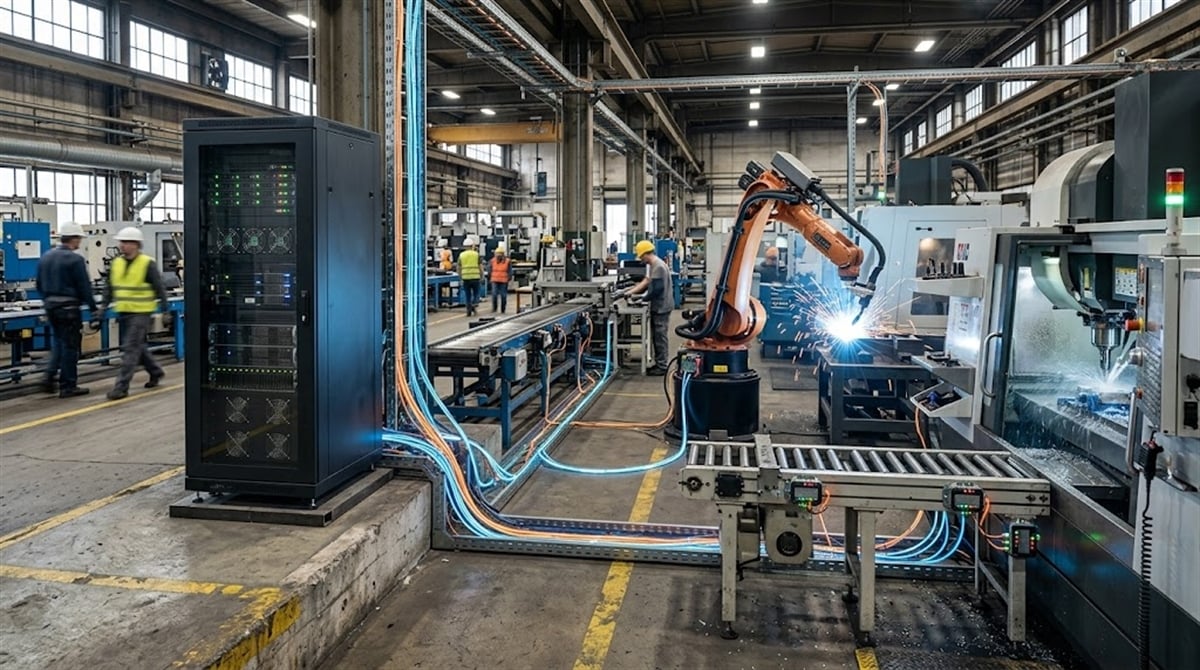
Hewlett Packard Enterprise's (NYSE: HPE) blowout Q2 earnings and accelerated long-term targets expose a severe valuation mismatch in the artificial intelligence (AI) hardware sector as enterprise adoption broadens beyond hyperscalers.
With agentic AI workloads rapidly migrating to the network edge, legacy OEMs are capturing hyper-growth market share previously assumed to belong solely to pure-play pioneers.
This structural pivot signals a new phase in the AI infrastructure build-out, validating a lower-multiple catch-up trade while forcing established high-growth incumbents to aggressively pivot their product stacks to defend their dominance.
The market is beginning to price in a new reality in which the AI build-out is no longer just a cloud-based story, creating distinct opportunities for both established and emerging leaders.
From Value Trap to AI TitanThe market has aggressively discounted traditional OEMs in the AI race, an assumption directly challenged by Hewlett Packard Enterprise's latest results.
The technology giant's Q2 2026 earnings report served as a powerful catalyst, sending the stock to all-time highs amid extreme demand for AI servers. Revenue rose 40% year-over-year to $10.7 billion, beating the $9.79 billion consensus estimate. The Cloud and AI segment spearheaded this outperformance, with revenues climbing 22.9% to $7.7 billion.
The more telling metric, however, was the forward-looking order book. Hewlett Packard Enterprise booked $1.8 billion in new AI system orders, bringing cumulative AI systems bookings to $16.4 billion and ballooning its total AI backlog to a record $5.9 billion. This is not simply deferred revenue; it is a clear indicator that enterprise-level AI adoption is accelerating.
President and CEO Antonio Neri reinforced this view, citing zero order cancellations and a significant pull-forward of long-term financial targets. Hewlett Packard Enterprise raised its fiscal 2026 revenue growth guidance to a range of 29% to 33% and boosted its free cash flow forecast by 75% to a minimum of $3.5 billion.
This operational excellence is directly translating into shareholder returns and is a fundamental underpinning for the stock's re-rating. The surge in cash flow from operations, which hit $1.4 billion for the quarter, provides robust support for Hewlett Packard Enterprise's $0.1425 quarterly dividend.
For institutional investors, this combination of hyper-growth and a stable yield is a compelling proposition. The acquisition of Juniper Networks was a critical strategic move.
Enterprise AI is not just about compute; it requires a sophisticated, high-speed networking fabric to connect GPU clusters.
The Juniper integration positions Hewlett Packard Enterprise to offer a complete, end-to-end solution, a significant competitive advantage when dealing with large corporate clients that demand integrated architecture and support.
At a forward price-to-earnings multiple of just 15.6x, Hewlett Packard Enterprise presents a clear valuation disconnect compared to its peers, offering an asymmetric risk-reward profile for investors betting on the broadening of AI infrastructure.
Supermicro's Counter-Offensive: Defending the Moat at the Edge
While the ascent of Hewlett Packard Enterprise captures the market's attention, it would be a mistake to discount the architect of the initial AI server boom, Super Micro Computer (NASDAQ: SMCI). Supermicro remains a dominant force, but the competitive landscape is shifting.
The hardware innovator faces headwinds from both component cost pressures and a customer base increasingly evaluating next-generation platforms, which are delaying purchasing cycles. The encroachment from legacy OEMs like Hewlett Packard Enterprise puts direct pressure on Supermicro to innovate and defend its market leadership.
In response, Supermicro is executing a strategic pivot from a hyperscale hardware assembler to a full-stack infrastructure provider with a sharp focus on the network edge. This is a direct counter-offensive to capture the next wave of AI deployments in space-constrained enterprise environments such as retail, manufacturing, and logistics.
Supermicro recently launched new server lines powered by AMD EPYC 4005 processors, specifically designed for compact inferencing systems. The hardware specialist is also rolling out its self-contained Super AI Station, a liquid-cooled, all-in-one solution designed for departmental or edge deployments without traditional data center infrastructure.
The market is increasingly acknowledging this strategic recalibration. In a move that appeared slightly behind the curve, Mizuho elevated its price target for Supermicro to $44, a figure already eclipsed by Supermicro's rapid stock price appreciation in the following sessions.
Short-term volatility is likely as analysts scramble to recalibrate their financial models to reflect these emerging sector dynamics; nevertheless, institutional participation remains elevated, indicating that sophisticated capital remains focused on Supermicro's structural evolution.
While Supermicro may cede some market share in large, generalized enterprise deals to players like Hewlett Packard Enterprise, its deep engineering expertise and speed to market with cutting-edge technology give it a strong advantage in specialized, high-performance, and edge-optimized systems.
The challenge for Supermicro is to maintain its growth trajectory while navigating potential margin compression as it competes more directly with diversified, high-margin OEMs.
A Tale of Value Vs. VelocityThe divergence between Hewlett Packard Enterprise and Supermicro highlights the maturation of the AI market. The first phase was a land grab for GPU capacity, dominated by hyperscalers and a few specialized hardware providers.
This new phase is about enterprise and edge deployment, where factors like integrated networking, global support, security, and total cost of ownership become paramount. This shift plays directly to the strengths of established players like Hewlett Packard Enterprise, which have spent decades building relationships and infrastructure to serve the Fortune 500.
The expanding total addressable market at the network edge suggests this is not a zero-sum game. Both challengers appear poised to benefit from durable, long-term tailwinds.
The key difference for investors lies in their valuation and risk profiles. Hewlett Packard Enterprise offers a value-oriented catch-up trade, backed by a solid dividend and accelerating free cash flow, as the market re-prices it from a legacy hardware name to an AI infrastructure leader. Supermicro offers continued exposure to hyper-growth but carries execution risk as it fends off new competition while successfully penetrating the edge market.
Investors looking to capitalize on this structural shift in the AI hardware market might consider the distinct theses for each name. Those prioritizing a margin of safety and income generation may find the fundamental momentum and valuation of Hewlett Packard Enterprise compelling. Growth-focused investors, on the other hand, could monitor Supermicro's traction with its new edge computing platforms as a key indicator of its ability to sustain its leadership position in a more competitive environment.
 Read This Story Online Read This Story Online |