Editor’s Note: Former tech executive and angel investor Jeff Brown — picked Bitcoin before it jumped as high as 52,400%, Tesla before it jumped as high as 2,150%, and Nvidia before it jumped as high as 32,000%. Today, he’ll show you how to claim a stake in Elon Musk’s upcoming IPO — BEFORE the company goes public on June 12. Click here to see the details or read more below.
Dear Reader,
I’ll get straight to the point because there’s not much time left…
The SpaceX IPO is scheduled for June 12…
And Elon Musk is predicting anyone who gets in today will have a chance to turn…
$100 into $100,000…
$500 into $500,000…
And $1,000 into $1 million!
But you cannot wait until after the IPO.
Click here and I’ll show you how to claim your stake and get ahead of the masses.
After the IPO, it will be too late…
And you’ll likely never see an opportunity like this again.
This IPO will only happen one time.
That means this is your only shot. Click here now.
We have so much to look forward to,
Jeff Brown
Founder & CEO, Brownstone Research
Meta Platforms 10% Layoff Raises a Bigger Question About AI Spending
Written by Leo Miller. Article Posted: 5/21/2026.

Key Points
- Meta Platforms stock has seen large swings in 2026, being up as much as 12% and down as much as 20%
- Through recently announced layoffs, the company is looking to soothe fears around its elevated spending
- However, shares are not seeing an uptick on this news—here's why
- Special Report: Elon’s “Hidden” Company
Shares of Meta Platforms (NASDAQ: META) have experienced a notable degree of volatility in 2026. The stock started the year strong, rising about 12% by the end of January. Its impressive Q4 2025 earnings report fueled an over 10% single-day gain.
However, a convergence of pressures then hit the stock. These included fears over artificial intelligence (AI) spending, legal losses, and the U.S.-Iran conflict, which weighed on the market as a whole. By the end of March, Meta was down 20% for the year.
4 Simple Steps to Protect Your Bank Account (Ad)
In a few short months, the US government could gain unprecedented powers over personal bank accounts - including the ability to track every transaction or freeze funds.
Martin D. Weiss, PhD, founder of Weiss Ratings, has identified 4 simple steps Americans can take today to help safeguard their savings before any changes take effect.
Discover all 4 steps to help protect your bank account nowThe stock has recovered considerably since then and is now down less than 10% in 2026. Meta’s returns have hovered near this level since the end of April, after shares took an 8.6% hit following its Q1 2026 earnings report.
Meta is taking steps to counter the biggest headwind to its performance: rising AI capital expenditure (CapEx) forecasts. The company is undertaking some of its largest layoffs in recent memory, aimed at offsetting AI investment. However, markets don’t appear to be buying the story.
Meta Initiates 10% Layoff—But for Much Different Reasons Than in the Past
In mid-May, reports emerged that Meta is laying off 8,000 employees. These job reductions account for approximately 10% of Meta’s total workforce.
The move marks the company’s most significant workforce shake-up since its “Year of Efficiency,” which took place between 2022 and 2023. That initiative cut 21,000 jobs.
However, there are significant differences between these recent cuts and the Year of Efficiency reductions.
Somewhat counterintuitively, Meta undertook one of its most aggressive hiring sprees ever from 2020 to 2022, during the height of the COVID pandemic.
By the end of 2022, Meta’s employee count had nearly doubled from the end of 2019, rising from around 45,000 to more than 86,000. This came as COVID lockdowns pushed people to spend much more time online and increased e-commerce activity. As a result, Meta’s sales growth surged 37% year over year (YOY) in 2021.
The company added employees, believing this marked the beginning of a long-term tailwind for its business. However, as Meta admitted, that proved not to be the case, with sales falling 1% YOY in 2022. In 2023, Meta reduced its employee count by 22% to around 67,000 in response.
Meta’s past cuts were a response to weaker-than-expected demand. That is not the case today.
Meta just posted its highest revenue growth in years, up 33% YOY. Demand is clearly strong, but it is being met with greater investment in technology rather than in headcount. In this sense, the move is much less a sign of weakness than the mass layoffs of the past.
Layoffs Are Unlikely to Win Over Investors' Hearts
Still, Meta shares haven’t really moved since the recent layoffs began. This suggests investors likely don’t believe the cuts will have a major impact on its financials.
Notably, analysts at Morgan Stanley have estimated that a 20% workforce reduction would generate annual savings of between $3 billion and $7 billion. At 10%, it is fair to say that figure would fall to roughly $1.5 billion to $3.5 billion.
Meta will also likely incur a significant charge to cover severance packages. When it cut 10,000 employees in March 2023, its expected pre-tax severance charge and other personnel costs were $1 billion, which works out to $100,000 per employee. Holding that per-employee metric steady, the company may incur around $800 million in charges from the latest layoff, reducing the near-term benefit.
Overall, Meta’s savings would amount to a drop in the bucket compared with the midpoint of its 2026 CapEx guidance of $135 billion. Furthermore, it's unclear whether Meta will simply direct whatever it saves from layoffs toward more AI investment, or whether its CapEx guide will remain unchanged.
Either way, compared with its massive CapEx spending, the potential benefit of the layoffs is not much of a needle mover. That is likely one reason shares have not benefited. Additionally, CEO Mark Zuckerberg told employees that he “does not expect more company-wide layoffs this year."
This pushes back on earlier reports that the company would lay off 20% of its workforce in 2026. Investors may have viewed the smaller-than-expected cuts as a disappointment.
Growth Is the Key to Meta’s AI Journey
In aggregate, this data shows that Meta will not be able to justify its AI spending through layoffs alone. Rather, the company will need to grow revenue, and eventually free cash flow, to do so.
In this context, the fact that Meta is also reassigning 7,000 employees to AI-related roles may be more impactful than the layoffs themselves. After the cuts, Meta’s employee count will fall to around 71,000. That means the company will reallocate roughly 10% of its remaining workforce to AI-related roles. This increased focus on AI could help the firm better utilize its investments and drive growth.
Shake Shack Insiders Buy as SHAK Stock Faces More Pressure
Written by Thomas Hughes. Article Posted: 5/27/2026.

Key Points
- Shake Shack insiders are buying stock in a show of confidence that may have come too early.
- The stock price is set up to move lower and can fall below $40 this year.
- Valuation, missed growth targets, and rising beef prices are headwinds hard to overcome.
- Special Report: Elon’s “Hidden” Company
Shake Shack (NYSE: SHAK) insiders bought stock in May, signaling confidence in the company’s long-term outlook. Those insiders included several directors and the CEO who, along with other notable insiders, own more than 8.5% of the shares. They are buying amid a stock price meltdown that may not be over.
The main culprit behind the sell-off is rising beef prices and their impact on margins, and that headwind is far from fading. Beef costs are already at record levels and are forecast to rise another 5% to 10% over the next year. They may remain elevated well into 2028. Herd size and demand, fueled by the global protein craze, are the root causes, and the herd is not expected to show meaningful recovery until late 2027. Who knows how long the protein craze will last?
Shake Shack Misses Estimates in Q1: 2026 Targets in Question
4 Simple Steps to Protect Your Bank Account (Ad)
In a few short months, the US government could gain unprecedented powers over personal bank accounts - including the ability to track every transaction or freeze funds.
Martin D. Weiss, PhD, founder of Weiss Ratings, has identified 4 simple steps Americans can take today to help safeguard their savings before any changes take effect.
Discover all 4 steps to help protect your bank account nowShake Shack reported decent quarterly earnings on May 7, with revenue growing 14.3% to $366.7 million. The problems, however, begin with the weak comparison. The top line missed consensus by 150 basis points (bps) despite a 4.6% comp-store gain and a higher store count. Management cited weather impacts among other factors, but the bottom line is that full-year targets may not be met.
Bottom-line results were equally tepid. The company broke even but missed consensus by 11 cents, a hefty miss, while adjusted EBITDA fell 9.3% and operating losses replaced profits from the prior year. The guidance added to the pressure, as revenue targets were reaffirmed while the low end of the profit range was reduced. The likely outcome is that Shake Shack performs at the low end of its range, and that range may decline as the year progresses.
Balance sheet highlights show no red flags as of mid-2026. The company remains well-capitalized, with net cash, low leverage, and improving equity. The risk is that operating losses will persist, due in part to higher beef costs and aggressive store openings, which could further pressure market sentiment and stock price action.
Execution Is Critical for Shake Shack This Year
Shake Shack’s valuation has contributed to the stock’s decline. Trading at 50x current-year earnings, the stock remains expensive and vulnerable to a deeper pullback. Looking ahead, the valuation prices in a robust growth trajectory; even so, at 20x the 2035 outlook, execution is critical. Headwinds such as rising input costs in the company’s core category, along with any missteps, will likely be reflected in the stock price.
Institutional activity has also weighed on Shake Shack’s stock price. Institutions own more than 85% of the shares and sold heavily in Q4 2025 and Q1 2026. That has created a meaningful headwind that could persist into Q2. Early Q2 data suggest some accumulation, but overall activity remains very low; the best that can be said is that selling may have ended, though it is still too soon to tell.
Either way, short sellers are pressing this market, having lifted short interest in early Q2 to a historically high level above 15%.
Analysts Have Hope: Trim Price Targets for SHAK Stock
Analyst sentiment trends show optimism about Shake Shack’s long-term growth trajectory, but they also present a headwind in Q2. Coverage has increased and sentiment has firmed, with the Moderate Buy rating carrying a 53% Buy-side bias, but price targets are declining.
The downside is that price targets may continue to fall given the outlook for beef prices, but there is a silver lining. The market is front-running the shift in sentiment, pushing SHAK below the lower end of the target range. In this environment, Shake Shack’s price action will likely struggle to rebound until there is a fundamental shift in the outlook. When that shift comes, the rebound may be vigorous.
SHAK's price action has not been bullish. The stock fell sharply in early Q2, shedding more than 40% in April and May, and appears set to move lower. Late-May trading shows a bearish continuation pattern that, if confirmed, could lead to another 40% decline in the share price. In that scenario, support targets near the long-term lows at $38.75 and could be reached over the summer.
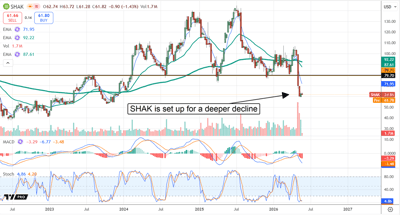
Shake Shack catalysts include the newly announced Project Catalyst. It aims to improve store efficiency, traffic, and comparable sales with technology upgrades, kitchen updates, and the company’s first loyalty program. The initiative should provide clearer results, as it has for other fast-casual banners, as seen in the subsequent earnings report. In addition, an expected CFO transition could strengthen financial performance and support long-term growth.
This email message is a paid sponsorship provided by Brownstone Research, a third-party advertiser of MarketBeat. Why did I get this message?.
If you need help with your account, feel free to email MarketBeat's U.S. based support team at [email protected].
If you would no longer like to receive promotional emails from MarketBeat advertisers, you can unsubscribe or manage your mailing preferences here.
© 2006-2026 MarketBeat Media, LLC. All rights reserved.
345 North Reid Place, Sixth Floor, Sioux Falls, South Dakota 57103-7078. USA..