Markets are swinging harder for a reason. The Fed held rates steady, inflation is still running at 2.4%, and geopolitical stress has pushed volatility back into focus. In this kind of tape, reacting late can get expensive fast, so see the options framework I’m using here.
That’s why I put together Mastering Options Trading: Ultimate Guide to Success. It walks through how traders think about bullish, bearish, and sideways setups without needing to predict every headline. Take a look at the guide here.
Inside, I cover a straightforward income-focused approach, a method some investors use to target quality stocks at better entry prices, and the basics of managing risk when earnings and macro news collide. Read the market breakdown here.
This is not about chasing fast trades or promising outcomes. It is about being better prepared when volatility returns and having a plan before the next sharp move shows up.
Get the guide here.
(**By clicking this link you agree to receive emails from StockEarnings and our affiliates. You can opt out at any time. Privacy Policy. **)
Hiral Ghelani
Founder & CEO, StockEarnings, Inc.
2 Software Stocks Turning AI Fears Into Fundamental Gains
Reported by Dan Schmidt. Published: 5/21/2026.

Key Points
- Fears that AI would devastate software revenue streams have largely failed to materialize, with many companies reporting accelerating sales growth in early 2026.
- Atlassian surpassed fiscal Q3 2026 estimates by wide margins, with AI tool Rovo users generating more than double the ARR of non-users.
- Datadog crossed $1 billion in quarterly revenue for the first time in Q1 2026 and is forming a Golden Cross technical signal, suggesting further upside.
- Special Report: Elon Musk’s $1 Quadrillion AI IPO
Software stock investors have had plenty of reasons to be bearish lately. New AI agents were expected to cut into valuable software revenue streams, and many analysts were ready to put the “per-seat” business model on life support. But in the months following the software stock meltdown, a funny thing happened: these fears failed to materialize meaningfully in earnings. In fact, many of the companies with supposedly at-risk recurring revenue streams saw sales growth accelerate in the first quarter of 2026, and these stocks are now trading well below their historical valuation levels.
Is it time to nibble on software stocks? Sentiment toward the sector remains very negative, and Morgan Stanley flagged SaaS debt as a concern, noting that 46% of software loans mature over the next four years. But the apocalyptic predictions appear to have been off base, and many software companies now see AI as a tailwind. We’ll focus on a pair of software stocks that suddenly look appealing from both a fundamental and technical perspective.
Software Stocks With Bullish Fundamental and Technical Signals
4 Simple Steps to Protect Your Bank Account (Ad)
In a few short months, the US government could gain unprecedented powers over personal bank accounts - including the ability to track every transaction or freeze funds.
Martin D. Weiss, PhD, founder of Weiss Ratings, has identified 4 simple steps Americans can take today to help safeguard their savings before any changes take effect.
Discover all 4 steps to help protect your bank account nowThe iShares Expanded Tech-Software Sector ETF (BATS: IGV) is still down more than 10% over the last 12 months, but the downtrend has been neutralized. Strong earnings have already boosted several companies in the space, including large caps like Oracle Corp. (NYSE: ORCL) and Fortinet Inc. (NASDAQ: FTNT). Software stocks are also starting to benefit from the tech sector rotation as investors look to move away from pricey memory and chipmaker stocks without exiting the market entirely. The following two companies both helped put a nail in the “AI will doom software” coffin with their Q1 2026 results.
Atlassian: Cloud Acceleration Blows Up Per-Seat Compression Thesis
One of the companies projected to take a hard hit from AI was Atlassian Corp. PLC (NASDAQ: TEAM), which develops digital tools for workflow management.
For investors, the pain was real, as the stock is down nearly 60% over the last 12 months. However, the company reported its fiscal Q3 2026 earnings on April 30, and AI is now looking like a tailwind rather than a headwind.
Atlassian easily surpassed Q3 earnings and revenue estimates, with earnings per share (EPS) figures smashing expectations by more than 20%. Revenue grew more than 30% year over year (YOY), but the adoption of the AI-powered assistant Rovo is what really caught the market’s attention. Millions of users have already adopted Rovo into their Jira or Confluence cloud workflows, and the results have been exceptional: clients using Rovo reported more than double the annual recurring revenue (ARR) of non-users. The stock jumped nearly 30% in the session following the earnings release, which triggered several bullish technical signals.

The bearish momentum had been waning since the end of February, as evidenced by the bullish crossover on the Moving Average Convergence Divergence (MACD) indicator. The MACD continued to show upward momentum through March and April before finally moving decisively above the histogram following the April 30 earnings pop. The stock now trades above its 50-day moving average for the first time all year, providing a solid technical backdrop to the company’s fundamental strength.
Datadog: Beneficiary of Hyperscaler Workload Outsourcing
Here’s a software stock that is actually making new all-time highs in 2026. Datadog Inc. (NASDAQ: DDOG) soared more than 30% following its Q1 earnings beat on May 7, and the stock is continuing to creep higher ahead of several technical catalysts.
The company’s Q1 2026 numbers eased any concerns about AI bleeding sales: quarterly revenue topped $1 billion for the first time, and EPS beat expectations by more than 17%. The company is also attracting more lucrative customers as hyperscalers outsource their workload.
More than 4,500 customers reported annual recurring revenue of $100,000 or more, an increase of more than 20% YOY. Many of these high-value customers are using Datadog’s GPUs to outsource their AI model training environments, generating a massive, resilient revenue stream.
The stock received a wave of price target bumps following the report, including a new Street-high of $305 from Stifel Nicolaus.

DDOG shares have now surged past their previous November high and could soon get a boost from a wave of technical signals. Like TEAM, the MACD hinted at building bullish momentum before the earnings catalyst. Now that the breakout is underway, another technical catalyst is forming: a Golden Cross, which occurs when the 50-day moving average crosses above the 200-day moving average. The Golden Cross is often an “all clear” message for algorithmic traders to open new positions in a stock, so more highs could be on tap for DDOG this summer.
Zscaler Stock Drops 30%: Why the Dip Is a Buy Opportunity
Reported by Thomas Hughes. Published: 5/27/2026.

Key Points
- Zscaler is well-positioned to entrench itself further in cloud-based cybersecurity: zero-trust works for AI.
- Spending increases support revenue gains and earnings growth: margin recovery will come in time.
- The late-May price plunge opens up a buying opportunity that's not likely to linger long.
- Special Report: Elon Musk’s $1 Quadrillion AI IPO
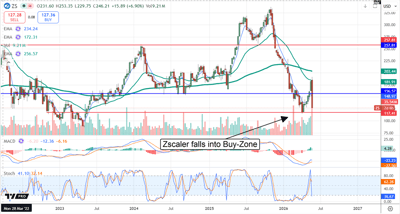
Zscaler’s (NASDAQ: ZS) stock price tanked 30% after its fiscal third-quarter earnings report and guidance update, creating a compelling buy-the-dip opportunity. While the results were mixed, they were not the main reason for the selloff. The bigger concern was the company’s spending plans, as Zscaler intends to increase investment in AI to capitalize on strong demand.
Although near-term headwinds are weighing on the stock today, long-term growth opportunities still support a case for higher prices, and the rebound may come more quickly than the initial price plunge suggests.
4 Simple Steps to Protect Your Bank Account (Ad)
In a few short months, the US government could gain unprecedented powers over personal bank accounts - including the ability to track every transaction or freeze funds.
Martin D. Weiss, PhD, founder of Weiss Ratings, has identified 4 simple steps Americans can take today to help safeguard their savings before any changes take effect.
Discover all 4 steps to help protect your bank account nowThe stock fell 30% by midday, a steep decline. However, Zscaler’s share price had already risen roughly 60% in the weeks leading up to the release, leaving it vulnerable to a correction. The key question is what comes next, and price patterns suggest a rebound is the most likely outcome. The market has shown strong support in the $120 to $140 range, making the recent plunge an opportunity to buy.
Sell-Side Activity Provides Floor for ZS Stock
Buyers include sell-side participants. Although analysts are lowering price targets, the market may be overreacting by pushing the stock below the lower end of those targets and into deep-value territory. Institutions have also been buying. Analysts are reaffirming their ratings, indicating a Moderate Buy with a bullish bias, and see a solid double-digit rebound at consensus. The worst-case scenario is that sentiment trends continue to limit upside until later in the year or early 2027, while the best case is that catalysts emerge as soon as the fiscal Q4 report and the 2027 guidance update.
Institutional activity is also noteworthy. Institutions own more than 85% of the stock and have been buying in 2026. The group sold in Q3 2025, returned to accumulation in Q4, and then carried that trend into early Q2 2026. The most likely outcome is that institutions continue buying at the lower price point, helping to underpin support near the 2026 lows. The risk is that they begin selling, but the growth outlook gives little reason to expect that. Zscaler has become a mission-critical element of enterprise cloud security, expanding its services, deepening its penetration, and entering new verticals.
Growth Impresses, But Cash Flow Gives the Market Pause
Zscaler delivered a solid fiscal third-quarter report, with revenue rising nearly 25.5% to more than $850 million. The record result beat MarketBeat’s reported consensus by nearly 200 basis points, driven by client wins and gains in penetration. Annual recurring revenue grew 25% overall, 21% organically, and 14% from net new contracts. Margin trends were also strong, with adjusted net income up 30% and adjusted earnings per share (EPS) of $1.08, 700 basis points above forecasts. However, there was one concern for the market: cash flow declined year over year due to increased spending, and capital expenditures are expected to remain elevated in the coming quarters.
Even so, the guidance is encouraging. While fourth-quarter revenue guidance came in with a midpoint below consensus, it still points to 22% growth and strong margins. Adjusted EPS is expected to come in above consensus, and the company also projects strength in full-year results. Guidance for fiscal 2026 revenue growth was raised to 24.56%, with adjusted EPS of $4.10 versus the $4.02 consensus.
Navigating Zscaler Risks and Catalysts in 2026
Zscaler’s primary catalyst this year and next will be a recovery in free cash flow margin. Accelerated investments in memory, compute, and storage are weighing on free cash flow and giving investors reason for concern. The opportunity, however, is for steady improvement as those investments translate into growth, scale, and better earnings leverage. The question is how soon margin recovery will begin, and that may not happen until later in 2027.
Execution and turnover remain risks. The company lost key members of its sales team and will need time to recover, creating uncertainty about future growth. Meanwhile, the stock’s rich valuation leaves little room for missteps, including the underwhelming integration of Red Canary. Red Canary was expected to be a growth pillar but has so far failed to accelerate growth. It is intended to help turn Zscaler into a comprehensive, next-generation AI-driven security operations center.
What the market may be missing about Zscaler is that while capital expenditure is a near-term headwind, it is also part of the long-term solution. Zscaler’s platform is becoming more indispensable to users each quarter, and the Red Canary acquisition positions it as a go-to player in a highly profitable industry. When margin recovery does arrive, Zscaler’s cloud-native cybersecurity business should be more entrenched, with more clients and more services to support long-term cash flow and shareholder value.
This email is a sponsored email sent on behalf of StockEarnings, a third-party advertiser of The Early Bird and MarketBeat.
If you have questions about your newsletter, don't hesitate to contact our South Dakota based support team at [email protected].
If you no longer wish to receive email from The Early Bird, you can unsubscribe.
© 2006-2026 MarketBeat Media, LLC. All rights protected.
345 N Reid Pl., Suite 620, Sioux Falls, South Dakota 57103-7078. United States of America..