
| From | Dana Criswell <[email protected]> |
| Subject | The Inventor Who Listened to His Daughter |
| Date | May 30, 2026 3:02 PM |
Links have been removed from this email. Learn more in the FAQ.
Links have been removed from this email. Learn more in the FAQ.
View this post on the web at [link removed]
My wife loves to sew. It is the hobby she comes back to when the week has worn her out — fabric spread across the table, the hum of the machine, something taking shape under her hands. So when she told me the other night about the man who invented the first sewing machine and then decided not to give it to the world, I listened the way you listen to someone who knows her subject. The story stuck with me, and the more I looked into it, the more I thought other people should hear it too.
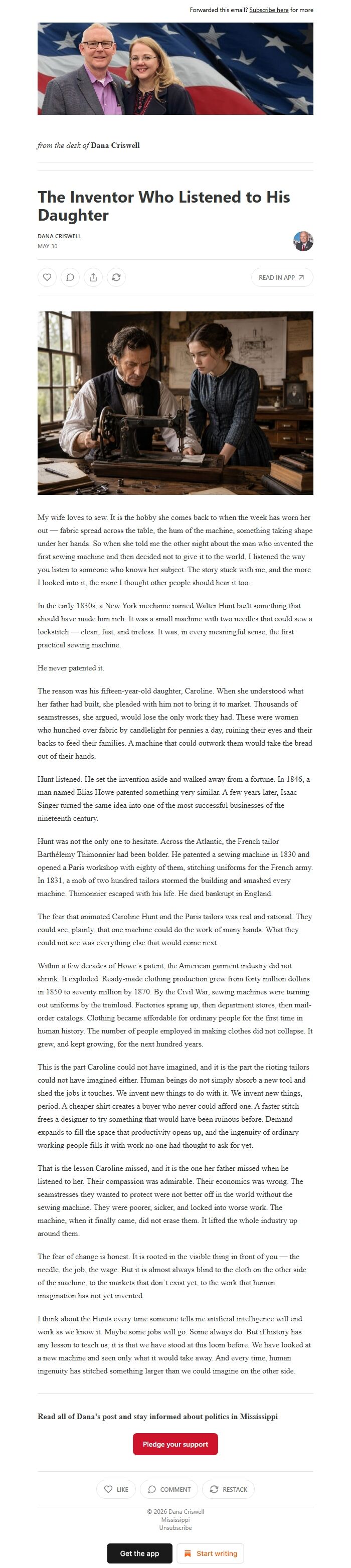
In the early 1830s, a New York mechanic named Walter Hunt built something that should have made him rich. It was a small machine with two needles that could sew a lockstitch — clean, fast, and tireless. It was, in every meaningful sense, the first practical sewing machine.
He never patented it.
The reason was his fifteen-year-old daughter, Caroline. When she understood what her father had built, she pleaded with him not to bring it to market. Thousands of seamstresses, she argued, would lose the only work they had. These were women who hunched over fabric by candlelight for pennies a day, ruining their eyes and their backs to feed their families. A machine that could outwork them would take the bread out of their hands.
Hunt listened. He set the invention aside and walked away from a fortune. In 1846, a man named Elias Howe patented something very similar. A few years later, Isaac Singer turned the same idea into one of the most successful businesses of the nineteenth century.
Hunt was not the only one to hesitate. Across the Atlantic, the French tailor Barthélemy Thimonnier had been bolder. He patented a sewing machine in 1830 and opened a Paris workshop with eighty of them, stitching uniforms for the French army. In 1831, a mob of two hundred tailors stormed the building and smashed every machine. Thimonnier escaped with his life. He died bankrupt in England.
The fear that animated Caroline Hunt and the Paris tailors was real and rational. They could see, plainly, that one machine could do the work of many hands. What they could not see was everything else that would come next.
Within a few decades of Howe’s patent, the American garment industry did not shrink. It exploded. Ready-made clothing production grew from forty million dollars in 1850 to seventy million by 1870. By the Civil War, sewing machines were turning out uniforms by the trainload. Factories sprang up, then department stores, then mail-order catalogs. Clothing became affordable for ordinary people for the first time in human history. The number of people employed in making clothes did not collapse. It grew, and kept growing, for the next hundred years.
This is the part Caroline could not have imagined, and it is the part the rioting tailors could not have imagined either. Human beings do not simply absorb a new tool and shed the jobs it touches. We invent new things to do with it. We invent new things, period. A cheaper shirt creates a buyer who never could afford one. A faster stitch frees a designer to try something that would have been ruinous before. Demand expands to fill the space that productivity opens up, and the ingenuity of ordinary working people fills it with work no one had thought to ask for yet.
That is the lesson Caroline missed, and it is the one her father missed when he listened to her. Their compassion was admirable. Their economics was wrong. The seamstresses they wanted to protect were not better off in the world without the sewing machine. They were poorer, sicker, and locked into worse work. The machine, when it finally came, did not erase them. It lifted the whole industry up around them.
The fear of change is honest. It is rooted in the visible thing in front of you — the needle, the job, the wage. But it is almost always blind to the cloth on the other side of the machine, to the markets that don’t exist yet, to the work that human imagination has not yet invented.
I think about the Hunts every time someone tells me artificial intelligence will end work as we know it. Maybe some jobs will go. Some always do. But if history has any lesson to teach us, it is that we have stood at this loom before. We have looked at a new machine and seen only what it would take away. And every time, human ingenuity has stitched something larger than we could imagine on the other side.
Unsubscribe [link removed]?
My wife loves to sew. It is the hobby she comes back to when the week has worn her out — fabric spread across the table, the hum of the machine, something taking shape under her hands. So when she told me the other night about the man who invented the first sewing machine and then decided not to give it to the world, I listened the way you listen to someone who knows her subject. The story stuck with me, and the more I looked into it, the more I thought other people should hear it too.
In the early 1830s, a New York mechanic named Walter Hunt built something that should have made him rich. It was a small machine with two needles that could sew a lockstitch — clean, fast, and tireless. It was, in every meaningful sense, the first practical sewing machine.
He never patented it.
The reason was his fifteen-year-old daughter, Caroline. When she understood what her father had built, she pleaded with him not to bring it to market. Thousands of seamstresses, she argued, would lose the only work they had. These were women who hunched over fabric by candlelight for pennies a day, ruining their eyes and their backs to feed their families. A machine that could outwork them would take the bread out of their hands.
Hunt listened. He set the invention aside and walked away from a fortune. In 1846, a man named Elias Howe patented something very similar. A few years later, Isaac Singer turned the same idea into one of the most successful businesses of the nineteenth century.
Hunt was not the only one to hesitate. Across the Atlantic, the French tailor Barthélemy Thimonnier had been bolder. He patented a sewing machine in 1830 and opened a Paris workshop with eighty of them, stitching uniforms for the French army. In 1831, a mob of two hundred tailors stormed the building and smashed every machine. Thimonnier escaped with his life. He died bankrupt in England.
The fear that animated Caroline Hunt and the Paris tailors was real and rational. They could see, plainly, that one machine could do the work of many hands. What they could not see was everything else that would come next.
Within a few decades of Howe’s patent, the American garment industry did not shrink. It exploded. Ready-made clothing production grew from forty million dollars in 1850 to seventy million by 1870. By the Civil War, sewing machines were turning out uniforms by the trainload. Factories sprang up, then department stores, then mail-order catalogs. Clothing became affordable for ordinary people for the first time in human history. The number of people employed in making clothes did not collapse. It grew, and kept growing, for the next hundred years.
This is the part Caroline could not have imagined, and it is the part the rioting tailors could not have imagined either. Human beings do not simply absorb a new tool and shed the jobs it touches. We invent new things to do with it. We invent new things, period. A cheaper shirt creates a buyer who never could afford one. A faster stitch frees a designer to try something that would have been ruinous before. Demand expands to fill the space that productivity opens up, and the ingenuity of ordinary working people fills it with work no one had thought to ask for yet.
That is the lesson Caroline missed, and it is the one her father missed when he listened to her. Their compassion was admirable. Their economics was wrong. The seamstresses they wanted to protect were not better off in the world without the sewing machine. They were poorer, sicker, and locked into worse work. The machine, when it finally came, did not erase them. It lifted the whole industry up around them.
The fear of change is honest. It is rooted in the visible thing in front of you — the needle, the job, the wage. But it is almost always blind to the cloth on the other side of the machine, to the markets that don’t exist yet, to the work that human imagination has not yet invented.
I think about the Hunts every time someone tells me artificial intelligence will end work as we know it. Maybe some jobs will go. Some always do. But if history has any lesson to teach us, it is that we have stood at this loom before. We have looked at a new machine and seen only what it would take away. And every time, human ingenuity has stitched something larger than we could imagine on the other side.
Unsubscribe [link removed]?
Message Analysis
- Sender: Dana Criswell
- Political Party: Republican
- Country: United States
- State/Locality: Mississippi
- Office: State Representative