
| From | American Enterprise Institute <[email protected]> |
| Subject | Trump Cannot Ignore Economic Pain |
| Date | May 30, 2026 11:07 AM |
Links have been removed from this email. Learn more in the FAQ.
Links have been removed from this email. Learn more in the FAQ.
AEI's weekly digest of top commentary and scholarship on the issues that matter most
AEI This Week
AEI's weekly digest of top commentary and scholarship on the issues that matter most
VOTER ANGER BUILDS
Trump Cannot Ignore Economic Pain
May 30, 2026
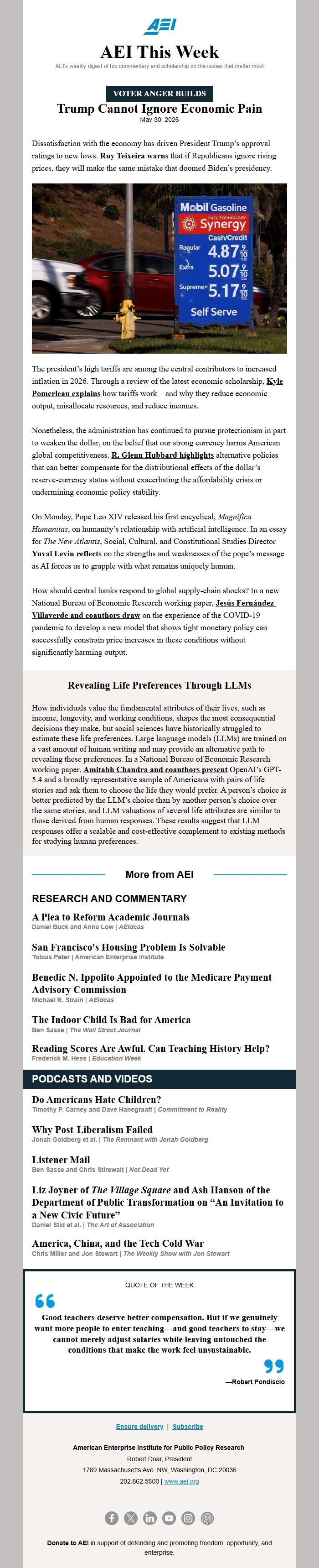
Dissatisfaction with the economy has driven President Trump’s approval ratings to new lows. Ruy Teixeira warns ([link removed] ) that if Republicans ignore rising prices, they will make the same mistake that doomed Biden’s presidency.
gas-prices ([link removed] )
The president’s high tariffs are among the central contributors to increased inflation in 2026. Through a review of the latest economic scholarship, Kyle Pomerleau explains ([link removed] ) how tariffs work—and why they reduce economic output, misallocate resources, and reduce incomes.
Nonetheless, the administration has continued to pursue protectionism in part to weaken the dollar, on the belief that our strong currency harms American global competitiveness. R. Glenn Hubbard highlights ([link removed] ) alternative policies that can better compensate for the distributional effects of the dollar’s reserve-currency status without exacerbating the affordability crisis or undermining economic policy stability.
On Monday, Pope Leo XIV released his first encyclical, Magnifica Humanitas, on humanity’s relationship with artificial intelligence. In an essay for The New Atlantis, Social, Cultural, and Constitutional Studies Director Yuval Levin reflects ([link removed] ) on the strengths and weaknesses of the pope’s message as AI forces us to grapple with what remains uniquely human.
How should central banks respond to global supply-chain shocks? In a new National Bureau of Economic Research working paper, Jesús Fernández-Villaverde and coauthors draw ([link removed] ) on the experience of the COVID-19 pandemic to develop a new model that shows tight monetary policy can successfully constrain price increases in these conditions without significantly harming output.
Revealing Life Preferences Through LLMs
How individuals value the fundamental attributes of their lives, such as income, longevity, and working conditions, shapes the most consequential decisions they make, but social sciences have historically struggled to estimate these life preferences. Large language models (LLMs) are trained on a vast amount of human writing and may provide an alternative path to revealing these preferences. In a National Bureau of Economic Research working paper, Amitabh Chandra and coauthors present ([link removed] ) OpenAI’s GPT-5.4 and a broadly representative sample of Americans with pairs of life stories and ask them to choose the life they would prefer. A person’s choice is better predicted by the LLM’s choice than by another person’s choice over the same stories, and LLM valuations of several life attributes are similar to those derived from human responses. These results suggest that LLM responses offer a scalable and cost-effective complement to existing methods for studying human preferences.
More from AEI
RESEARCH AND COMMENTARY
A Plea to Reform Academic Journals ([link removed] )
Daniel Buck and Anna Low | AEIdeas
San Francisco's Housing Problem Is Solvable ([link removed] )
Tobias Peter | American Enterprise Institute
Benedic N. Ippolito Appointed to the Medicare Payment Advisory Commission ([link removed] )
Michael R. Strain | AEIdeas
The Indoor Child Is Bad for America ([link removed] )
Ben Sasse | The Wall Street Journal
Reading Scores Are Awful. Can Teaching History Help? ([link removed] )
Frederick M. Hess | Education Week
PODCASTS AND VIDEOS
Do Americans Hate Children? ([link removed] )
Timothy P. Carney and Dave Hanegraaff | Commitment to Reality
Why Post-Liberalism Failed ([link removed] )
Jonah Goldberg et al. | The Remnant with Jonah Goldberg
Listener Mail ([link removed] )
Ben Sasse and Chris Stirewalt | Not Dead Yet
Liz Joyner of The Village Square and Ash Hanson of the Department of Public Transformation on “An Invitation to a New Civic Future” ([link removed] )
Daniel Stid et al. | The Art of Association
America, China, and the Tech Cold War ([link removed] )
Chris Miller and Jon Stewart | The Weekly Show with Jon Stewart
QUOTE OF THE WEEK
Good teachers deserve better compensation. But if we genuinely want more people to enter teaching—and good teachers to stay—we cannot merely adjust salaries while leaving untouched the conditions that make the work feel unsustainable.
—Robert Pondiscio ([link removed] )
Ensure delivery ([link removed] ) | Subscribe ([link removed] )
American Enterprise Institute for Public Policy Research
Robert Doar, President
1789 Massachusetts Ave. NW, Washington, DC 20036
202.862.5800 | www.aei.org ([link removed] )
Unsubscribe from the link below. ([link removed] )
Facebook ([link removed] )
X ([link removed] )
LinkedIn ([link removed] )
YouTube ([link removed] )
Instagram ([link removed] )
Podcast Logo New_Gray ([link removed] )
Donate to AEI ([link removed] ) in support of defending and promoting freedom, opportunity, and enterprise.
This message is for: [email protected] | Manage preferences or Unsubscribe ([link removed] )
AEI This Week
AEI's weekly digest of top commentary and scholarship on the issues that matter most
VOTER ANGER BUILDS
Trump Cannot Ignore Economic Pain
May 30, 2026
Dissatisfaction with the economy has driven President Trump’s approval ratings to new lows. Ruy Teixeira warns ([link removed] ) that if Republicans ignore rising prices, they will make the same mistake that doomed Biden’s presidency.
gas-prices ([link removed] )
The president’s high tariffs are among the central contributors to increased inflation in 2026. Through a review of the latest economic scholarship, Kyle Pomerleau explains ([link removed] ) how tariffs work—and why they reduce economic output, misallocate resources, and reduce incomes.
Nonetheless, the administration has continued to pursue protectionism in part to weaken the dollar, on the belief that our strong currency harms American global competitiveness. R. Glenn Hubbard highlights ([link removed] ) alternative policies that can better compensate for the distributional effects of the dollar’s reserve-currency status without exacerbating the affordability crisis or undermining economic policy stability.
On Monday, Pope Leo XIV released his first encyclical, Magnifica Humanitas, on humanity’s relationship with artificial intelligence. In an essay for The New Atlantis, Social, Cultural, and Constitutional Studies Director Yuval Levin reflects ([link removed] ) on the strengths and weaknesses of the pope’s message as AI forces us to grapple with what remains uniquely human.
How should central banks respond to global supply-chain shocks? In a new National Bureau of Economic Research working paper, Jesús Fernández-Villaverde and coauthors draw ([link removed] ) on the experience of the COVID-19 pandemic to develop a new model that shows tight monetary policy can successfully constrain price increases in these conditions without significantly harming output.
Revealing Life Preferences Through LLMs
How individuals value the fundamental attributes of their lives, such as income, longevity, and working conditions, shapes the most consequential decisions they make, but social sciences have historically struggled to estimate these life preferences. Large language models (LLMs) are trained on a vast amount of human writing and may provide an alternative path to revealing these preferences. In a National Bureau of Economic Research working paper, Amitabh Chandra and coauthors present ([link removed] ) OpenAI’s GPT-5.4 and a broadly representative sample of Americans with pairs of life stories and ask them to choose the life they would prefer. A person’s choice is better predicted by the LLM’s choice than by another person’s choice over the same stories, and LLM valuations of several life attributes are similar to those derived from human responses. These results suggest that LLM responses offer a scalable and cost-effective complement to existing methods for studying human preferences.
More from AEI
RESEARCH AND COMMENTARY
A Plea to Reform Academic Journals ([link removed] )
Daniel Buck and Anna Low | AEIdeas
San Francisco's Housing Problem Is Solvable ([link removed] )
Tobias Peter | American Enterprise Institute
Benedic N. Ippolito Appointed to the Medicare Payment Advisory Commission ([link removed] )
Michael R. Strain | AEIdeas
The Indoor Child Is Bad for America ([link removed] )
Ben Sasse | The Wall Street Journal
Reading Scores Are Awful. Can Teaching History Help? ([link removed] )
Frederick M. Hess | Education Week
PODCASTS AND VIDEOS
Do Americans Hate Children? ([link removed] )
Timothy P. Carney and Dave Hanegraaff | Commitment to Reality
Why Post-Liberalism Failed ([link removed] )
Jonah Goldberg et al. | The Remnant with Jonah Goldberg
Listener Mail ([link removed] )
Ben Sasse and Chris Stirewalt | Not Dead Yet
Liz Joyner of The Village Square and Ash Hanson of the Department of Public Transformation on “An Invitation to a New Civic Future” ([link removed] )
Daniel Stid et al. | The Art of Association
America, China, and the Tech Cold War ([link removed] )
Chris Miller and Jon Stewart | The Weekly Show with Jon Stewart
QUOTE OF THE WEEK
Good teachers deserve better compensation. But if we genuinely want more people to enter teaching—and good teachers to stay—we cannot merely adjust salaries while leaving untouched the conditions that make the work feel unsustainable.
—Robert Pondiscio ([link removed] )
Ensure delivery ([link removed] ) | Subscribe ([link removed] )
American Enterprise Institute for Public Policy Research
Robert Doar, President
1789 Massachusetts Ave. NW, Washington, DC 20036
202.862.5800 | www.aei.org ([link removed] )
Unsubscribe from the link below. ([link removed] )
Facebook ([link removed] )
X ([link removed] )
LinkedIn ([link removed] )
YouTube ([link removed] )
Instagram ([link removed] )
Podcast Logo New_Gray ([link removed] )
Donate to AEI ([link removed] ) in support of defending and promoting freedom, opportunity, and enterprise.
This message is for: [email protected] | Manage preferences or Unsubscribe ([link removed] )
Message Analysis
- Sender: American Enterprise Institute
- Political Party: n/a
- Country: United States
- State/Locality: n/a
- Office: n/a
-
Email Providers:
- HubSpot