
| From | Environment America <[email protected]> |
| Subject | Tell NOAA: Don't scrap whale-saving speed limits |
| Date | May 20, 2026 3:20 PM |
Links have been removed from this email. Learn more in the FAQ.
Links have been removed from this email. Learn more in the FAQ.
:
John,
Every year, North Atlantic Right whales migrate along our East Coast -- straight through some of the busiest shipping lanes in the country.[1]
The only thing standing between these endangered whales and deadly collisions with these mammoth ships? Boat speed limits.
But now, the National Oceanic and Atmospheric Administration (NOAA) is considering rolling back this life-saving policy.[2]
With fewer than 380 Right whales remaining, we can't afford to lose even a single one.
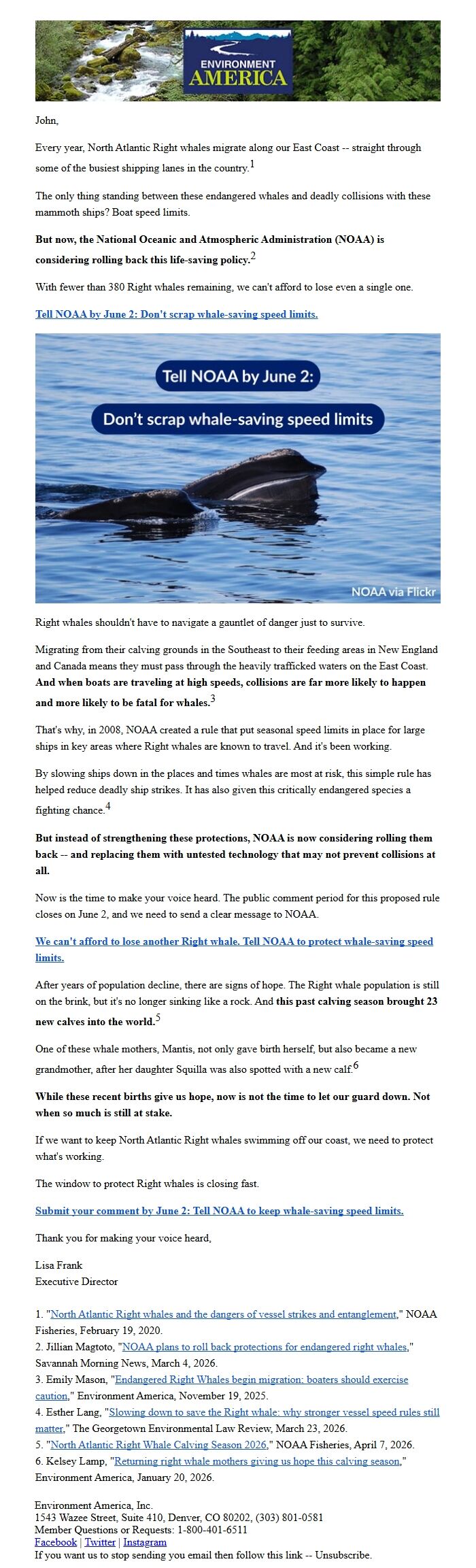
Tell NOAA by June 2: Don't scrap whale-saving speed limits.
[link removed]
Right whales shouldn't have to navigate a gauntlet of danger just to survive.
Migrating from their calving grounds in the Southeast to their feeding areas in New England and Canada means they must pass through the heavily trafficked waters on the East Coast. And when boats are traveling at high speeds, collisions are far more likely to happen and more likely to be fatal for whales.[3]
That's why, in 2008, NOAA created a rule that put seasonal speed limits in place for large ships in key areas where Right whales are known to travel. And it's been working.
By slowing ships down in the places and times whales are most at risk, this simple rule has helped reduce deadly ship strikes. It has also given this critically endangered species a fighting chance.[4]
But instead of strengthening these protections, NOAA is now considering rolling them back -- and replacing them with untested technology that may not prevent collisions at all.
Now is the time to make your voice heard. The public comment period for this proposed rule closes on June 2, and we need to send a clear message to NOAA.
We can't afford to lose another Right whale. Tell NOAA to protect whale-saving speed limits.
[link removed]
After years of population decline, there are signs of hope. The Right whale population is still on the brink, but it's no longer sinking like a rock. And this past calving season brought 23 new calves into the world.[5]
[]
One of these whale mothers, Mantis, not only gave birth herself, but also became a new grandmother, after her daughter Squilla was also spotted with a new calf.[6]
While these recent births give us hope, now is not the time to let our guard down. Not when so much is still at stake.
If we want to keep North Atlantic Right whales swimming off our coast, we need to protect what's working.
The window to protect Right whales is closing fast.
Submit your comment by June 2: Tell NOAA to keep whale-saving speed limits.
[link removed]
Thank you for making your voice heard,
Lisa Frank
Executive Director
1. "North Atlantic Right whales and the dangers of vessel strikes and entanglement," NOAA Fisheries, February 19, 2020.
[link removed]
2. Jillian Magtoto, "NOAA plans to roll back protections for endangered right whales," Savannah Morning News, March 4, 2026.
[link removed]
3. Emily Mason, "Endangered Right Whales begin migration; boaters should exercise caution," Environment America, November 19, 2025.
[link removed]
4. Esther Lang, "Slowing down to save the Right whale: why stronger vessel speed rules still matter," The Georgetown Environmental Law Review, March 23, 2026.
[link removed]
5. "North Atlantic Right Whale Calving Season 2026," NOAA Fisheries, April 7, 2026.
[link removed]
6. Kelsey Lamp, "Returning right whale mothers giving us hope this calving season," Environment America, January 20, 2026.
[link removed]
-----------------------------------------------------------
Environment America, Inc.
1543 Wazee Street, Suite 410, Denver, CO 80202
Ph: (303) 801-0581
Member Questions or Requests: 1-800-401-6511
[email protected]
Facebook: [link removed]
Twitter: [link removed]
Instagram: [link removed]
If you want us to stop sending you email then follow this link: [link removed]
John,
Every year, North Atlantic Right whales migrate along our East Coast -- straight through some of the busiest shipping lanes in the country.[1]
The only thing standing between these endangered whales and deadly collisions with these mammoth ships? Boat speed limits.
But now, the National Oceanic and Atmospheric Administration (NOAA) is considering rolling back this life-saving policy.[2]
With fewer than 380 Right whales remaining, we can't afford to lose even a single one.
Tell NOAA by June 2: Don't scrap whale-saving speed limits.
[link removed]
Right whales shouldn't have to navigate a gauntlet of danger just to survive.
Migrating from their calving grounds in the Southeast to their feeding areas in New England and Canada means they must pass through the heavily trafficked waters on the East Coast. And when boats are traveling at high speeds, collisions are far more likely to happen and more likely to be fatal for whales.[3]
That's why, in 2008, NOAA created a rule that put seasonal speed limits in place for large ships in key areas where Right whales are known to travel. And it's been working.
By slowing ships down in the places and times whales are most at risk, this simple rule has helped reduce deadly ship strikes. It has also given this critically endangered species a fighting chance.[4]
But instead of strengthening these protections, NOAA is now considering rolling them back -- and replacing them with untested technology that may not prevent collisions at all.
Now is the time to make your voice heard. The public comment period for this proposed rule closes on June 2, and we need to send a clear message to NOAA.
We can't afford to lose another Right whale. Tell NOAA to protect whale-saving speed limits.
[link removed]
After years of population decline, there are signs of hope. The Right whale population is still on the brink, but it's no longer sinking like a rock. And this past calving season brought 23 new calves into the world.[5]
[]
One of these whale mothers, Mantis, not only gave birth herself, but also became a new grandmother, after her daughter Squilla was also spotted with a new calf.[6]
While these recent births give us hope, now is not the time to let our guard down. Not when so much is still at stake.
If we want to keep North Atlantic Right whales swimming off our coast, we need to protect what's working.
The window to protect Right whales is closing fast.
Submit your comment by June 2: Tell NOAA to keep whale-saving speed limits.
[link removed]
Thank you for making your voice heard,
Lisa Frank
Executive Director
1. "North Atlantic Right whales and the dangers of vessel strikes and entanglement," NOAA Fisheries, February 19, 2020.
[link removed]
2. Jillian Magtoto, "NOAA plans to roll back protections for endangered right whales," Savannah Morning News, March 4, 2026.
[link removed]
3. Emily Mason, "Endangered Right Whales begin migration; boaters should exercise caution," Environment America, November 19, 2025.
[link removed]
4. Esther Lang, "Slowing down to save the Right whale: why stronger vessel speed rules still matter," The Georgetown Environmental Law Review, March 23, 2026.
[link removed]
5. "North Atlantic Right Whale Calving Season 2026," NOAA Fisheries, April 7, 2026.
[link removed]
6. Kelsey Lamp, "Returning right whale mothers giving us hope this calving season," Environment America, January 20, 2026.
[link removed]
-----------------------------------------------------------
Environment America, Inc.
1543 Wazee Street, Suite 410, Denver, CO 80202
Ph: (303) 801-0581
Member Questions or Requests: 1-800-401-6511
[email protected]
Facebook: [link removed]
Twitter: [link removed]
Instagram: [link removed]
If you want us to stop sending you email then follow this link: [link removed]
Message Analysis
- Sender: Environment America
- Political Party: n/a
- Country: United States
- State/Locality: n/a
- Office: n/a
-
Email Providers:
- ActionKit