Elon Musk Calling on Military 'Dark Energy' to Power AI

When it was put inside U.S. tanks, they moved almost silently and produced no smoke. Now, Elon Musk is using this strange technology to jump ahead in the AI race - and possibly change the course of history. Click here to see how this could ignite a $10 trillion boom for the stocks involved.
A New Focus for GoPro: Is a Takeover in the Frame?
Written by Jeffrey Neal Johnson. Publication Date: 5/14/2026.

Key Points
- Excluding one-time charges reveals a much healthier underlying gross margin for GoPro, suggesting operational resiliency.
- GoPro's board initiated a strategic review with full support from its founder, effectively putting the company in play for a sale.
- GoPro is now leveraging its powerful imaging technology to enter more lucrative professional, defense, and aerospace markets.
- Special Report: Elon Musk: This Could Turn $100 into $100,000
GoPro, Inc.'s (NASDAQ: GPRO) Q1 2026 earnings initially painted a picture of significant distress.
The company reported a 26% year-over-year (YOY) revenue decline to $99 million, missing analyst estimates by a wide margin, while GAAP gross margin fell to a meager 4.3%.
Ticker Revealed: Pre-IPO Access to "Next Elon Musk" Company (Ad)
We’ve found The Next Elon Musk… and what we believe to be the next Tesla.
It’s already racked up $26 billion in government contracts.
Peter Thiel just bet $1 Billion on it.
👉 Unlock the ticker now and get it completely free.Beneath those alarming figures, however, a different story is unfolding. It is a story of strategic pivot, masked operational improvements, and a formal process that places the entire company in play as an acquisition target.
The GoPro board's recent authorization of a full strategic review, prompted by unsolicited inbound interest, fundamentally shifts the investment thesis from a turnaround story to a potential M&A arbitrage opportunity. For investors, the question is no longer solely whether GoPro can reclaim its former glory, but what its intellectual property, brand recognition, and scaled manufacturing are worth to a potential acquirer.
Adjusting the Financial Lens on GoPro's Profitability
The market's reaction to GoPro's first-quarter performance was predictably negative, centering on the steep decline in gross margin from 32.3% in the prior-year period to just 4.5% on a non-GAAP basis.
But these figures require critical context. GoPro's Q1 results were heavily affected by discrete, one-time charges, including a $24.5 million charge for component purchase commitments and a $4.5 million write-down of slow-moving inventory.
Excluding these items reveals a normalized adjusted gross margin of approximately 31%. While still a contraction, that figure suggests a far more resilient underlying business than the headline numbers imply. GoPro management attributed the pressure to macro headwinds affecting the broader consumer electronics market, citing rising memory costs and supply chain volatility.
Performance in the direct-to-consumer channel reinforces this view of underlying stability. Revenue from GoPro's website accounted for 39% of total sales, up from 30% in Q1 2025. This channel shift provides a positive tailwind for long-term margin health, as it allows GoPro to capture more profit per unit and build direct relationships with its customer base. Concurrently, the street average selling price for its products improved by 6% YOY to $371, indicating some degree of pricing power and a successful move toward higher-value products.
GoPro's Board Opens the Door for a Takeover
The most significant catalyst for GoPro is the board's decision to engage a financial advisor and explore a sale. This move was made in response to multiple unsolicited acquisition inquiries following GoPro's April announcement of a formal push into the defense and aerospace sectors.
A critical hurdle for any potential deal has been cleared. Founder and CEO Nicholas Woodman, who controls approximately 63% of the voting power through his Class B shares, gave the process his unequivocal support during the Q1 earnings call. By stating that the effort has his "full and complete support," Woodman effectively removed the primary governance risk that could have deterred potential suitors.
This public endorsement signals that the board and its most influential shareholder are aligned on maximizing value, even if it means relinquishing control. The market is now free to price in a buyout premium without the overhang of a founder unwilling to sell.
Reboot: GoPro's IP Finds a New Mission
The interest from potential acquirers appears linked to GoPro's strategic repositioning of its powerful imaging technology. The brand, long synonymous with consumer action cameras, is now leveraging its IP in potentially more lucrative markets.
Mission 1: GoPro's High-Margin Play for the Professional Market
The recent launch of the MISSION 1 Series of compact cinema cameras marks a deliberate entry into the professional and prosumer markets. These cameras offer 8K and 4K capabilities with industry-leading thermal performance, directly competing with far more expensive equipment. This pivot allows GoPro to target a customer base less susceptible to consumer discretionary spending pressures and opens up higher-margin revenue streams.
From Skateparks to Spacecraft: GoPro's Defense Ambitions
GoPro has engaged Oliver Wyman, a leading consulting firm, to map out a strategy for the defense and aerospace markets. This initiative was validated when NASA utilized modified GoPro cameras on its Artemis II mission, proving the hardware's durability and performance in extreme environments. This foray into government and enterprise contracts could create a scalable, recurring revenue business that is completely delinked from the consumer hardware cycle. A larger technology or defense firm could see significant value in acquiring this mission-proven technology.
Traders Are Betting on a GoPro Buyout
Investor positioning reflects the speculative nature of the current situation. Call option volume recently spiked by 53%, with implied volatility surging as traders bet on a near-term acquisition announcement. GoPro's trading volume of 13.82 million shares dwarfs its average of 5.89 million, indicating heavy rotation.
Short interest remains elevated at 14.21% of the float. While this signals significant bearish sentiment on GoPro's standalone prospects, it also creates the potential for a short squeeze should positive M&A news leak.
Institutional ownership remains a solid 70.09%, with net inflows over the last 12 months suggesting that larger funds may be holding their positions in anticipation of a strategic event.
With a market capitalization hovering under $200 million, a larger player like Garmin Ltd. (NYSE: GRMN) or a tech giant seeking to enter the hardware space could acquire GoPro's global brand recognition, patent portfolio, and established manufacturing relationships for a relatively small outlay.
Investors focused on event-driven scenarios may want to watch for further developments in GoPro's strategic review. Cautious investors, on the other hand, may prefer to wait for concrete evidence of a transaction or a meaningful improvement in profitability before committing capital.
Aeluma's Post-Earnings Dip Creates a Buying Opportunity
Written by Thomas Hughes. Publication Date: 5/15/2026.

Key Points
- Aeluma's Q3 miss is a non-starter, leaving the outlook unchanged.
- The photonics opportunity is unparalleled, with the potential to disrupt markets.
- With bullish catalysts ahead, the May price pullback is a signal to buy.
- Special Report: Elon Musk: This Could Turn $100 into $100,000
Investors looking at Aeluma’s (NASDAQ: ALMU) position in AI and the April stock price increase were given an opportunity by the fiscal Q3 release. Through no fault of its own, the company missed revenue expectations, which were not particularly demanding to begin with.
Aeluma is technically a pre-revenue company, with forecast revenue of $1.35 million tied to government contracts. Those contracts were not revoked; rather, they were delayed by government shutdowns that have since been resolved.
Ticker Revealed: Pre-IPO Access to "Next Elon Musk" Company (Ad)
We’ve found The Next Elon Musk… and what we believe to be the next Tesla.
It’s already racked up $26 billion in government contracts.
Peter Thiel just bet $1 Billion on it.
👉 Unlock the ticker now and get it completely free.The biggest impact on Aeluma has been the delayed start of some projects, but there is no serious impact on its commercialization process.
Aeluma Advances Strategy in Q3: That’s What Matters
The company's commercialization process continues to advance. Q3 highlights included new or expanded partnerships with Tower Semiconductor (NASDAQ: TSEM) and Sumitomo Chemical Advanced Technology (OTCMKTS: SOMMY) for wafer production. Sumitomo will apply thin-layer compound semiconductor material to existing semiconductor wafers, then send them to Tower Semiconductor for final manufacturing. Because the compound material is applied directly to the substrate to create a hybrid wafer, the output conforms to standard manufacturing processes, enabling a more streamlined, cost-effective, and time-efficient process.
Aeluma is also critical to a number of end markets, including AI, datacenters, autonomous vehicles, industrial applications, and space. While the company is preparing to manufacture a broad range of photonic products, the focus is on quantum dot lasers. Quantum dot lasers offer superior performance, cost, size, and scalability compared with traditional photonic devices and are poised to disrupt the industry. Their main advantages include temperature stability, tolerance, and energy efficiency. Quantum dot lasers function normally at high temperatures, reducing the need for external cooling, tolerate a wider range of defects in the underlying silicon substrate, and use less energy.
Aeluma Stumble Triggers Buying Opportunity
Among the risks for investors is the need for capital and the potential for dilution. The company is well-capitalized in 2026, but that came at a cost, and additional capital may be required. As it stands, the company has nearly $38 million in cash, enough to sustain operations, but its share count has increased by more than 36% over the trailing 12 months. The company will likely raise modest amounts through share offerings to fund operational milestones in upcoming quarters, but another significant capital raise is unlikely until 2028. Aside from that, the balance sheet is in good shape, with no long-term debt and minimal liabilities.
The impact of the revenue miss and the reduction in guidance on Aeluma’s share price was severe, but traders and investors should take it with a grain of salt. The approximately 35% share price correction that followed earnings was directly related to the strength of the preceding run. ALMU stock advanced by more than 200% in about five weeks and was due for a correction regardless of the news. The critical detail was what came next: a buying signal.
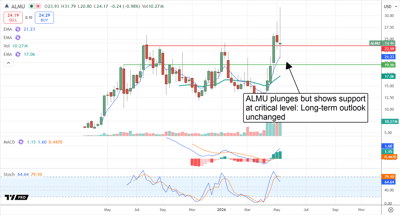
ALMU’s stock opened with a gap and extended its losses, crossing a critical threshold and triggering a buying frenzy. That threshold is near $23.50, coincident with the top of a trading range and now a strong technical support level. Support is evident on both the weekly and daily charts, as evidenced by candlestick formations and elevated trading volume, suggesting ALMU’s updraft isn’t over just yet.
Analyst and institutional data suggest these groups are buying the dip. MarketBeat tracks five analysts with trends showing covering rising, a firm Moderate Buy rating, an 80% buy-side bias, and a steady price target. The price target is interesting because it is around $25, very near the critical support level, and it strengthens the idea that ALMU hit a hard floor with the mid-May price plunge. Institutions, meanwhile, own about 25% of the stock and have been accumulating at a pace of approximately $4-to-$1 since the IPO, sustaining the bullish trend in early Q2 2026.
Aeluma Has Catalysts Ahead
Upcoming catalysts for Aeluma include the company’s improving customer demand profile. The company noted improving demand interest across the spectrum, with AI underpinning the increase. In its view, hyperscalers and enterprises are looking for long-term solutions that Aeluma can provide. Other catalysts include the growing number of patents, now at 36, and the potential for long-term monetization.
The patents cover Aeluma’s manufacturing process and design architecture, cementing its role as the source of heterogeneous semiconductor integration and the mass-production techniques critical to the semiconductor supply chain.
The biggest risk is adoption. While Aeluma has strong potential and improving end-market demand, no OEM has committed to the product. In this scenario, Aeluma risks another solution taking center stage, limiting its opportunity to do so. However, the likely outcome is that Aeluma continues to advance its capabilities and eventually secures its first major customer. In that scenario, ALMU’s stock price will likely revert to fresh highs.
This email is a paid advertisement from Altimetry, a third-party advertiser of InsiderTrades.com and MarketBeat.
This ad is sent on behalf of Altimetry, 110 Cambridge Street, Cambridge, MA 02141. If you would like to optout from receiving offers from Altimetry please click here.
If you need assistance with your account, please contact our U.S. based support team at [email protected].
If you no longer wish to receive email from InsiderTrades.com, you can unsubscribe.
© 2006-2026 MarketBeat Media, LLC. All rights reserved.
345 North Reid Place #620, Sioux Falls, S.D. 57103. United States of America..