
|


In today’s newsletter:
Q1 growth as good as it gets
Different Labour economic visions
Can the four-day week reduce obesity?
This week’s King’s Speech offered, among its thirty-five bills, three proposals in some tension with one another which reveal a good deal about our inconsistent approach to growth and economic policy more broadly.
The first is the Regulating for Growth Bill. Firms may be asked to fulfil a Growth Duty, a concept to be defined on a case-by-case basis by ministers issuing strategic steers to industry. It is hard to believe that British regulators are currently under-instructed. If anything, they are over-empowered and operate under statutes that treat process as a substitute for outcomes. The Bill is best understood as a further entry in what Chris Snowdon has termed Britain’s ‘capitalist command economy’: a system in which firms nominally remain in private hands while the state directs, targets and fines them into delivering ministerial priorities. It is therefore hard to see how injecting more ‘everything-ism’ into the economy will help it develop.
The second is the Nuclear Regulation Bill, which legislates the Fingleton Review’s principal recommendations. The review identified several obstacles to developing nuclear energy infrastructure, including fragmented oversight, a culture of defensive decision-making and a regulatory regime that has made Britain the most expensive place in the world to build a nuclear power station. The Bill establishes a Nuclear Commission, designates the ONR as lead regulator and constrains the Protected Landscapes Duty. This is exactly the kind of structural reform that the Regulating for Growth Bill isn’t. Whether ministers extend the Fingleton template to other infrastructure, as they have hinted, is something to watch out for.
The third is the Steel Industry (Nationalisation) Bill, which formalises in statute what £2.5 billion of decarbonisation subsidies and the April 2025 special-measures intervention had already made inevitable. After repeated protectionist measures and a gradual, expensive socialisation of losses, the state has decided that adding an unwanted asset to its balance sheet is preferable to endlessly subsidising it. Given that the government has spent years subsidising the supply of steel while legislating away the demand for it by restricting housebuilding and other construction projects, it is hard to see why the taxpayer must now spend a fortune to acquire a liability.
Taken together, the three bills describe a government that knows the supply side matters, occasionally legislates as if it does and just as often legislates as if it does not.
Valentin Boboc
Senior Economist
The best way to never miss out on IEA work, get access to exclusive content, and support our research and educational programmes is to become a paid IEA Insider.
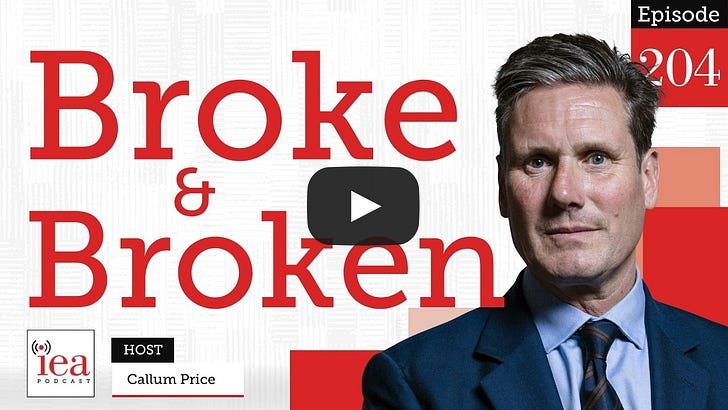
IEA Podcast: Director of Communications Callum Price and Editorial Director Kristian Niemietz are joined by Senior Economist Valentin Boboc to discuss the economic effects of political chaos, the King’s Speech, and two different Labour visions - IEA YouTube
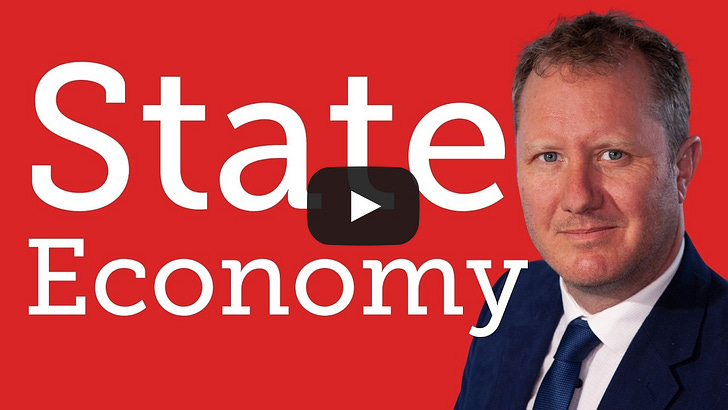
Is Britain a Capitalist Command Economy?
Not since the early 1980s has the government had such a stranglehold over economic life in Britain. Beyond record-high taxes and wartime-level state spending, the government now controls the price of gas, electricity, water, transport tickets and alcohol in Scotland and Wales. Captains of industry are summoned to Downing Street to be reprimanded for "price gouging" while businesses are given production targets and punished—not for producing too little, but for producing too much of the wrong thing.
We lack the words to describe our current economic model. What we have is almost the opposite of Chinese state capitalism: businesses stay in private hands but operate under so many instructions, targets and price controls that it's best described as a "capitalist command economy."

News and Views
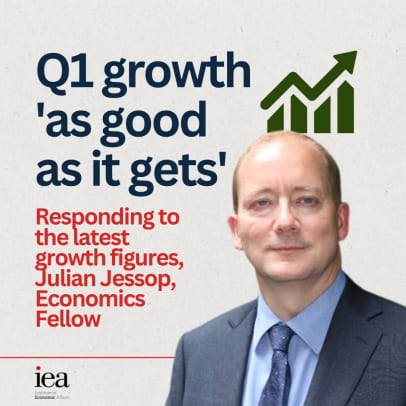 |
“The first official estimate confirmed that the UK economy made a flying start to 2026, but we have been here before: the first quarter has seen the strongest growth in each of last four years, followed by a marked slowdown.
“This may partly reflect some problems with the seasonal adjustments, which have been acknowledged by the Office for National Statistics. Nonetheless, the earlier improvements in many business and consumer surveys suggest that most of the 0.6% increase in GDP was genuine.
“Unfortunately, the same indicators are already pointing to a much weaker second quarter as the fallout from the crisis in the Middle East starts to hit. The decent growth in the first quarter will be as good as it gets.
“For now, manufacturing and most services appear to be holding up well, perhaps benefitting from demand brought forward to beat the expected supply shortages and price rises.
“But activity in key sectors such as retail, construction, and the housing market, is starting to weaken sharply, and confidence is fragile.
“The mounting political uncertainty at home will not help either. Nervousness in the financial markets over the fate of the Prime Minister is adding to the upward pressure on borrowing costs. The lack of any meaningful measures to boost growth in the King’s Speech is a worry too. Instead, the Government chose to double down on clumsy state interventions which are holding the economy back.”
Julian Jessop’s response to recent growth figures, cited in The Express
"Britain has built an 'extraction economy', where plenty of things are arbitrarily rationed." Dr Valentin Boboc on Labour’s two economic visions.
 |
Britain is slipping towards economic oblivion, Shadow Business Secretary Andrew Griffith MP mentions the IEA’s recent polling, and Chris Snowdon’s capitalist command economy in ConservativeHome
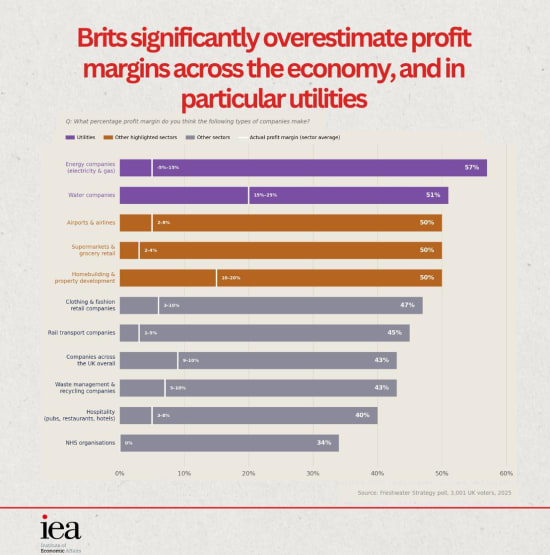
Our recent poll findings from our Growth Mindset paper show widespread misunderstandings of profit margins.
|
Could the four-day week reduce obesity? Chris Snowdon says no in The Times
“The UK is among the ten countries in this study with the lowest working hours and yet has one of the higher obesity rates, so the idea that a four-day week would make [us] slimmer seems dubious.
“For most people, a four-day week would mean a lower income, and we know that people on low incomes are more likely to be obese. Even if they weren’t, lower incomes would still be a bad thing.”
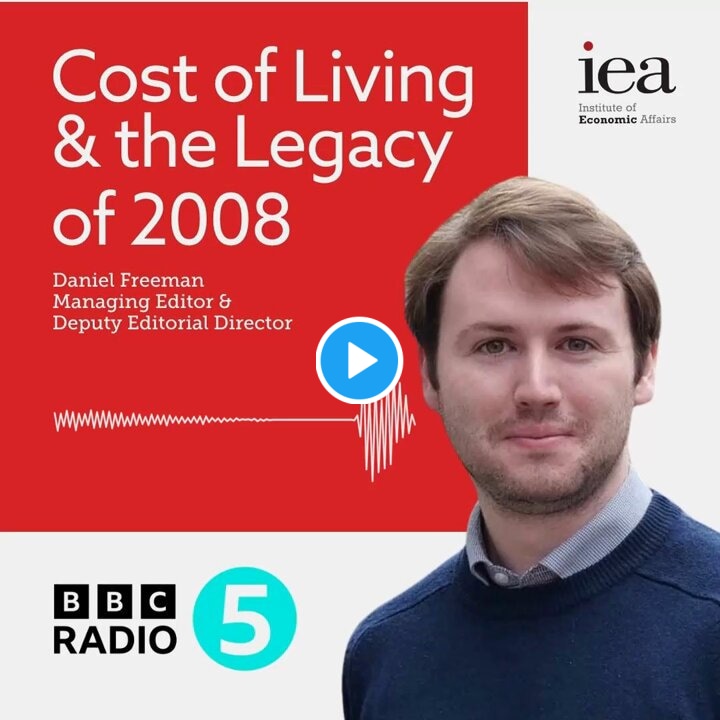
Daniel Freeman on the state of our growth rates, on BBC Radio 5:
|
Why does the PM want to put us at ‘the heart of Europe’? Incoming Director General Lord Hannan quotes Kristian Niemietz, Daily Mail
“As Kristian Niemietz of the Institute of Economic Affairs pointed out at the time, Labour MPs rejected the single market because they disliked the word ‘market’ and backed the customs union because they liked the word ‘union’.”
AI and comparative advantage, Valentin Boboc explores the effect of comparative advantage will have in any AI revolution EconLib
“Ultimately, the distinction between AI as a competitor and AI as a tool is defined by the shifting boundary of comparative advantage. While machines displace us in routine tasks where they hold an absolute edge, the physical and economic scarcity of compute forces them to specialise, turning them into instruments that amplify human judgment.”
Has the Right given up on economics? Junior Research Associate Mani Basharzad in CapX
Events and Opportunities
INVITATION: Is Britain Broken? | ||||||
| ||||||
 | ||||||
Join us for an exclusive event hosted by Institute of Economic Affairs in partnership with Guido Fawkes. | ||||||
|
 | A guest post by
|
You’re currently a free subscriber to Insider. For the full experience, upgrade your subscription.
Paid subscribers support the IEA's charitable mission and receive special invites to exclusive events, including the thought-provoking IEA Book Club.
We are offering all new subscribers a special offer. For a limited time only, you will receive 15% off and a complimentary copy of Dr Stephen Davies’ latest book, Apocalypse Next: The Economics of Global Catastrophic Risks.
| ||||||||||


