Dear Reader,
Everyone's focused on the coming SpaceX IPO.
$1.75 trillion valuation. Biggest in history.
But before you run out to buy the stock …
History shows us something remarkable.
When Apple went on a recent run, gaining 2,000% …
A little-known supplier called Broadcom gained 15,000%.
That's 7 times better than owning Apple itself.
A similar pattern played out with Nvidia …
While Nvidia soared 770%, a company called Vertiv — which keeps Nvidia's data centers from overheating — climbed 1,700%.
More than double Nvidia's return.
And right now, there's a little-known company that's shipped over five billion chips to SpaceX.
That figure is expected to top 10 billion by 2027.
SpaceX literally calls them "instrumental to Starlink's success."
Yet 999 out of 1,000 investors have probably never heard of them.
As part of our Memorial Day Savings Event, you can get the name and ticker for just $19.
That's 85% off the retail price.
You’ll also get a full year of Disruptors & Dominators, my monthly tech research newsletter, monthly stock recommendations … plus four special reports covering the entire SpaceX IPO opportunity.
Regular price: $129
Memorial Day sale price: $19
>>> Get discounted access now.
Regards,

Michael A. Robinson
Director of Tech Research, Weiss Ratings
P.S. SpaceX is expected to go public in June. You'll want to position yourself before then. This 85% OFF discount expires Monday night. Get the urgent details while you can, here.
Datavalut Gains Traction: 5 Reasons to Sell Now
By Thomas Hughes. Date Posted: 5/15/2026.
Key Points
- Datavault is gaining business traction but faces significant headwinds from the stock price.
- Dilution, cash burn, and short sellers point to lower share prices before a substantial rally can begin.
- Upcoming catalysts promise to drive volatility over the summer and into the back half of this year.
- Special Report: Elon Musk: This Could Turn $100 into $100,000
Datavault (NASDAQ: DVLT) is gaining traction and appears on track to begin ramping revenue. However, a combination of factors suggests that a revenue ramp won’t be enough to support this stock’s price, which is still poised to move much, much lower.
The primary concern is cash burn. The company is effectively creating a new industry and building its own infrastructure in the process, and it is burning cash at a rapid pace.
Ticker Revealed: Pre-IPO Access to "Next Elon Musk" Company (Ad)
We’ve found The Next Elon Musk… and what we believe to be the next Tesla.
It’s already racked up $26 billion in government contracts.
Peter Thiel just bet $1 Billion on it.
👉 Unlock the ticker now and get it completely free.While the company is adequately capitalized today, that “strong” financial position came at a cost and will only take it so far. As things stand, Datavault will most likely need additional capital by early 2027, if not by the end of 2026.
Datavault: Cash Burn, Dilution, and Short Interest in Play
Datavault’s balance sheet at the end of Q1 was much improved. The company’s cash balance remained flat, debt and liabilities were reduced, but assets and equity declined while the share count exploded. The share count is the reason this company is in such good financial shape, rising more than 10X year over year and continuing to climb since the quarter ended. While further share count increases aren’t expected in the near term, the most likely mid-term outcome is that the count rises before it falls, and those increases could again be substantial.
Trailing 12-month dilution, cash burn, and the threat of future dilution have set the stage for short-sellers, and they are active in this market. MarketBeat data shows them ramping up activity in 2026, sustaining a high 12% short interest and ready to pounce on bad news. The recent Q1 earnings report wasn’t terrible news, but it aligned with the outlook for future dilution and may trigger accelerated short activity.
Institutions and analysts provide little support for this market, leaving the door open to lower prices. While institutional activity shows the group buying at an aggressive pace, total interest is below 1%, net activity is tepid at best, and it is more likely tied to short-covering than actual accumulation. Analysts, likewise, forecast substantial upside at the consensus level, but it is a low-conviction target, with only two analysts tracked and only one with a price target. The consensus is Hold, with one optimistic Buy and one Sell, offering little impetus for institutions or retail investors to buy.
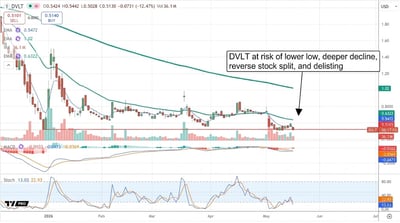
The price action was not encouraging following the earnings release, given the stock's decline of more than 10%. The move confirms resistance at critical levels aligned with exponential moving averages and prior support targets, suggesting new lows may be set. The key support level is a long-term low near 50 cents, a potential pivot point on a move lower. A break below this level would likely trigger additional selling, including from short sellers and investors cutting losses.
Datavault Has Catalysts: Good, Bad, and Ugly Catalysts
An upcoming bearish catalyst would be the potential delisting from Nasdaq. Datavault received a delisting notice earlier this year due to its low stock price and has until August to fix the situation. If the company can’t get its shares above $1 organically, which seems unlikely, a reverse stock split may become necessary. One possible outcome is that the company could retain its Nasdaq listing and, at least in theory, have easier access to the capital markets. The downside is that reverse stock splits seldom work for investors, often leading to increased short interest and even lower share prices.
Bullish catalysts include the Clarity Act and upcoming digital exchange launches. The Clarity Act is critical to the cryptocurrency industry because it clearly defines asset classes, enabling more efficient oversight, protecting developers, and providing pathways for institutional investment. Digital exchange launches are also critical to Datavault’s success, as they widen market access and exposure to its digitized assets.
Execution Is Critical: Missteps Will Reflect in the Price Action
The biggest risk for Datavault, aside from dilution, cash burn, and delisting, is execution. The company reaffirmed its year-end targets despite significant Q1 misses, setting a high bar to clear. Challenges include building the network, integrating acquisitions, and attracting consumers while navigating a difficult and evolving regulatory environment. The likely outcome is that hurdles and delays will arise and be reflected in the stock price over time.
What the market may be overlooking is the company’s ability to scale and its pending contracts. Revenue fell significantly short of the high bar in place in Q1, but it still grew more than 440% year over year and is expected to remain strong in the coming quarters and years. The pipeline includes approximately $800 million in signed tokenization deals, with monetization expected by year’s end. Assuming flawless execution and favorable tailwinds, the company may quickly achieve profitability, reduce its need for future dilution, and provide a catalyst for short-sellers, analysts, and institutions to begin buying the stock.
Navy Catalyst Ignites Odysight’s Growth Engine
By Jeffrey Neal Johnson. Date Posted: 5/12/2026.

Key Points
- A new U.S. Navy partnership validates Odysight.ai's technology for mission-critical defense applications.
- Odysight.ai has a strong financial position with zero debt and a substantial backlog of future revenue.
- Successful deployments with international air forces showcase a clear strategy for global market expansion.
- Special Report: Elon Musk: This Could Turn $100 into $100,000
A landmark Cooperative Research and Development Agreement (CRADA) with the U.S. Navy has provided a strong institutional validation for Odysight.ai (NASDAQ: ODYS), sending shares into a volatile, high-volume surge.
The deal centers on deploying Odysight.ai's advanced visual sensing and artificial intelligence (AI) platform for condition-based maintenance on mission-critical aircraft carrier arresting cables.
Ticker Revealed: Pre-IPO Access to "Next Elon Musk" Company (Ad)
We’ve found The Next Elon Musk… and what we believe to be the next Tesla.
It’s already racked up $26 billion in government contracts.
Peter Thiel just bet $1 Billion on it.
👉 Unlock the ticker now and get it completely free.While the market initially reacted to the headline, the core investment thesis appears to rest on a much deeper fundamental story: a rapidly monetizing $13.8 million backlog and a pristine, zero-debt balance sheet. As global defense budgets continue to pivot toward predictive maintenance and operational readiness, this de-risked micro-cap may offer an asymmetrical entry point before its technology scales fleet-wide.
Why This CRADA Is a Game-Changer
The CRADA with the Naval Air Warfare Center Aircraft Division Lakehurst (NAWCAD) is much more than a routine supply contract. For a micro-cap like Odysight.ai, it represents a deep, formal collaboration that embeds its technology at the heart of the Pentagon's modernization efforts. This partnership provides invaluable real-world operational feedback, allowing Odysight.ai to refine its algorithms and hardware in one of the world's most demanding environments.
This direct line to the end user significantly de-risks future product development and creates a powerful competitive moat. Successfully proving the technology on carrier arresting cables, a system under immense and constant operational stress, is a strategic masterstroke.
It also gives Odysight.ai an authoritative case study to support expansion into other mission-critical systems. That validation establishes a clear, logical path for scaling across the U.S. Navy's fixed-wing aircraft, rotary-wing helicopters, and ground vehicle fleets. The approach mirrors a successful pattern of securing contracts with elite military operators worldwide. Odysight.ai has already logged key operational milestones with the Israeli Air Force for its SH-60 helicopter program and the Italian Air Force for AW139 platform testing. These engagements reinforce the system's interoperability and position Odysight.ai as a trusted partner within premier international defense supply chains, not just a vendor.
Why Zero Debt and a $13.8M Backlog Matter
Many pre-profitability technology sector companies are hampered by weak balance sheets and the constant threat of dilutive financing. Odysight.ai stands in stark contrast to that narrative. The technology developer exited its 2025 fiscal year with approximately $26 million in cash and equivalents and, critically, zero long-term debt. This robust liquidity profile is a powerful strategic asset. It provides a multi-year operational runway, giving management the flexibility to execute its pilot programs and scale production without the immediate pressure to tap equity markets. That financial independence allows Odysight.ai to negotiate from a position of strength and focus entirely on technological and commercial execution.
This stability is reinforced by exceptional revenue visibility. Odysight.ai is currently working through a contracted backlog of $13.8 million. That figure, representing more than 4.5 times Odysight.ai's trailing 12-month revenue, signals a fundamental inflection point. Odysight.ai is transitioning from a speculative research-and-development entity into a commercial-stage enterprise with a clearer path to accelerated growth. The successful monetization of this backlog throughout 2026 will be a key performance indicator for investors. Consistent conversion of the backlog into top-line revenue could trigger a significant re-rating of the stock as the market shifts from valuing potential to rewarding proven execution.
The Market's Volatile Reaction
The Navy CRADA announcement on May 11, 2026, served as a powerful market catalyst, igniting a trading firestorm. Shares of Odysight.ai saw volume surge to 39.12 million, up from its daily average of just under 470,000. The stock vaulted to an intraday high of $11.30 before aggressive profit-taking pushed it down to $4.75 by the closing bell.
This extreme price action, which triggered a Limit Up-Limit Down (LULD) trading pause, confirms that both retail momentum traders and institutional algorithms have now firmly fixed their sights on the equity. While the sharp retracement highlights near-term volatility, the record volume and elevated close signal a meaningful shift in market awareness.
Adding to this newfound interest is a strategic move to enhance liquidity and broaden the shareholder base. On April 9, 2026, Odysight.ai finalized a dual listing on the Tel Aviv Stock Exchange (TASE). This provides direct access to a deep pool of sophisticated regional institutional capital. That investor base has a nuanced understanding of the defense technology sector and is well-positioned to appreciate the long-term value of Odysight.ai's contractual milestones, potentially creating a more stable valuation floor for the stock moving forward.
From Pilot to Profit: What to Watch for Next
The path forward for Odysight.ai hinges on execution. While the current analyst consensus rating is a Hold, that is common for a company at its commercial inflection point. The recent Moderate Buy rating and $10 price target from Benchmark Co. suggest that some on Wall Street are beginning to price in successful execution of the current backlog and the scalability of the Navy partnership. The key metric for investors to monitor will be the pace at which the $13.8 million backlog is converted into recognized revenue in the coming quarterly reports. A consistent sequential increase would help validate the commercial model.
Furthermore, any announcements of follow-on contracts stemming from the NAWCAD pilot program would serve as a powerful upside catalyst, confirming the land-and-expand strategy. While Odysight.ai appears financially well-positioned to withstand near-term headwinds, investors should remain mindful of the inherent risks of any micro-cap investment, including customer concentration and the operational challenges of scaling production to meet enterprise-level demand. For investors with a higher risk tolerance and a focus on disruptive defense technology, Odysight.ai offers a de-risked ground-floor opportunity. More conservative market participants may prefer to see a few quarters of consistent backlog conversion before committing capital.
This email content is a paid advertisement sent on behalf of Weiss Ratings, a third-party advertiser of InsiderTrades.com and MarketBeat.
11780 US Highway 1,
Palm Beach Gardens, FL 33408-3080
Would you like to edit your e-mail notification preferences or unsubscribe from our mailing list?
Copyright © 2026 Weiss Ratings. All rights reserved.
If you need help with your newsletter, please feel free to email MarketBeat's U.S. based support team at [email protected].
If you no longer wish to receive email from InsiderTrades.com, you can unsubscribe.
© 2006-2026 MarketBeat Media, LLC.
345 N Reid Place #620, Sioux Falls, SD 57103. USA..