Dear Reader,
The $1.75 trillion SpaceX IPO is officially happening.
And the media hype is reaching a fever pitch.
But if you're lining up to buy shares on day one … I strongly urge you to reconsider.
Because I've seen this exact story play out many times before.
When regular investors pile into wildly overpriced, hyped-up IPOs on launch day, they could end up holding the bag when the early insiders cash out.
Plus, buying into a company already valued at $1.75 trillion could severely limit your upside.
The truth is I believe there's a much smarter, backdoor way to play this event.
You see, the real reason Elon is taking SpaceX public has nothing to do with rockets … and everything to do with funding a massive undertaking I call "Project Unlimited."
Elon himself believes this project will help unlock $100 trillion in potential growth …
And the best part?
A little-known partner company is supplying the critical technology to make it all happen.
While the CNBC talking heads hype up the IPO, this under-the-radar firm could be poised for a massive windfall.
However, you need to position yourself before the June 2026 listing date.
Click here to get the details on this "hidden" stock before the IPO.

Michael Robinson
AbbVie Fires Healthy Trend-Following Signal: Is a Rebound Ahead?
Author: Thomas Hughes. Article Posted: 4/29/2026.
Key Points
- AbbVie is amid a trend-following opportunity, underpinned by cash flow and capital return.
- Institutions are accumulating aggressively, limiting downside risk in Q2.
- Analyst trends suggest a fresh all-time high is coming; the only question is how quickly the stock price will rise.
- Special Report: Elon Musk already made me a “wealthy man”
AbbVie's (NYSE: ABBV) share price has been under pressure due to rising costs and concerns that its post-Humira days won’t be as strong. However, the stock's decline created the conditions for a trend-following signal, which was triggered after its Q1 earnings results.
The results initially left the market wanting more, but the stock's drop at the open sparked a buying frenzy. The share price quickly rebounded from the low, confirming support at a critical level and pointing to high potential for a rebound.
Trump Just Executed a Bloodless Coup & Nobody Noticed (Ad)
For the first time in history, a sitting U.S. president has effectively positioned himself to control the Federal Reserve - and it may begin as soon as May 15th.
A handful of little-known stocks could be positioned for dramatic gains of 1,000% or more over the next 12-24 months as this power shift plays out.
Get three stock picks and one free ticker symbol right nowAbbVie’s trend-following signal includes its long-term, 150-week exponential moving average (EMA), price action, and indicators such as MACD and stochastic. The exponential moving average has served as a trend line for many years, and the price action confirms it.
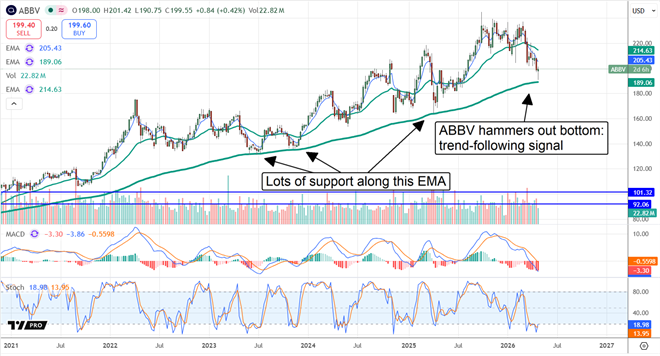
The candle formed is a Hammer Doji, a pattern often signaling the end of a downtrend as the market hammers out a bottom. The indicators show the market is oversold and that bearish momentum is extreme, setting the stage for a rebound. The question now is what may trigger that rebound, and it may be as simple as value and dividends.
AbbVie Presents a Value and Yield Opportunity Smart Money Is Buying
AbbVie stock trades at approximately 14X its current-year earnings forecast as of late April. That is about 40% below its long-running average, opening the door to significant upside. The case for higher prices is supported by the dividend, which yields an attractive 3.4% at these levels, with distribution growth in the forecast. AbbVie is as good as a Dividend King, given its relationship to Abbott Laboratories (NYSE: ABT), and has increased its payment every year since the spin-off.
The payout ratio is on the high side, around 65%, but that is not unusual for a dividend payer of this quality. The key detail is the cash flow and balance sheet, which support the payment and its sustainability. As it stands, ABBV can sustain its payments and mid-single-digit compound annual growth rate (CAGR) for the foreseeable future, with no hiccups in sight.
Analyst forecasts align with the valuation. The 26 tracked by MarketBeat peg the stock at Moderate Buy, with a 65% buy-side bias and nearly 30% upside at the consensus. Activity in 2026, leading into the Q1 report, included some price target reductions but nothing major, as most moves clustered in a tight range around the consensus target. The likely outcome is that analysts' sentiment remains firm, although a market catalyst may not emerge from this group until later in the year.
Institutional interest is far more robust. This group underpins the rebound outlook, owning more than 70% of the stock and aggressively accumulating over the trailing 12 months. MarketBeat data shows their activity ramping in Q1 2025, sustaining the high level through Q1 2026, and remaining bullish in early Q2, running at better than a $2-to-$1 pace during that time. Activity in Q1 accelerated as price action fell, rising to over $4-to-$1, highlighting the value opportunity. Assuming this group continues to buy robustly, ABBV’s bottom is likely in, and a rebound is only a matter of time.
AbbVie Puts Patent Cliff in Rear-View Mirror
AbbVie’s Q1 results should put any concerns about its patent cliff behind it. Revenue grew 12.4% to $15 billion on strength in Skyrizi and Rinvoq, while Humira sales lagged at $668 million and new studies highlighted Rinvoq's efficacy. AbbVie said in a separate release that Rinvoq outperformed Humira on the primary endpoint and met secondary objectives, setting the stage for continued outperformance in upcoming quarters. Segmentally, all but Oncology posted growth, led by a 26% increase in Neurosciences and a 16.4% increase in Immunology.
Margins are another area of strength. GAAP earnings came in well below forecasts due to acquired R&D milestones, but adjusted results were much better. Adjusted EPS of $2.65 increased 7.7% from the prior year, missing consensus by only a narrow margin. Guidance, the more important factor, was more positive, with the company lifting its full-year adjusted EPS range to more closely align with market expectations. The likely outcome is that the company continues to execute well, including on pipeline advancements, and outperforms in upcoming quarters.
This year’s catalysts include expected results from clinical trials, particularly in the Oncology portfolio, and the expansion of existing treatments. The company has numerous applications in progress for expanded coverage of key therapeutics, including blockbusters Rinvoq and Skyrizi. Risks include competition, especially for Humira, but that threat diminishes with each passing quarter.
Palantir's Critics Are "Right"—But They're Also Still Wrong
Author: Chris Markoch. Article Posted: 5/14/2026.
Key Points
- Palantir posted 85% revenue growth and raised full-year guidance, reinforcing its leadership in enterprise AI software.
- Critics continue to focus on valuation, but PLTR stock has repeatedly rewarded investors despite those concerns.
- Analysts and institutional investors are still increasing exposure to Palantir as the stock consolidates after earnings.
- Special Report: Elon Musk already made me a “wealthy man”
Palantir Technologies (NASDAQ: PLTR) is down just over 10% since its May 4 earnings report as of the May 13 close. The earnings report was exceptional on every level, but it wasn’t enough to convince the company’s skeptics to push the buy button.
In fairness, there’s a lot of noise surrounding Palantir that has nothing to do with the earnings report. The stock initially dropped on concerns over the impact artificial intelligence (AI) would have on software stocks.
SpaceX is going public - here's the overlooked opportunity (Ad)
The SpaceX IPO is valued at $1.75 trillion - but buying shares directly may not be the strongest play available to investors.
Weiss Ratings analyst Eliza Lasky has identified an alternative approach that sidesteps SpaceX shares entirely, with the potential for larger gains than the IPO itself.
See how to position yourself ahead of the SpaceX IPOThat’s a legitimate macro conversation. However, it assumes that Palantir is a passive software company waiting to be disrupted.
But, to the contrary, this company is the one doing the disrupting, and it continues to do just that on both the government and the commercial side.
What the Earnings Actually Said
The Q1 2026 results were historically good. Palantir posted revenue of $1.63 billion, an 85% year-over-year increase, and the fastest top-line growth the company has delivered since its 2020 direct listing. The quarter marked the company's 11th consecutive period of revenue acceleration. That’s a streak that most large-cap software companies can't come close to matching.
U.S. revenue crossed the 100% threshold for the first time since going public, rising 104% year-over-year to $1.28 billion. On the commercial side, domestic revenue surged 133% to $595 million. Government contracts contributed $687 million, up 84%. Net income nearly quadrupled to $870.5 million compared to $214 million in the same period a year ago. The company's Rule of 40 score, a key metric combining revenue growth and profitability, hit 145%, among the highest ever recorded for an enterprise software company of this scale.
Management didn't just beat estimates; it raised full-year revenue guidance to $7.65–$7.66 billion, implying 71% growth for 2026 and topping the analyst consensus by nearly $400 million.
The Valuation Debate—And Why It Keeps Losing
Palantir critics are hyper focused on the firm's short-term valuation. The company’s valuation is extreme. It factors years' worth of exceptional performance into the current price. And, the critique goes, what happens to the share price if the company can’t deliver those results?
However, these are the same arguments that have been made with PLTR at $20, $50, $100, and $180. They weren’t any less right. But every single time, the people who weren’t buying missed the next leg up. The critique isn't wrong; it's just not useful. In the case of PLTR, the only shots investors have missed are the ones they didn’t take.
A longer-term view of Palantir shows a company that’s been growing its business at 75% to 100% annually. At that rate, profits are bound to follow—a point Palantir CEO Dr. Alex Karp made in his letter to shareholders. Karp noted that Palantir made as much profit in the first quarter as it did in revenue just 12 months ago.
The Palantir Critics Are Arguing Among Themselves
The critique about Palantir is the same today as it’s been for several years. But it doesn’t really matter to many retail investors. And here’s why. Consider investors who bought the stock below $20 or even below $10, rode it to above $180, and probably took out their initial investment along the way.
These investors are now sitting on pure profit. They’re not losing sleep about valuation, and they aren’t going to apologize for having conviction in PLTR. That's why the valuation debate rings hollow. At this point, it’s well-meaning investors who are content in being “right” but missed out and continue to miss out on a one-of-one company.
Analysts Are Raising Their Targets
It’s always important to pay attention to what analysts do, perhaps more than what they say. PLTR’s consensus price target is $195.16, almost 50% above mid-March levels. It’s also more than double where it was one year ago.
Here again, some critics will note that the consensus price hasn’t increased much over the last three months. But since the earnings report, Rosenblatt Securities raised its price target to $225 from $200; Citigroup also went to $225 from $210. And, of course, Dan Ives from Wedbush reiterated his $230 price target for PLTR.
Institutional buying is another addition to the story. Two recent 13-F filings show that multiple Vanguard funds have started new positions in PLTR. The purchases total 195,923,062 shares, which comes out to roughly $27 billion as of May 8, the day of purchase.
What the Dip in Palantir Actually Represents
PLTR is going through a healthy, and normal, consolidation. Like gold above $5,000, Palantir stock trading above $200 was trading in rarefied air. Palantir’s inability to hold that big number isn’t a sign that the business model is flawed; it just showed that even the bulls need time to reset.
And what’s happening with PLTR is a reset. But it’s one that current shareholders are likely to look back on the same way they’ve viewed every other dip. The company’s earnings results are obviously not enough to win over the valuation skeptics. But being right about the valuation and being right about the stock are two very different things.
This email content is a paid advertisement from Weiss Ratings, a third-party advertiser of Earnings360 and MarketBeat.
11780 US Highway 1,
Palm Beach Gardens, FL 33408-3080
Would you like to edit your e-mail notification preferences or unsubscribe from our mailing list?
Copyright © 2026 Weiss Ratings. All rights reserved.
If you need assistance with your account, please contact MarketBeat's South Dakota based support team at [email protected].
If you no longer wish to receive email from Earnings360, you can unsubscribe.
© 2006-2026 MarketBeat Media, LLC. All rights protected.
345 N Reid Pl., Sixth Floor, Sioux Falls, S.D. 57103. U.S.A..