BlackRock already has a fund running on it.
Goldman Sachs has announced full integration plans.
JPMorgan is already moving $2 billion a day through it.
And your stock broker hasn't said a word about it.
The talking heads on CNBC? Clueless.
Your token financial guru on Twitter? Same.
But if you study the news closely, the story is hiding in plain sight.
Watch the free briefing: What the institutions are buying while Main Street sleeps.
President Trump just signed a law forcing every financial institution in America to migrate onto a new high-speed Money Grid by April 2027.
Larry Fink, the CEO of BlackRock, the biggest asset manager on Earth, calls the New Money Grid "the next major evolution in market infrastructure".
And here's the thing…
Every transaction on this grid burns one scarce digital asset that BlackRock, JPMorgan, Goldman Sachs, Fidelity and Andreessen Horowitz are hoarding before the news goes mainstream.
And why wouldn't they be?
Considering $382 trillion will flood onto these rails over the next year and this one scarce resource is not only needed, it's 100% mandatory.
Inescapable because it hosts over 50% of the world's dollar backed stable coins.
The institutions know this.
That's why they're accumulating quietly without alerting the masses and driving the price up before they're done loading their positions.
And everyday Americans have a narrow window to get in ahead of the crowd.
That's why I put the full story in a free special report…
Get the name, the ticker, how to buy, and everything you need to decide if this is right for you.
The smart money is already moving.
That's a fact.
The question is: will you move with them or watch from the sidelines?
Andy Howard
The Edge™ Senior Blockchain Analyst
Powering Up: UGI Banks $685M in Strategic Turnaround
Authored by Jeffrey Neal Johnson. Article Published: 5/4/2026.
Key Points
- UGI Corporation is executing a formalized business turnaround by divesting non-core assets to improve its financial health and sharpen its focus.
- A significant infusion of capital from recent asset sales is being used to aggressively deleverage the balance sheet and secure UGI Corporation's dividend.
- Profitability in UGI Corporation's core gas segments is improving, suggesting positive operational momentum for the newly streamlined enterprise.
- Special Report: Elon Musk already made me a “wealthy man”
Utility sector investors often prioritize balance sheet stability and dividend security above all else. A strategic shift is underway at UGI Corporation (NYSE: UGI) that appears designed to deliver on both fronts. UGI Corporation is executing a significant capital optimization plan, anchored by the recent divestiture of its Pennsylvania electric division, to aggressively deleverage its financial position and sharpen its focus on core energy distribution segments.
This operational pivot may present a compelling opportunity for investors seeking a deeply discounted entry point into a utility with a renewed commitment to capital efficiency and a secure, high-yield dividend.
Ticker Revealed: Pre-IPO Access to "Next Elon Musk" Company (Ad)
We’ve found The Next Elon Musk… and what we believe to be the next Tesla.
It’s already racked up $26 billion in government contracts.
Peter Thiel just bet $1 Billion on it.
👉 Unlock the ticker now and get it completely free.The cornerstone of this initiative is the definitive agreement announced on April 28, 2026, to sell its Pennsylvania Electric Division to funds managed by Argo Infrastructure Partners. The transaction will inject approximately $470 million in cash, which management has explicitly earmarked for debt reduction. The sale includes a portfolio of 2,700 miles of transmission lines and 14 substations, marking a decisive exit from a capital-intensive, regulated electricity business. It also represents UGI’s second major transaction with Argo in the last 12 months, signaling a streamlined execution pathway for future portfolio adjustments.
The announced divestiture is not the first move in UGI’s new strategy. The company has also been methodically exiting its European LPG business, a series of transactions that added another $215 million to the liquidity pipeline. Combined, these divestitures provide UGI with a war chest of roughly $685 million to fortify its balance sheet, a sum representing a meaningful percentage of its $8.07 billion market capitalization.
Forging a Fortress Balance Sheet
The direct consequence of this capital infusion is a cleaner, more resilient financial profile. For a utility, a lower debt-to-equity ratio provides significant operational flexibility, reduces risk during periods of macroeconomic turbulence, and can lower the overall cost of capital by improving credit metrics. These savings in interest expense can flow directly to the bottom line, boosting earnings and cash flow that can be reinvested or returned to shareholders. For equity holders, it also enhances the security of dividend payments, which remain a primary attraction of the stock.
UGI boasts a 37-year track record of consecutive dividend increases, a testament to its long-term operational stability. The current annualized dividend of $1.50 per share provides a forward yield of 4.2%. Critically, this distribution is well-supported by UGI Corporation's financial performance. The dividend payout ratio stands at a sustainable 55% of trailing earnings and a more conservative 25% of cash flow. These metrics suggest that the dividend is not only safe but has room for continued growth as UGI Corporation’s turnaround strategy and deleveraged balance sheet gain traction.
Turnaround Unspooling: Core Profitability Is on an Upward Trend
A surface-level review of UGI’s most recent earnings report for Q1 2026 could give investors pause. UGI Corporation reported earnings per share of $1.26, missing the analyst consensus estimate of $1.50. While quarterly revenue rose 2.6% year over year to $2.08 billion, the EPS miss warrants a deeper look into UGI Corporation's operational health.
Beneath the headline numbers, the core business demonstrates considerable strength. Reportable segment earnings before interest and taxes (EBIT) expanded by 5% year over year, reaching $441 million. This growth was primarily driven by the implementation of new base rates for its Pennsylvania natural gas division and a significant 16% increase in core market volume. This indicates that, despite certain headwinds or non-operational items affecting the final EPS figure, the profitability of UGI Corporation's primary natural gas and propane segments is improving.
This underlying performance aligns with management’s publicly stated goals. CEO Robert Flexon has characterized 2026 as a business turnaround year, a sentiment reinforced by the February appointment of Sidd Manjeshwar as Chief Strategy Officer. This leadership alignment signals that the recent divestitures are not reactionary but part of a deliberate, forward-looking plan to optimize the asset portfolio for long-term value creation.
Why UGI Trades at a Steep Discount to Its Peers
From a valuation perspective, UGI Corporation trades at a notable discount to its peers. With a trailing price-to-earnings ratio (P/E) of 13x and a forward P/E of 12x, UGI Corporation appears undervalued relative to the broader utility sector. For comparison, a direct competitor, Atmos Energy Corporation (NYSE: ATO), currently trades at a P/E closer to 25x. This valuation gap likely reflects market skepticism stemming from past performance and the complexity of its prior business mix. It could narrow as UGI successfully executes its deleveraging strategy and the market recognizes the improved financial stability of the leaner enterprise.
Wall Street sentiment remains cautiously optimistic. The consensus rating among five analysts is a Moderate Buy, with an average price target of $42. This target suggests a potential upside of about 18% from the early May share price.
However, investors should consider potential risks. UGI Corporation is currently navigating rate cases with the Pennsylvania Public Utility Commission, and the outcome will be a key determinant of future margin expansion.
Additionally, recent insider trading data shows net selling of $1.26 million over the past 12 months. While this appears to be part of planned compensation, it warrants monitoring.
Strategically Reengineering a Sharper Focus
UGI's strategic actions represent a clear and decisive pivot toward its core competencies in natural gas and propane distribution. The infusion of nearly $700 million from asset sales provides a direct and immediate path to a stronger balance sheet. This financial discipline, combined with underlying operational growth in its core segments and a discounted valuation, creates a compelling narrative.
Investors seeking stable, high-yield exposure within the utility sector might consider adding UGI Corporation to their watchlist. UGI Corporation's commitment to a formal turnaround, backed by tangible strategic divestitures, appears to be positioning it for a period of enhanced shareholder returns.
Why Satellogic Could Be One of the Biggest Space Winners of 2026
Authored by Thomas Hughes. Article Published: 5/14/2026.
Key Points
- Satellogic reached a turning point in 2026, producing its first-ever positive operating cash flow.
- Analysts are lifting targets, but the market has outrun sentiment and may correct before hitting fresh highs.
- Institutions are likely buyers, having ramped accumulative activity in Q1 2026.
- Special Report: Elon Musk already made me a “wealthy man”
Satellogic (NASDAQ: SATL) is a rising star in the space industry and a top-10 operator by constellation size.
The company is on track to continue launching satellites in 2026, expand its already functioning service base, and launch new products later this year. Its business is driven by the democratization of space-based observation, which enables low-cost, highly efficient, high-frequency monitoring of Earth-based assets.
Ticker Revealed: Pre-IPO Access to "Next Elon Musk" Company (Ad)
We’ve found The Next Elon Musk… and what we believe to be the next Tesla.
It’s already racked up $26 billion in government contracts.
Peter Thiel just bet $1 Billion on it.
👉 Unlock the ticker now and get it completely free.More importantly, the business model supports dedicated services, which in turn creates a lucrative defense and sovereign business. The takeaway for investors is that space is about to explode, underpinned by technological advancements, AI, and the SpaceX IPO, and this company is well-positioned to benefit.
Satellogic Reaches a Turning Point in 2026
The Q1 results highlighted a turning point for this name. Revenue grew by 80%, and the company recorded meaningful improvements in leverage, including on the cost of revenue line. Cost of revenue increased by only 17%, reflecting structural leverage tied to scale. Growth was supported by both new and existing clients, with service quality often converting single-image customers into longer-term subscribers. Looking ahead, the company is expected to grow at a mid-50% compound annual growth rate for at least the next five years, setting the stage for more than a 5X increase in revenue and a path to profitability within four years.
Another key detail from the firm's Q1 was positive operating cash flow. The figure was small, but it was positive and is expected to continue improving in the coming quarters. The company is well-capitalized and now generating cash flow, suggesting that dilution and debt risk have diminished. Even so, the diluted share count is up approximately 45% following a capital raise completed earlier in 2026.
The balance sheet details reflect the capital raise, including the issuance of debt instruments over the trailing 12 months. The good news is that cash is up and remains ample at nearly $122 million, providing a multiquarter runway for strategic execution. Leverage also remains manageable, with debt just over 1X cash.
The bad news is that debt has increased significantly compared with the prior year, and cash burn is expected to continue. The key question is how much cash flow improvement will materialize in the coming quarters and when investors will recoup their losses. One impact of the Q1 activity is that equity has turned negative, a situation that will likely worsen as the cash pile diminishes.
Bullish Catalysts Drive Satellogic Price Action
Satellogic has enough catalysts in 2026 to support an outlook for business acceleration and improving cash flow dynamics. Among them are strength in the defense and sovereign businesses, including more than $30 million in new or follow-on contracts, continued launches of NewSat satellites, the expansion of the Aleph-1 constellation, and the upcoming launch of Merlin. Merlin is a next-generation constellation targeted at the defense industry. It enables daily global remapping at 1-meter resolution, which is critical for real-time, actionable decision-making.
Analysts and institutional trends suggest that Satellogic’s uptrend is strong and has room to run. MarketBeat tracks only eight analysts who cover the stock, a relatively small number, but coverage is increasing, sentiment is firming, and price targets are rising. The only downside is that the stock price action is leading consensus, not the other way around, leaving the market susceptible to increased volatility and potentially sharp pullbacks within the uptrend. However, assuming the company executes well, growth will likely reinforce bullish analyst trends, leading to stronger coverage and higher price targets.
Institutional data is equally bullish. The group owns about 17.5% of the stock, which is still a relatively small amount, but institutions are accumulating. Activity is rising sequentially and provides a strong tailwind, with accumulation running at a rate of $10-to-$1. In this scenario, the pace may slow in upcoming quarters but is unlikely to revert to distribution for many years.
The stock price action is very bullish, with SATL bottoming in 2023, moving higher, correcting, rebounding, confirming a reversal, and moving higher again, resulting in an 800% gain over that period. More recently, the stock has staged a solid rally, supported by rising volume and a converging MACD, signaling strengthening momentum.
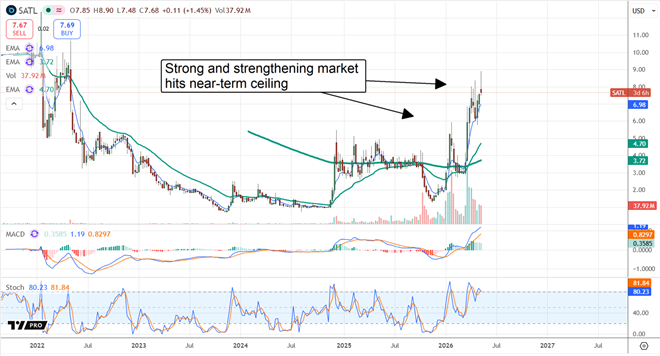
The likely outcome is that SATL stock continues to trend higher, although some near-term risk remains. The latest candle suggests a top may have been reached and that a price pullback is at hand. Solid support may be found near $7, but a move to $6 or lower is not out of the question.
Execution is the biggest risk. The company's business is tied to satellite launches, and any hiccups, missteps, or lost product will be reflected in the stock price.
This email message is a paid advertisement provided by Awesomely, LLC, a third-party advertiser of InsiderTrades.com and MarketBeat.
If you need help with your newsletter, don't hesitate to contact MarketBeat's South Dakota based support team at [email protected].
If you no longer wish to receive email from InsiderTrades.com, you can unsubscribe.
Copyright 2006-2026 MarketBeat Media, LLC. All rights protected.
345 N Reid Place #620, Sioux Falls, S.D. 57103-7078. U.S.A..