
| From | Center for the National Interest <[email protected]> |
| Subject | Policy Brief | Iran: The U.S. Needs to Find an Offramp, Soon |
| Date | May 14, 2026 3:13 PM |
Links have been removed from this email. Learn more in the FAQ.
Links have been removed from this email. Learn more in the FAQ.
[link removed]
** CFTNI Policy Brief
------------------------------------------------------------
** Iran: The U.S. Needs to Find an Offramp, Soon
------------------------------------------------------------
Ten weeks after the U.S. and Israel began their campaign of military strikes against Iran, a ceasefire remains in place, but negotiations appear deadlocked. In the Center for the National Interest’s latest Policy Brief, CFTNI Senior Fellow Greg Priddy assesses current circumstances and U.S. options in what has become an economic war of attrition.
In particular, Priddy argues that American national interests would be best served by acknowledging that we do not in fact “hold all the cards” and that the Trump administration will have to engage more seriously in diplomatic give-and-take with Iran to protect U.S. interests. Acquiescing to limited uranium enrichment under IAEA safeguards after any enrichment moratorium ends is likely to be necessary to get an agreement, he argues, and Washington should explore what Iran might be willing to concede in return. Unfortunately, he argues, waiting for Iran to capitulate on enrichment under the weight of the U.S. naval blockade could subject Americans to economic damage that they may not accept to pursue a war that few consider essential or existential.
Read the brief ([link removed]) .
For more CFTNI publications, please see our website ([link removed]) .
Paul J. Saunders
President
[link removed]
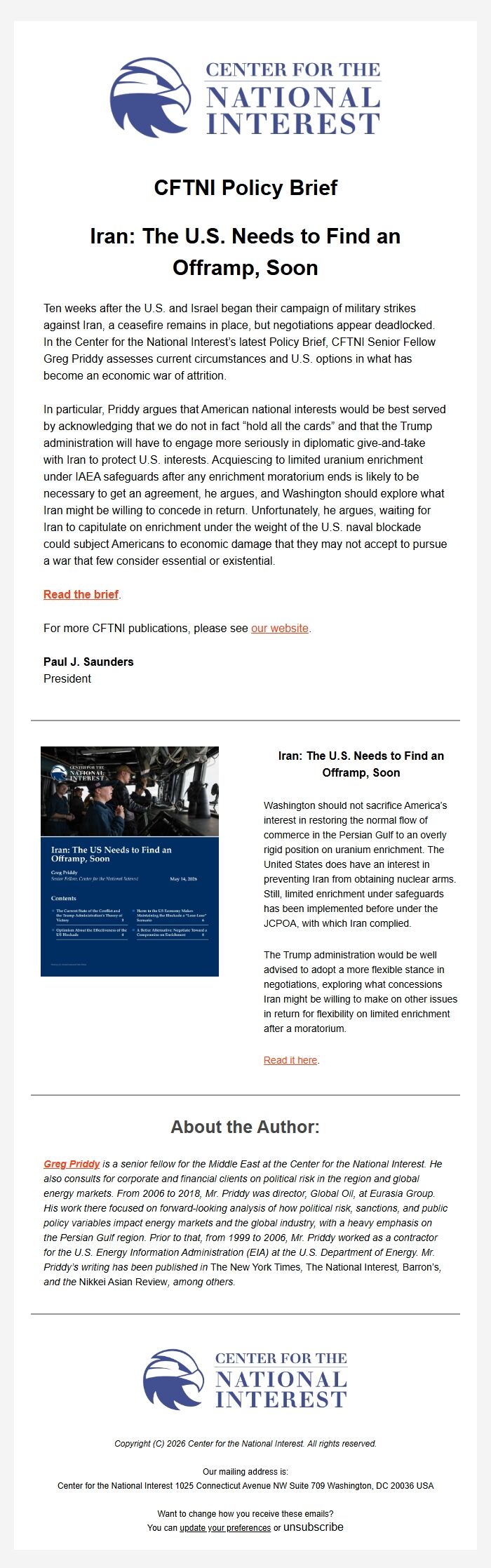
Iran: The U.S. Needs to Find an Offramp, Soon
Washington should not sacrifice America’s interest in restoring the normal flow of commerce in the Persian Gulf to an overly rigid position on uranium enrichment. The United States does have an interest in preventing Iran from obtaining nuclear arms. Still, limited enrichment under safeguards has been implemented before under the JCPOA, with which Iran complied.
The Trump administration would be well advised to adopt a more flexible stance in negotiations, exploring what concessions Iran might be willing to make on other issues in return for flexibility on limited enrichment after a moratorium.
Read it here ([link removed]) .
About the Author:
Greg Priddy ([link removed]) is a senior fellow for the Middle East at the Center for the National Interest. He also consults for corporate and financial clients on political risk in the region and global energy markets. From 2006 to 2018, Mr. Priddy was director, Global Oil, at Eurasia Group. His work there focused on forward-looking analysis of how political risk, sanctions, and public policy variables impact energy markets and the global industry, with a heavy emphasis on the Persian Gulf region. Prior to that, from 1999 to 2006, Mr. Priddy worked as a contractor for the U.S. Energy Information Administration (EIA) at the U.S. Department of Energy. Mr. Priddy’s writing has been published in The New York Times, The National Interest, Barron’s, and the Nikkei Asian Review, among others.
Copyright (C) 2026 Center for the National Interest. All rights reserved.
Our mailing address is:
Center for the National Interest
1025 Connecticut Avenue NW
Suite 709
Washington, DC 20036
USA
Want to change how you receive these emails?
You can update your preferences ([link removed]) or unsubscribe ([link removed])
** CFTNI Policy Brief
------------------------------------------------------------
** Iran: The U.S. Needs to Find an Offramp, Soon
------------------------------------------------------------
Ten weeks after the U.S. and Israel began their campaign of military strikes against Iran, a ceasefire remains in place, but negotiations appear deadlocked. In the Center for the National Interest’s latest Policy Brief, CFTNI Senior Fellow Greg Priddy assesses current circumstances and U.S. options in what has become an economic war of attrition.
In particular, Priddy argues that American national interests would be best served by acknowledging that we do not in fact “hold all the cards” and that the Trump administration will have to engage more seriously in diplomatic give-and-take with Iran to protect U.S. interests. Acquiescing to limited uranium enrichment under IAEA safeguards after any enrichment moratorium ends is likely to be necessary to get an agreement, he argues, and Washington should explore what Iran might be willing to concede in return. Unfortunately, he argues, waiting for Iran to capitulate on enrichment under the weight of the U.S. naval blockade could subject Americans to economic damage that they may not accept to pursue a war that few consider essential or existential.
Read the brief ([link removed]) .
For more CFTNI publications, please see our website ([link removed]) .
Paul J. Saunders
President
[link removed]
Iran: The U.S. Needs to Find an Offramp, Soon
Washington should not sacrifice America’s interest in restoring the normal flow of commerce in the Persian Gulf to an overly rigid position on uranium enrichment. The United States does have an interest in preventing Iran from obtaining nuclear arms. Still, limited enrichment under safeguards has been implemented before under the JCPOA, with which Iran complied.
The Trump administration would be well advised to adopt a more flexible stance in negotiations, exploring what concessions Iran might be willing to make on other issues in return for flexibility on limited enrichment after a moratorium.
Read it here ([link removed]) .
About the Author:
Greg Priddy ([link removed]) is a senior fellow for the Middle East at the Center for the National Interest. He also consults for corporate and financial clients on political risk in the region and global energy markets. From 2006 to 2018, Mr. Priddy was director, Global Oil, at Eurasia Group. His work there focused on forward-looking analysis of how political risk, sanctions, and public policy variables impact energy markets and the global industry, with a heavy emphasis on the Persian Gulf region. Prior to that, from 1999 to 2006, Mr. Priddy worked as a contractor for the U.S. Energy Information Administration (EIA) at the U.S. Department of Energy. Mr. Priddy’s writing has been published in The New York Times, The National Interest, Barron’s, and the Nikkei Asian Review, among others.
Copyright (C) 2026 Center for the National Interest. All rights reserved.
Our mailing address is:
Center for the National Interest
1025 Connecticut Avenue NW
Suite 709
Washington, DC 20036
USA
Want to change how you receive these emails?
You can update your preferences ([link removed]) or unsubscribe ([link removed])
Message Analysis
- Sender: Center for the National Interest
- Political Party: n/a
- Country: United States
- State/Locality: n/a
- Office: n/a
-
Email Providers:
- MailChimp