My name is Porter Stansberry.
I'm the founder of one of the largest financial research firms in the world.
Over the last 26 years, we've helped investors navigate almost every major economic cycle, and we've been on the forefront of every big financial story from the rise of Bitcoin and mRNA vaccines to robotics and artificial intelligence.
But today, I'm breaking what I believe is the biggest story of my career.
Because one of the most famous historians alive — a man whose books have sold over 45 million copies in 65 languages — recently issued a warning that should stop every American dead in their tracks.
He warned of a coming wave that would create what he calls the "Useless Class."
Not the unemployed. The unemployable.
An entire segment of American society — including many white-collar professionals who earn six figures — rendered permanently irrelevant.
Not by a recession. Not by a policy mistake. But by a structural shift so large, so fast, and so irreversible that it has only one historical parallel.
1776.

That is not hyperbole.
As you'll see today, the last, and only, time a force this powerful reshaped the economic order was 250 years ago.
Now, on the eve of America's 250th anniversary, it's happening again.
One famous Stanford economist is even calling it:
"The biggest change ever… bigger than electricity… bigger than the steam engine."
And the aftershock could reset not just your personal wealth, but the entire U.S. economic system — how you work, how you earn, how you protect everything you've built.
Because as you'll discover, everything from the government quietly taking stakes in companies like Intel, Lithium Americas, and MP Materials…
To Trump's moves on Venezuela and Greenland… his never-ending executive orders… and his increasingly centralized grip over the economy…
All the way to the surging popularity of radical socialist politicians like Bernie Sanders, AOC, and Zohran Mamdani…
It's all deeply connected. All part of the same story.
A story that one Nobel Prize winner says is dividing not just the economy but our entire society.
And whether you end up on the winning side of this moment – or find yourself part of the historian's "Useless Class" – comes down to the decisions you make starting now.
The stocks to buy… the stocks to sell… and the three money moves to ensure you and your loved ones aren't left behind by what's coming.
Good investing,
Porter Stansberry
Norwegian Cruise Line Cuts Outlook as Headwinds Build
Author: Jennifer Ryan Woods. Date Posted: 5/5/2026.
Key Points
- Norwegian Cruise Line beat earnings expectations in Q1 but missed on revenue, with net yields and cost controls coming in better than guidance, pointing to some early progress in its turnaround.
- The company cut its full-year outlook, now expecting net yields to decline by 3% to 5%, and lowered its EBITDA and earnings guidance, largely due to a more challenging macro backdrop.
- While management says many of the company’s issues are internal and fixable, Norwegian continues to lag the broader cruise industry, with its stock down over the past year as peers have posted strong gains.
- Special Report: Elon’s “Hidden” Company
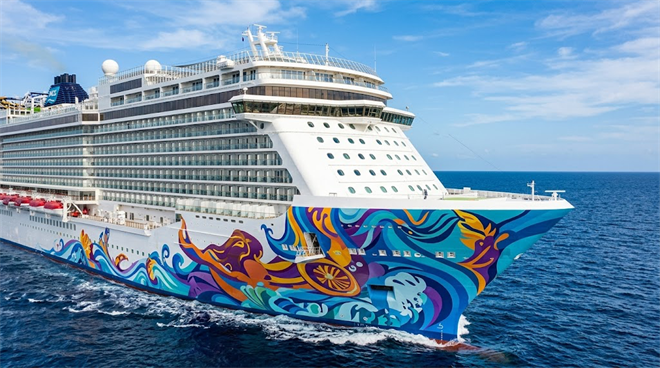
It’s been rough seas for Norwegian Cruise Line Holdings Ltd. (NYSE: NCLH), and it’s unlikely to be smooth sailing anytime soon. After reporting mixed first-quarter results on Monday morning, the company slashed its outlook, citing mounting headwinds ahead.
The cruise company has been taking steps to address internal missteps that have weighed on results over the past few years. While progress is being made, particularly on cost savings, weaker bookings and broader operational challenges will take time to resolve. At the same time, a difficult macro backdrop is making it harder to right the ship, as the conflict in the Middle East has driven up fuel costs and led to softer demand in some areas.
EPS Beats Expectations But Revenue Falls Short
Ticker Revealed: Pre-IPO Access to "Next Elon Musk" Company (Ad)
We’ve found The Next Elon Musk… and what we believe to be the next Tesla.
It’s already racked up $26 billion in government contracts.
Peter Thiel just bet $1 Billion on it.
👉 Unlock the ticker now and get it completely free.For Q1, Norwegian reported earnings of 23 cents per share, up from 7 cents per share a year ago and 8 cents above analysts’ estimates. Revenue came in at $2.33 billion, up nearly 10% year over year but about $26 million shy of Wall Street expectations.
Overall, it was a relatively solid quarter, with several key metrics coming in at or above guidance. Net yield, a key performance indicator that essentially measures the profit generated per guest per day, declined about 1% on a constant-currency basis, which was better than the company’s guidance for a 1.6% decline.
The company’s cost controls also began to show traction. Adjusted net cruise costs, excluding fuel, fell 1%, which was slightly better than expected and helped adjusted EBITDA come in at $533 million, ahead of the company’s $515 million guidance.
Weaker Outlook Takes Center Stage
On the earnings call, Chief Executive John Chidsey, who stepped into the role in February as part of the company’s turnaround effort, said that while Norwegian has been making progress on internal priorities, including improving culture, cutting costs, and refining marketing to better manage revenue, the impact will take time.
In the meantime, an increasingly challenging macro backdrop, which was not fully accounted for in prior guidance, has added further pressure.
As a result, Norwegian said it expects net yield to decline 3.6% in Q2, reflecting pressure on European sailings and weaker-than-expected domestic demand as consumers reevaluate their travel plans amid the broader macro environment.
The third quarter is expected to be significantly weaker than the second quarter. While the fourth quarter is expected to remain pressured, net yields should improve from Q3. For the full year, the company expects net yields to fall between 3% and 5%.
Due to softer-than-expected top-line performance and higher fuel costs, the company reduced its full-year adjusted EBITDA guidance to between $2.48 billion and $2.64 billion. Adjusted earnings are now expected to come in between $1.45 and $1.79 per share.
CEO Focused on "Fixable" Issues Within Company's Control
On the earnings call, CEO John Chidsey acknowledged that the updated guidance was disappointing, noting that while the company can’t control macro conditions, it is focused on improving execution and operations.
“I want to be clear, while the macro environment continues to rapidly shift beyond our control, many of the issues we are addressing are internal and fixable. They come back to execution, alignment, and discipline,” Chidsey said on the call.
He added, “While progress will take time, I am confident we are moving in the right direction to deliver stronger, more sustainable performance over time.”
The company's cost-cutting efforts, which include streamlining operations and reducing marketing spending, are expected to generate about $125 million in annualized savings.
Outlook Cut Could Drive Analyst Revisions
Unsurprisingly, Norwegian's updated guidance was not well received by Wall Street.
Shares dropped sharply after the report, falling about 8%. The stock traded near its 52-week low of $16.78, which it hit roughly a year ago.
Heading into the report, analysts were relatively bullish on Norwegian. The stock carried a Moderate Buy rating, with 11 Hold ratings, eight Buy ratings, and one Strong Buy.
The average 12-month price target of $24.76 suggested strong upside from its pre-earnings close of $18.20.
It remains to be seen whether Wall Street’s outlook will shift as analysts digest the weaker guidance.
Norwegian Lags Peers as Cruise Industry Remains Strong
Norwegian’s challenges have made it an outlier within an otherwise resilient cruise industry.
"I have confidence in the industry...the growth trends," Chidsey said during the call, adding that many of Norwegian's issues are "self-inflicted wounds that we need to go fix." He added, "I wouldn’t say that we’ve completely lost our way with agents and consumers, but I wouldn’t say we’re hitting on all cylinders."
The company's missteps are evident in its stock performance compared with peers such as Carnival Corp. (NYSE: CCL) and Royal Caribbean Cruises (NYSE: RCL). While Norwegian shares are down roughly 1% over the past year, Carnival shares are up more than 30%, and Royal Caribbean stock has gained over 10%.
Norwegian clearly has work to do to get back on track. While turnaround efforts are underway, the fixes will take time. Coupled with an uncertain macro backdrop, the company could be navigating choppy waters for a while.
Atomic Dividends: Big Tech's New Energy Bet
Author: Jeffrey Neal Johnson. Date Posted: 5/5/2026.
Key Points
- The insatiable energy demands of artificial intelligence are forcing technology giants to secure long-term nuclear power contracts.
- Clean energy utilities are de-risking their business models with guaranteed revenue from investment-grade technology companies.
- Global asset managers are now actively underwriting the construction of new American nuclear reactors, signaling a shift in private capital.
- Special Report: Elon’s “Hidden” Company
A structural power deficit is taking shape across the United States, driven by the voracious energy appetite of artificial intelligence (AI) and hyperscale data centers. That pressure has pushed technology giants into an unlikely alliance, compelling them to help underwrite the future of an energy source once left to decay: nuclear power.
Unprecedented 20-year power purchase agreements (PPAs) are now reshaping the valuation calculus for clean energy utilities, while sophisticated asset managers are deploying billions to restart dormant reactor projects. This convergence of big tech demand and smart infrastructure capital appears to be setting off a multi-decade compounding cycle for nuclear-exposed equities, and two names in particular could stand to benefit.
Big Tech's Scramble for Baseload Power
Ticker Revealed: Pre-IPO Access to "Next Elon Musk" Company (Ad)
We’ve found The Next Elon Musk… and what we believe to be the next Tesla.
It’s already racked up $26 billion in government contracts.
Peter Thiel just bet $1 Billion on it.
👉 Unlock the ticker now and get it completely free.The grid's stable foundation, or baseload power, can no longer keep pace with the exponential demand growth from the digital economy. In response, technology giants are bypassing traditional utility procurement and going straight to the source. In January 2026, Vistra Corp. (NYSE: VST) secured a landmark 2.6-gigawatt (GW) 20-year PPA with Meta Platforms (NASDAQ: META).
The deal dedicates output from three of Vistra's PJM grid nuclear assets — Perry, Davis-Besse, and Beaver Valley — to power Meta's operations, ensuring decades of predictable revenue and helping fund plant upgrades.
The Meta PPA was not a one-off for Vistra. The company also locked in a 1.2 GW PPA with Amazon's (NASDAQ: AMZN) AWS at its Comanche Peak facility. The trend is sector-wide. Constellation Energy (NASDAQ: CEG) is restarting the previously shuttered Three Mile Island plant, now named the Crane Clean Energy Center, backed by a 20-year PPA from Microsoft (NASDAQ: MSFT). Similarly, Talen Energy (NASDAQ: TLN) signed a 1.9 GW deal with Amazon at its Susquehanna nuclear plant. These long-duration contracts with investment-grade counterparties provide immense cash flow visibility, transforming how the market values these utility operators.
How Vistra De-Risked Its Nuclear Revenue Stream
Vistra Corp. is strategically positioning itself as a primary beneficiary of this baseload power shortage. The company's recent PPAs fundamentally de-risk its revenue model, shifting a portion of its generation portfolio from fluctuating wholesale power markets to long-term, fixed-price contracts. This stability is not yet fully reflected in its valuation, suggesting an opportunity may exist.
A primary concern for investors has been Vistra's balance sheet, which carries a notable $19.6 billion in net debt. The durability of its new contracted cash flows, however, significantly mitigates this risk. Credit rating agency Fitch acknowledged this improved financial profile by upgrading Vistra to investment grade in March 2026. The high credit quality of its offtake partners provides a secure foundation for servicing its debt and funding future growth, including its recent $4.7 billion acquisition of 5.5 GW of dispatchable natural gas assets from Cogentrix to help hedge against intermittency.
The Architect of the American Nuclear Build-Out
While established operators monetize existing assets, a different strategy is unfolding in the infrastructure space. Brookfield Asset Management (NYSE: BAM) is moving beyond passive investment to become an active architect of the nuclear renaissance. On May 4, 2026, the global asset manager announced a joint venture with The Nuclear Company, a specialized project execution firm.
This new entity will have the exclusive mandate to deploy Westinghouse AP1000 and AP300 reactor technology, a critical advantage given Brookfield's 51% ownership stake in Westinghouse Electric Company.
The venture's first objective is a direct signal of its ambition: evaluating completion of the V.C. Summer Nuclear Units 2 and 3 in South Carolina, a project abandoned in 2017 due to cost overruns. Brookfield's willingness to underwrite such a complex project demonstrates immense confidence in the current regulatory and commercial landscape. By leveraging Westinghouse's established technology and supply chains, Brookfield aims to eliminate the historical construction risks that have long plagued new nuclear development in the United States. This move represents a pivotal shift, with private capital now prepared to lead the build-out of new, large-scale nuclear capacity.
A Chain Reaction of Catalysts
The strategic moves by individual companies are supported by powerful macroeconomic tailwinds. A recent Bank of America Global Research report described the global nuclear development cycle as strongly underpinned by the twin forces of soaring electricity demand and renewed policy support for carbon-free energy. That view is echoed in the commodities market. Bank of America metals strategist Michael Widmer forecasts that uranium prices could reach $130 per pound by the fourth quarter of 2026, a material premium to current spot prices. Rising fuel costs create a favorable environment for large, efficient operators like Vistra and Constellation, which have the scale to secure advantageous long-term supply contracts.
2 Paths to Atomic Profits: Operators Vs. Builders
The U.S. power grid is at an inflection point, with the demands of artificial intelligence serving as the primary catalyst for a structural reinvestment in nuclear energy. This has created two distinct avenues for investor consideration. On one side are the independent power producers like Vistra Corp., which own and operate a fleet of prized nuclear assets positioned to capture long-term, contracted revenue streams from technology giants.
On the other hand are the infrastructure financiers and developers like Brookfield Asset Management, which are positioned to engineer and fund the next generation of nuclear reactors. Investors considering this sector must weigh the operational risks and balance sheet leverage of utilities against the project execution and capital deployment challenges faced by infrastructure managers. The powerful secular tailwinds of digitization and decarbonization, however, suggest that both segments may offer compelling opportunities for those seeking exposure to this emerging, multi-decade energy investment cycle.
This email is a paid advertisement from Porter & Company, a third-party advertiser of InsiderTrades.com and MarketBeat.
If you have questions about your account, please don't hesitate to contact MarketBeat's U.S. based support team at [email protected].
If you no longer wish to receive email from InsiderTrades.com, you can unsubscribe.
© 2006-2026 MarketBeat Media, LLC. All rights protected.
345 N Reid Place #620, Sioux Falls, SD 57103-7078. United States of America..