BlackRock already has a fund running on it.
Goldman Sachs has announced full integration plans.
JPMorgan is already moving $2 billion a day through it.
And your stock broker hasn't said a word about it.
The talking heads on CNBC? Clueless.
Your token financial guru on Twitter? Same.
But if you study the news closely, the story is hiding in plain sight.
Watch the free briefing: What the institutions are buying while Main Street sleeps.
President Trump just signed a law forcing every financial institution in America to migrate onto a new high-speed Money Grid by April 2027.
Larry Fink, the CEO of BlackRock, the biggest asset manager on Earth, calls the New Money Grid "the next major evolution in market infrastructure".
And here's the thing…
Every transaction on this grid burns one scarce digital asset that BlackRock, JPMorgan, Goldman Sachs, Fidelity and Andreessen Horowitz are hoarding before the news goes mainstream.
And why wouldn't they be?
Considering $382 trillion will flood onto these rails over the next year and this one scarce resource is not only needed, it's 100% mandatory.
Inescapable because it hosts over 50% of the world's dollar backed stable coins.
The institutions know this.
That's why they're accumulating quietly without alerting the masses and driving the price up before they're done loading their positions.
And everyday Americans have a narrow window to get in ahead of the crowd.
That's why I put the full story in a free special report…
Get the name, the ticker, how to buy, and everything you need to decide if this is right for you.
The smart money is already moving.
That's a fact.
The question is: will you move with them or watch from the sidelines?
Andy Howard
The Edge™ Senior Blockchain Analyst
Did Qualcomm Just Put Apple in Check?
Reported by Jeffrey Neal Johnson. Posted: 4/28/2026.

Key Points
- Qualcomm's alliance with OpenAI is a strategic move to create a new, open ecosystem for advanced on-device artificial intelligence.
- Management's confidence is underscored by a substantial share repurchase program, signaling a strong belief in Qualcomm’s long-term valuation.
- Qualcomm is working to transition from a component supplier to the central platform for the entire mobile artificial intelligence ecosystem.
- Special Report: Elon Musk’s $1 Quadrillion AI IPO
As a technology sector investor, the market sometimes sends a signal so clear it cannot be ignored. Recently, semiconductor sector giant Qualcomm (NASDAQ: QCOM) saw its stock climb more than 11% in a single trading session. That strong move came in response to reports of a transformative alliance with OpenAI, the leader in artificial intelligence (AI). Trading volume was nearly triple the daily average, reaching 33 million shares, suggesting that substantial capital was flowing into the stock.
Such a sudden and aggressive market shift suggests the established hierarchy in the multi-trillion-dollar smartphone market is being challenged. For years, the industry has been defined by incremental hardware upgrades and software updates.
The #1 altcoin for the Kevin Warsh Fed era (Ad)
That's when Kevin Warsh is projected to take over as Fed Chair on May 15th...
Warsh has publicly called Bitcoin "the new gold." He's invested in crypto personally. He views digital assets as legitimate… not a threat, not a fad. For the first time in history, the most powerful financial seat in the world will be occupied by someone who actually gets crypto.
Our analysts have been tracking this transition for months. They've identified what they believe is the #1 crypto positioned to benefit as the Warsh era begins.
See the #1 altcoin our analysts have flagged.This new partnership, however, signals a fundamental change in strategy. It appears to be the opening move in a new competitive era in which a device’s intelligence matters more than camera pixels or screen resolution. For investors, understanding this pivot is crucial to identifying the companies poised to lead the next decade of mobile innovation.
It Is a War of Ecosystems, Not Just Devices
The catalyst behind this strategic pivot is a fundamental change in how AI works. The partnership between Qualcomm and OpenAI focuses on creating chips that run powerful AI models directly on devices, a concept known as Edge AI. This marks a significant leap from the cloud-based AI that has dominated for years.
This move to the edge brings a host of powerful advantages:
True Instantaneous Performance: By processing locally, Edge AI eliminates the network lag inherent in cloud computing. This can make AI assistants and applications feel seamless and truly responsive.
A Fortress of Privacy: Keeping sensitive user data on the device, rather than sending it to a remote server, is a critical privacy advantage and a powerful selling point for modern consumers.
Unlocking New Capabilities: On-device processing enables more sophisticated, always-on AI applications that can deeply integrate with a phone's hardware in real time, creating experiences not possible with cloud-based systems.
This technology is the weapon in a much larger strategic battle. Qualcomm is positioning its Snapdragon platform as the premier hardware for manufacturers looking to compete in AI. This open ecosystem model invites collaboration across the entire Android market, echoing the historic PC wars in which the open architecture of Windows-based machines ultimately captured dominant market share from Apple Inc.'s (NASDAQ: AAPL) closed system.
This strategy is a direct challenge to Apple's walled-garden approach. While Apple’s control over its hardware and software has been a major strength, it can also slow the integration of breakthrough third-party innovations.
By partnering with one of the biggest names in AI, Qualcomm is making an aggressive play to leapfrog Apple’s internal development. The goal appears to be making Snapdragon silicon the indispensable standard for developers building next-generation AI applications, forcing the industry to build on its platform.
Management's Bet: Back the Vision With Cash
A visionary strategy requires more than just good ideas; it requires the financial conviction to see it through, especially when facing short-term market headwinds. While the long-term potential of Edge AI is significant, some analysts remain cautious, citing a projected 1.1% decline in near-term earnings growth within a softer overall smartphone market.
Qualcomm’s management, however, is making a strong case through its capital allocation strategy. The clearest signal of that confidence is the board's authorization of a $20 billion share repurchase program. A buyback of this scale is a direct statement from Qualcomm that it believes its shares are fundamentally undervalued.
Qualcomm’s buyback could retire up to 14.5% of its outstanding shares, creating two major benefits for investors. First, it establishes strong, sustained demand for the stock, which could help support shares during periods of volatility. Second, by reducing the share count, the program directly boosts earnings per share (EPS), a critical valuation metric that can make the stock appear more attractive even if profits remain flat.
This aggressive buyback is supported by Qualcomm’s steady dividend. The current 2.4% yield provides a reliable income stream, rewarding shareholders for their patience as the long-term AI strategy matures. Together, these financial tools act as a suit of armor for the investment thesis, signaling deep confidence from leadership and providing a financial buffer against near-term uncertainty.
How to Track the AI Rerating
The combination of a disruptive technological pivot and aggressive financial support has placed Qualcomm at a critical inflection point. Qualcomm is making a clear effort to transition from being seen as a component supplier, subject to handset sales cycles, into the central platform for the entire mobile AI ecosystem.
The market’s initial reaction and Qualcomm’s financial commitments suggest a potential re-rating of the stock could be underway. In this scenario, investors may increasingly value Qualcomm for its foundational role in the secular, long-term growth of artificial intelligence. Success is not guaranteed, but the strategy to become the indispensable hardware for mobile AI is clear.
For those monitoring this transformation, the upcoming Q2 2026 earnings release on April 29 and the 2026 Investor Day on June 24 are key events. Investors may look for updates on the OpenAI partnership, initial feedback from device manufacturers, and any revisions to Qualcomm’s long-term financial outlook. These data points will be crucial in determining whether Qualcomm is successfully executing its ambitious vision and solidifying its path toward market leadership in the new AI era.
Spotify’s Ad Slump Raises a Bigger Question Than You Think
Authored by Chris Markoch. Publication Date: 4/29/2026.

Key Points
- Spotify stock dropped sharply after weak guidance and declining ad revenue raised growth concerns.
- Slowing premium subscriber growth challenges the company’s ability to justify its premium valuation.
- Technical indicators suggest SPOT may face further downside if key support levels fail.
- Special Report: Elon Musk’s $1 Quadrillion AI IPO
Spotify Technologies SA (NASDAQ: SPOT) fell nearly 13% after delivering cautious guidance in its Q1 2026 earnings report. A key weakness was ad revenue, which declined for the second consecutive quarter. Spotify continues to become more efficient at generating revenue by adding premium subscribers. That said, ad revenue still makes up a significant portion of the company’s top-line growth.
The #1 altcoin for the Kevin Warsh Fed era (Ad)
That's when Kevin Warsh is projected to take over as Fed Chair on May 15th...
Warsh has publicly called Bitcoin "the new gold." He's invested in crypto personally. He views digital assets as legitimate… not a threat, not a fad. For the first time in history, the most powerful financial seat in the world will be occupied by someone who actually gets crypto.
Our analysts have been tracking this transition for months. They've identified what they believe is the #1 crypto positioned to benefit as the Warsh era begins.
See the #1 altcoin our analysts have flagged.And the early reaction from investors has not been kind. Investors seemed to give Spotify a pass after its last earnings report.
The post-earnings selloff on April 28 felt more punishing. That’s because the company’s weak guidance went beyond ad revenue and into premium subscribers, which the company expects to slow after several strong quarters. That points to a more fundamental issue with SPOT.
Premium Subscriber Growth Is Slowing at the Worst Time
Let's start with the good news. In the current quarter, Spotify reported year-over-year premium subscriber growth of 9% to 293 million, up from 290 million in the prior quarter.
But that means the company is now facing tough comparisons with last year’s growth numbers. And growth gets trickier at a time when consumers may be cutting back on monthly subscriptions.
This gets to one of the core issues to consider with SPOT stock. Since users can get a free (ad-supported) version of Spotify without a premium membership, the company’s earnings report presents a conundrum. If premium subscribers are dropping, it’s logical to expect ad revenue to rise. But in Spotify’s case, it didn’t.
The converse is also true. If ad revenue is down, investors would hope premium subscribers would be climbing. That was the case over the past two quarters. However, the company is suggesting that it won’t be the case in the next quarter.
This isn’t to suggest that Spotify is a failing business. However, it’s a company that’s been trading at a premium multiple based on growth expectations. Those expectations may need to be repriced.
Spotify’s Valuation Problem: Growth Stock or Media Company?
The core issue for investors to consider is a miscast valuation. SPOT is trading at 45x earnings and 27x forward earnings. At first glance, that doesn’t look too bad. It’s below the company’s historical average. It’s also in line with the premium afforded to most technology stocks.
However, that’s where the issue comes in. Is Spotify really a technology company? On one level, you can make the growth-stock case. However, the business model is far closer to Netflix (NASDAQ: NFLX), which is part of the consumer discretionary sector.
Viewed through the lens of a media company, the valuation question becomes more problematic. NFLX trades at 29x earnings, which is only a slight premium to both the S&P 500 and the sector average. And that’s where SPOT looks overvalued, which could mean the stock has further to fall.
Analysts were generally bullish heading into the earnings report, at which point SPOT had a consensus price target of $692.14. After the selloff, that target still implied over 60% upside. However, once analysts weigh in following the report, that price target may begin to trend downward.
That would confirm what’s being seen in institutional selling, which has outpaced buying by nearly 3:1 in the last 12 months, with the heaviest selling coming in Q3 2025. One interpretation of that selling is that institutions were anticipating what investors are now seeing from Spotify.
Technical Breakdown Suggests More Downside Ahead for SPOT Stock
SPOT is under pressure again following another disappointing earnings report, and this time the technical picture suggests the damage could be more lasting. The stock has broken cleanly below its 50-day moving average and is sitting on a precarious ledge around $430-$440.
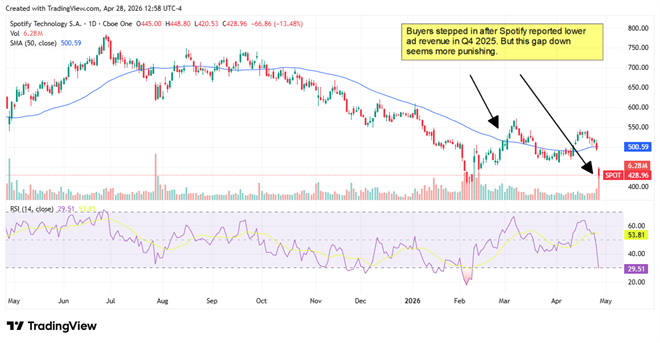
It gets even uglier when you look at the weekly chart over a five-year period. SPOT is now at a level that marked prior resistance on the weekly chart before the big 2024-2025 rally. What's concerning is that the February selloff attracted buyers aggressively near $390-$400, but with two consecutive earnings misses now on the books, investors may not be as likely to show up this time.
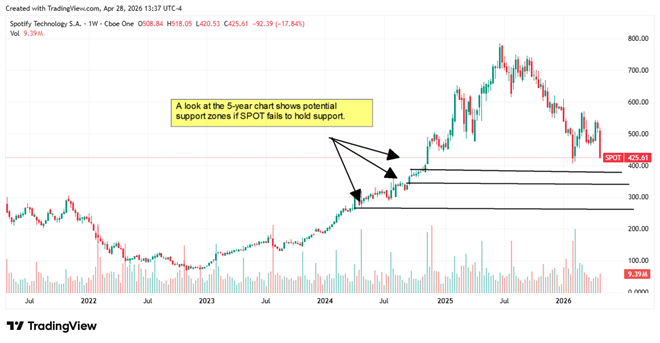
The daily RSI is technically oversold, but that signal carries little weight when the weekly RSI still has plenty of room to fall. If $390-$400 fails to hold on a closing basis, the next logical target is the $340-$350 range, roughly another 20% lower, where SPOT built its base before breaking out in mid-2024.
A broader macro deterioration could even invite a test of $280-$300, though that remains a tail-risk scenario. Nevertheless, the path of least resistance for now points lower.
This email is a sponsored email provided by Awesomely, LLC, a third-party advertiser of DividendStocks.com and MarketBeat.
If you need assistance with your subscription, please don't hesitate to email our South Dakota based support team at [email protected].
If you no longer wish to receive email from DividendStocks.com, you can unsubscribe.
Copyright 2006-2026 MarketBeat Media, LLC. All rights protected.
345 N Reid Pl., Sixth Floor, Sioux Falls, S.D. 57103-7078. USA..