Dear Reader,
Something unusual is happening in America right now.
11 U.S. states have officially recognized gold as legal tender.
Most people are ignoring this.
But historically, changes like this signal something much bigger.
Because when governments start treating gold like money again…
It often means confidence in traditional systems is starting to crack.
That’s one reason many analysts now expect gold to enter a major “breakout rally.”
Some are even calling for $5,000 or higher.
But here’s what most investors get wrong:
They rush into bullion… ETFs… or risky mining stocks.
And miss the biggest gains altogether.
Because there’s a little-known strategy — with a nearly 20-year track record of strong returns — that approaches gold very differently.
By clicking the link above, you will begin receiving the Stansberry Digest, and will also begin receiving occasional marketing messages. You can unsubscribe from Stansberry Digest at any time. Privacy Policy.
It’s simple.
It’s accessible.
And can lead to some of the biggest gains imaginable when it comes to gold.
Click here to learn exactly how it all works, in this FREE new report.
By clicking the link above, you will begin receiving the Stansberry Digest, and will also begin receiving occasional marketing messages. You can unsubscribe from Stansberry Digest at any time. Privacy Policy.
Regards,
A.J. Wiederman
Senior Staff, Stansberry Research
Amazon’s Earnings Just Sent the Stock to New Highs—What’s Next?
Written by Sam Quirke. Published: 4/30/2026.

Key Points
- Amazon has surged more than 35% in just over a month and hit an all-time high on April 30.
- The recent earnings report was solid and confirmed that AI is now driving real revenue, not just future potential.
- However, with expectations having been reset higher as well, the next move depends on whether Amazon can keep delivering at this level.
- Special Report: Have $500? Invest in Elon’s AI Masterplan
Shares of tech giant Amazon.com Inc. (NASDAQ: AMZN) opened at a fresh all-time high on Thursday, April 30, following its earnings report the previous night. It’s the latest leg in a strong rally that has seen the stock gain more than 35% since the end of March. For investors who had grown frustrated with the stock’s lack of momentum over the past year, it looks like their patience has paid off.
As we’ll see below, based on the numbers themselves, the question isn’t whether Amazon has delivered—it clearly has. Rather, the question is whether it can keep delivering at a level that justifies both the recent move and what now looks like a much higher bar. Let’s jump in and take a closer look.
A Knockout Quarter Across the Board
Ticker Revealed: Pre-IPO Access to "Next Elon Musk" Company (Ad)
We’ve found The Next Elon Musk… and what we believe to be the next Tesla.
It’s already racked up $26 billion in government contracts.
Peter Thiel just bet $1 Billion on it.
👉 Unlock the ticker now and get it completely free.In terms of what to make of the report, some earnings simply beat expectations, while others reshape the narrative. This was firmly the latter. Amazon delivered results comfortably ahead of expectations on both revenue and earnings, but more importantly, it did so in a way that directly addressed the market’s biggest concerns.
For months, investors had questioned whether, and when, the company’s massive investment in artificial intelligence (AI) would translate into meaningful returns. This quarter provided the clearest indication yet that it already is.
AWS growth accelerated sharply, with year-over-year sales growth of 28%, reinforcing the story of rising demand for cloud and AI infrastructure. That’s important because AWS remains the engine of Amazon’s profitability. Any sign of momentum there has an outsized impact on how the entire business is valued.
AI Is Now Driving the Business, Not Just the Story
However, the most important shift in this report is that AI is no longer just a narrative layer sitting atop Amazon’s business. It’s now clearly embedded within it.
Demand for AI-related services is driving AWS's growth, and that demand is showing up not just in current revenue but also in backlog and forward visibility. Strategic partnerships and large-scale customer commitments further reinforce the idea that Amazon is becoming a central player in the infrastructure powering the AI economy.
At the same time, the company is beginning to highlight the upside potential of its own custom silicon, particularly its Trainium chips. These are not just cost-saving tools, but potential revenue drivers in their own right, positioning Amazon as both a provider and enabler of AI infrastructure.
For investors, that means they no longer have to focus on whether Amazon can effectively monetize AI, but instead on how big that opportunity can become.
The CapEx Debate Is Evolving
That said, it doesn’t mean the ongoing, valid concerns about spending have disappeared. Amazon must continue to invest heavily to realize its potential, with capital expenditures expected to remain extremely elevated as it builds out the necessary infrastructure. Not long ago, this was seen as a major headwind, with investors worried that returns might take too long to materialize.
While the scale of the spending hasn’t changed, the perception of it has with this report. That’s a meaningful shift, but it is not without its own risks, especially when it's affecting free cash flow to the extent it is at Amazon. It goes without saying that high spending still requires high returns, and the market will be watching closely to ensure that this early momentum continues.
The Potential Problem: The Bar Just Got Much Higher
If there is a challenge for Amazon coming out of this report, it’s that expectations have now increased just as much as the stock. A 35% rally in just over a month, combined with a decisive earnings beat, means that much of the near-term optimism is surely already reflected in the price.
The thing is, though, analysts are projecting further gains, with some post-earnings price target updates reaching as high as $325. That creates a different kind of setup. Amazon is no longer a stock that needs to prove itself; it needs to sustain and build on what it has just delivered. That means there’s a higher bar and less room for disappointment. In other words, any signs of slowing growth, weaker demand, or delays in translating AI momentum into broader profitability could quickly shift sentiment.
For investors, that means balancing two realities. On the one hand, the long-term opportunity remains compelling, with AI-driven growth, expanding margins, and new revenue streams pointing to further upside. On the other hand, the stock is now trading at levels that suggest much of that success will materialize. Yes, Amazon has proven the bull case for now—the next move depends on whether it can keep proving it.
Insiders Are Selling Big Tech, But Here Are 3 Reasons You May Not Want To
Written by Thomas Hughes. Published: 4/28/2026.

Key Points
- Insider selling in big tech stocks such as NVIDIA, Meta Platforms, AMD, and Palantir reflects personal financial needs rather than deteriorating business fundamentals.
- Institutions are buying shares of these AI-linked stocks at ratios of $2 or $3 to $1 against insider sales, signaling broad professional confidence in the sector.
- Rising analyst coverage, firming sentiment, higher price targets, and upcoming earnings reports are converging as tailwinds that could drive these stocks to fresh all-time highs.
- Special Report: Have $500? Invest in Elon’s AI Masterplan
Insiders are selling big tech stocks, but investors should think twice before doing the same.
These insiders have all been in their positions for years—most for at least 10, and some for more than 20. In addition to share-based compensation, they have also seen substantial gains over the past few years.
Ticker Revealed: Pre-IPO Access to "Next Elon Musk" Company (Ad)
We’ve found The Next Elon Musk… and what we believe to be the next Tesla.
It’s already racked up $26 billion in government contracts.
Peter Thiel just bet $1 Billion on it.
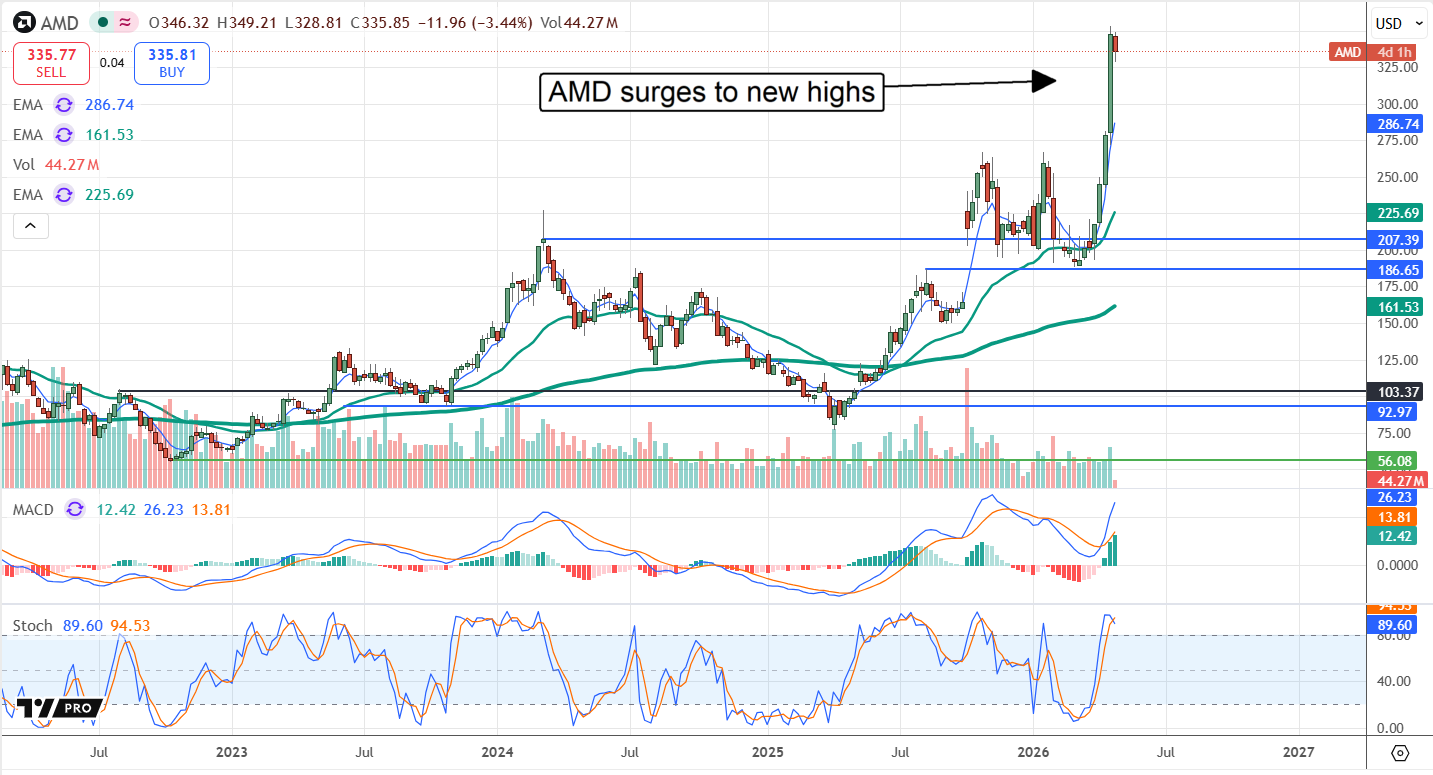
👉 Unlock the ticker now and get it completely free.Stocks like NVIDIA (NASDAQ: NVDA), Meta Platforms (NASDAQ: META), Advanced Micro Devices (NASDAQ: AMD), and Palantir (NASDAQ: PLTR) have gained triple digits over that time frame, and quadrupled over the longer term. They are also likely to continue moving higher as the year progresses. Those moves can create practical reasons for insiders to sell: locking in gains, reallocating portfolios, and paying taxes.
But should investors follow their lead? Here are three reasons they shouldn’t.
Reason #1: The AI Buildout Theme Has Not Fully Played Out
The AI bubble that is driving these businesses and stock prices is far from over.
The worst-case scenario is that phase one—the build-out phase—ran into a hiccup when demand overwhelmed NVIDIA’s GPU supply, but we are now on the cusp of moving past that bottleneck.
In the meantime, spending is spilling over into adjacent verticals, as newly minted GPU owners now need connectors, control units, sensors, and actuators, along with the racks to house them, the data centers to shelter them, the cooling systems to extend their life, and all the wires and optics needed to connect them. And that’s not counting the infrastructure needed to take AI out of the datacenters and put it to work.
In this scenario, Advanced Micro Devices’ launch of MI450 products and Helios rack-scale solutions unleashes pent-up datacenter demand and spending, driving the entire complex higher by year’s end and over time. NVIDIA and AMD GPUs are built on different architectures and use different manufacturing and advanced packaging solutions, so they face different hurdles. AMD will likely hit a capacity wall in its ability to deliver GPUs, but it will probably take at least a few quarters to do so.
Reason #2: Institutions Are Accumulating Big Tech
While insiders, ranging from CEOs to CFOs and their boards of directors, are selling shares, institutions are buying them.
Institutional activity varies by stock, but InsiderTrades data show institutions buying NVIDIA and AMD at robust rates, in the $2-to-$1 or $3-to-$1 range, with similar trends in names like Meta Platforms and Palantir.
Neither Meta Platforms nor Palantir is involved in GPU production, nor are they what you could call AI infrastructure stocks. But both are critical to the AI trade, representing the monetization of AI and the potential it brings.
Meta Platforms is among the earliest non-infrastructure stocks to go all-in on AI, ramping spending several times since 2022 and showing results within a matter of quarters each time. The visible results are increased traffic, higher engagement, and improved ad metrics—specifically in the number of ads shown and the revenue each generates.
Palantir is another example of AI monetization, enabling governments and organizations to visualize large, complex data sets and make actionable decisions from them. The once-panned name is now a focal point, with institutions buying the stock at a $3-to-$1 pace over the trailing 12 months (TTM) leading into May and ramping activity sequentially.
Reason #3: Analyst Upgrades, Earnings Catalysts, and Chart Strength Are Lining Up
Analysts' trends are equally bullish and, knowing they preach to a choir of institutions, are leading the market to even higher levels.
The data show coverage rising on a TTM basis, sentiment improving, and price targets moving higher, creating a triple tailwind for price action. The net result is that Moderate Buy ratings now carry strongly bullish biases, verging on Strong Buy, with price target trends pointing toward the high end of the range. That suggests fresh all-time highs for the Magnificent Seven and names like Advanced Micro Devices could eventually support trillion-dollar valuations.
In addition, the charts are very bullish for these stocks. The few that haven’t already broken out to new highs are in rebound mode, having established a support base, and are on track to do so later this year.
The likely catalysts are upcoming earnings reports, with many of the Mag Seven expected to beat consensus estimates and provide bullish guidance updates.
Of the four stocks listed here, Advanced Micro Devices stands to make the largest move by year-end. Its revenue growth could accelerate into the triple-digit range, potentially in Q3 but certainly by Q1 of the following year, as its business surges to NVIDIA-like proportions. In that scenario, its stock price could rise by 8x to 10x as it catches up to NVIDIA’s valuation.
This email is a sponsored email for Stansberry Research, a third-party advertiser of The Early Bird and MarketBeat.
This ad is sent on behalf of Stansberry Research, 1125 N. Charles Street, Baltimore, Maryland 21201.
If you have questions or concerns about your subscription, please contact our U.S. based support team at [email protected].
If you no longer wish to receive email from The Early Bird, you can unsubscribe.
© 2006-2026 MarketBeat Media, LLC.
345 N Reid Place, Suite 620, Sioux Falls, SD 57103-7078. United States of America..