Hello,
Thanks for signing up for MarketBeat Daily Ratings—we’re excited to have you on board.
Every weekday, you’ll get a curated summary of new “Buy” and “Sell” ratings from Wall Street’s top-rated analysts, the latest stock news, and bonus investing content—all delivered straight to your inbox.
You’re just two quick steps away from completing your sign-up:
1. Make sure our emails go to your inbox
Gmail users:
Mobile: Tap the three dots (…) in the top right and select Move to Inbox or Move to Primary
Desktop: Click the folder icon at the top and select Move to Inbox or Primary
Apple Mail users:
Tap our email address at the top (next to From: on mobile), then select Add to VIP
Other providers:
Reply to this message and add [email protected] to your contacts
2. Confirm your subscription
Click this link to confirm your subscription. This verifies your account and ensures you receive your newsletters without interruption instead of getting stuck in your spam filter.
Confirm your subscription here.
After you confirm, feel free to download our popular free report, "7 Stocks to Buy and Hold Forever" with this link.
Thanks again for subscribing—we look forward to being part of your investing journey.

Matthew Paulson
Founder and CEO, MarketBeat.
P.S. If you didn’t mean to subscribe, no problem—you can unsubscribe here.
Additional Reading from MarketBeat Media Anheuser-Busch Stock Jumps as Volume Growth Signals TurnaroundReported by Chris Markoch. Publication Date: 5/7/2026. 
Key Points- BUD stock rallied as volume growth returned, signaling improving consumer demand beyond pricing power.
- Premium brands and alternative beverages (no-alcohol, Beyond Beer) are leading growth.
- Upcoming catalysts like the World Cup could boost sales, but valuation suggests caution.
- Special Report: Elon Musk: This Could Turn $100 into $100,000
Anheuser-Busch InBev (NYSE: BUD) stock surged nearly 9% on the day it reported strong Q1 2026 earnings, and the rally continued into the next trading day.
One of the key takeaways from the report was that the company posted gains in both revenue and volume. Volume, in particular, has been a challenge over the past several quarters.
The report also showed that Anheuser-Busch, the parent company of the Budweiser and Bud Light brands, is retaining its title as the “king of beers,” although the crown has shifted to its Corona brand.
The company reported adjusted earnings per share (EPS) of 97 cents, topping estimates of 90 cents. Anheuser-Busch also delivered revenue of $15.27 billion, beating forecasts for $14.69 billion. The revenue figure matched the number from Q4 2025.
That’s why it bears repeating that the more relevant number for investors is volume. The company is no longer having to rely on pricing power to make its numbers. That suggests that the environment for consumer discretionary stocks may be starting to normalize.
The Preference for Premium Remains in PlacePart of Anheuser-Busch's strategy in recent years has been to segment its broad portfolio. This gives investors a better sense of where the company’s growth is coming from. It shouldn’t be too much of a surprise that one of the strongest growth areas comes from its premium brands.
In the quarter just ended, the company reported net revenue growth of 11% in its premium beer category. And the company’s Corona and Stella Artois brands are leading the way.
That was supported by the company’s broader assessment that alcohol participation is stable, with approximately 77% of legal drinking age adults having consumed alcohol in the six months prior to the report. That percentage was essentially flat year over year, indicating that the company’s strength is coming from its beer category.
This Is Not Your Father’s BUDIt doesn’t take a very close look under the hood of the earnings report to see two striking data points. On the company’s list of “Replicable growth drivers,” the two largest categories in revenue growth were no-alcohol beer and Beyond Beer at 27% and 37%, respectively.
The first confirms that Millennial and Gen Z consumers are seeking alcohol-free experiences. The second category, created in 2018, houses the company’s portfolio of hard seltzers, wine and spirits, traditional malt-based beverages, and low- or no-alcohol drinks. It’s a nod to the idea that tastes are changing for those who continue to consume alcoholic beverages.
However, this is a move that investors should welcome. Like many other beer companies, Anheuser-Busch saw the writing on the wall a long time ago. The company has been diversifying its portfolio to keep up with trends that are shaping the market.
Future Catalysts—The World Cup and MoreIs now a good time to buy BUD? The stock is trading near its 52-week high and is rapidly approaching the consensus price target of $90.50 from 16 analysts tracked by MarketBeat. Furthermore, BUD is trading about 13% above its 50-day simple moving average (SMA). The immediate setup favors a pullback.
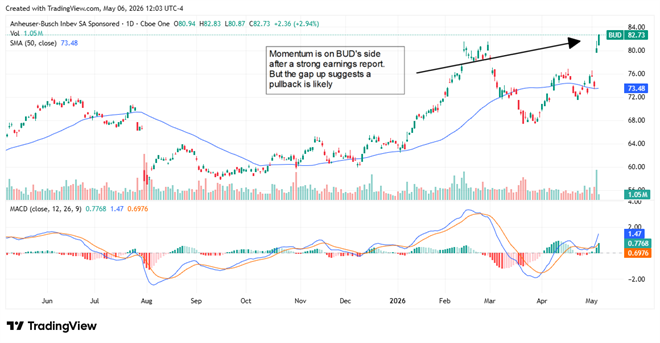
But would that be a dip worth buying? One reason to believe BUD may have catalysts ahead comes from the calendar. The World Cup begins in June and runs into July. This will be an international event attracting fans from all over the world, and it should particularly benefit the company's Mid-America segment.
There will also be many “America 250” celebrations throughout the country. Budweiser and Bud Light are likely to be key symbols of America at those events.
BUD Is a Mix of Hope and CautionSince the earnings report, several analysts have reiterated a rating of “Buy” or its equivalent. However, those ratings aren’t coming with an increase in their price targets. That’s something to be cautious about with BUD stock now sitting at a 5-year high.
And that comes after the stock had a pandemic-fueled rally that broke it out of a sharp sell-off that began in 2019. It hasn’t been a party for shareholders. Competition and a shift away from alcohol have been a drag on BUD.
But the company’s data shows a significant addressable market for alcoholic beverages. And one of the company’s primary competitors, Molson Coors (NYSE: TAP) delivered earnings this week with a similar volume story.
That suggests the market is there, and the decline in volume may have been linked to inflation rather than a lack of interest. It’s a thesis that will require more than one quarter to play out. But with forecasted earnings growth of 13% on a stock trading around 19x earnings, it could be time to revisit BUD on any pullback. |