A message from Porter & Company I wish this wasn’t the case…
But it’s happening, exactly as I predicted.
I first warned my readers of this threat months ago. Many disregarded it.
Now it’s accelerating and unless you prepare now you could be blindsided by an event two Nobel Prize winners have warned of… an event that you cannot ignore.
The clock is ticking. Just take a look:
In a single month, March of this year, U.S. employers announced 60,620 job cuts. That's a 25% jump from February. And one force was named as the reason why.
Then the floodgates really opened.
Meta announced it's laying off roughly 8,000 employees – 10% of its workforce – and quietly killing another 6,000 unfilled roles.
The same week, Microsoft offered "voluntary separation" to 7% of its U.S. workers — more than 8,500 people.
Translation: quit on your terms, or we'll fire you on ours.
And they're not alone. Not by a long shot.
Amazon cut 16,000 corporate jobs… Block cut 40% of its workforce…. Salesforce eliminated 44% of its support team... Oracle is reportedly axing up to 30,000 roles.
IBM, Snap, Pinterest, Klarna… the list grows by the week.
Almost 80,000 tech jobs evaporated in the first three months of 2026 alone.
Although most people think this is about AI… it’s not. The story goes far deeper and is far more consequential. It’s something that I’ve been warning off for months now.
And I’m not the only one.
Two Nobel Prize winners have warned of this Final Displacement.
Because they know, as I do, this event could trigger a once-in-a-generation wealth shift.
A transfer of wealth that’s already begun with Goldman Sachs estimating 12,400 Americans are being financially destroyed every day… while others grow richer than ever before.
Which side you’re on could depend on what you do next.
Because for those who understand what’s unfolding, this could be one of the greatest wealth-building phenomena of their lives.
But for those who bury their head in the sand… this force threatens to wipe out years of investment returns and could even destroy their financial future.
Here’s the full story for you.

26 years ago, I started telling friends, family, and anyone who would listen about an unprecedented societal shift that was barreling down on us.
I’d discovered that a new technology was about to unleash massive, almost unimaginable, changes. I likened the impact to the railroad boom, the Industrial Revolution, and the rise of personal computing.
At the time, I was working as an investment analyst for an elite research group, but my colleagues and bosses refused to listen to me.
No matter what I said, they simply would not acknowledge the sands shifting beneath their feet.
The legendary Dr. Kurt Richebächer – one of the world’s leading Austrian economists – even called me and my ideas “radical.”
But I was certain this new technology would trigger a transformation that was simply unfathomable to most people… and those on the frontier could reap financial returns unlike any the world had ever seen before.
So, I decided to put my entire career – not to mention every cent I had – on the line to spread the story myself.
I left my job as a research analyst… went home to my third-floor apartment in one of Baltimore’s worst neighborhoods… and with a borrowed laptop, I wrote my first financial prophecy.
And in an investment paper that’s now been read by more than one hundred thousand people…
I explained how the endless miles of new fiber optic cables being laid was creating a new railroad across America.
And that this new “railroad” was going to upend the telecommunications industry and pave the way for a new internet economy.
I also warned it would decimate some of America's most dominant companies like AT&T.
At the time, this was an outlandish idea, with analysts calling AT&T “dominant”, “unstoppable”, and “the giant that no other company can topple.”
But those who were willing to open their minds to my so-called “radical” ideas were not only able to sell these companies before they collapsed…
They also had the chance to get in early on the firms that would go on to command this new internet economy:
Amazon, Adobe, Qualcomm, SunMicrosystems, Uniphase, Texas Instruments… These are household names now, but when I first recommended them in the late 90s, they were complete unknowns.
Since then, I’ve issued a number of other financial prophecies, many of which have come to pass precisely as I predicted.
But today, I’m stepping forward with a new exposé that I believe could surpass anything I’ve ever done…
It’s an investigation into what I call The Final Displacement… and I don’t think we will ever again see a story that rivals the magnitude of this during my lifetime.
I’m not talking about AI… quantum computing… augmented reality… the blockchain… or anything else you might be thinking of.
No. This is far bigger than them all. In fact…
It’s the cornerstone that all our recent technological innovations have been built upon and the future will be built upon too.
Yet you’ve likely never heard of it before.
Outside of the labs in the world’s most prestigious universities and tech companies, almost nobody has.
But those who have… those who can see the writing on the wall… they’re investing billions of dollars, as they know this will transform everything.
Marc Andreessen… Ben Horowitz… Elon Musk… Jeff Bezos… Mark Zuckerberg…Jensen Huang… Bill Gates… the list goes on and on.
They know, as I do, that in a few years from now, we will not recognize the world we live in.
How we work, live, communicate, transact… it will all be completely upended by what’s coming next.
Today, I’m going to share it all with you… and I promise you’ve never heard anything like this before.
You see, despite the magnitude of this story, nobody is openly and freely discussing this turning point. And that deeply concerns me, because I believe its emergence will draw an indelible demarcation line in society.
On one side, you’ll have those who understand it, invest in it, and who are greatly enriched by it.
On the other side… you’ll have those who underestimate it, turn a blind eye and are unfortunately impoverished by the sweeping changes it ushers in.
I know what side I’ll be on.
And I know what side I want you to be on.
So go here to watch my full investigation into this story.
Including the names of the companies to buy and sell if you want to capitalize on the impending multi-trillion-dollar displacement.
Good investing,
Porter Stansberry
More Reading from MarketBeat.com Anheuser-Busch Stock Jumps as Volume Growth Signals TurnaroundAuthor: Chris Markoch. Article Posted: 5/7/2026. 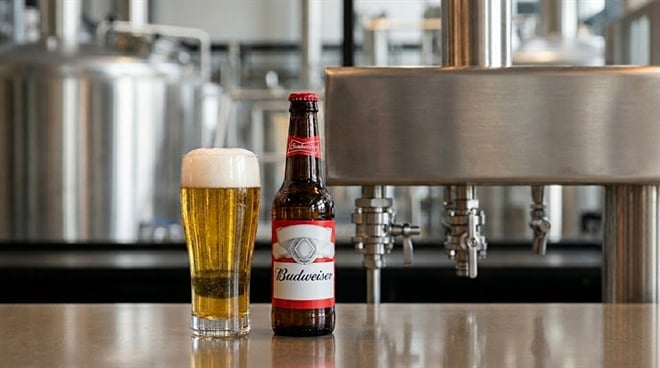
Key Points- BUD stock rallied as volume growth returned, signaling improving consumer demand beyond pricing power.
- Premium brands and alternative beverages (no-alcohol, Beyond Beer) are leading growth.
- Upcoming catalysts like the World Cup could boost sales, but valuation suggests caution.
- Special Report: NOT buy any SpaceX IPO shares until you read THIS

Anheuser-Busch InBev (NYSE: BUD) stock shot up nearly 9% the day it reported strong Q1 2026 earnings, and the rally continued into the next trading day.
One of the key takeaways from the report was that the company posted increases in both revenue and volume. The latter has been a challenge over the past several quarters.
The report also showed that Anheuser-Busch, the parent company of the Budweiser and Bud Light brands, is retaining its title as the “king of beers,” although the crown has shifted to its Corona brand.
The company reported adjusted earnings per share (EPS) of 97 cents, topping estimates of 90 cents. Anheuser-Busch also delivered revenue of $15.27 billion, beating forecasts for $14.69 billion. The revenue number matched the figure from Q4 2025.
That’s why it bears repeating that the more relevant number for investors is volume. The company is no longer having to rely on pricing power to make its numbers. That suggests that the environment for consumer discretionary stocks may be starting to normalize.
The Preference for Premium Remains in PlacePart of Anheuser-Busch's strategy in recent years has been to segment its broad portfolio. This gives investors a better idea of where the company’s growth comes from. It shouldn’t be too much of a surprise that one of the strongest growth areas is its premium brands.
In the quarter just ended, the company reported 11% net revenue growth in its premium beer category. Corona and Stella Artois are leading the way.
That was supported by the company’s broader assessment that alcohol participation is stable, with approximately 77% of legal drinking age adults having consumed alcohol in the six months prior to the report. That percentage was essentially flat year over year, indicating that the company’s strength is coming from its beer category.
This Is Not Your Father’s BUDIt doesn’t take a very close look under the hood of the earnings report to see two striking data points. On the company’s list of “Replicable growth drivers,” the two largest categories in revenue growth were no-alcohol beer and Beyond Beer at 27% and 37% , respectively.
The first confirms that Millennial and Gen Z consumers are seeking alcohol-free experiences. The second category, created in 2018, houses the company’s portfolio of hard seltzers, wine and spirits, traditional malt-based beverages, and low- or no-alcohol drinks. It’s a nod to the idea that tastes are changing for those who continue to consume alcoholic beverages.
However, this is a move that investors should welcome. Like many other beer companies, Anheuser-Busch saw the writing on the wall a long time ago. The company has been diversifying its portfolio to keep up with trends that are shaping the market.
Future Catalysts—The World Cup and MoreIs now a good time to buy BUD? The stock is trading near its 52-week high and is rapidly approaching the consensus price target of $90.50 from 16 analysts tracked by MarketBeat. Furthermore, BUD is trading about 13% above its 50-day simple moving average (SMA). The immediate setup favors a pullback.
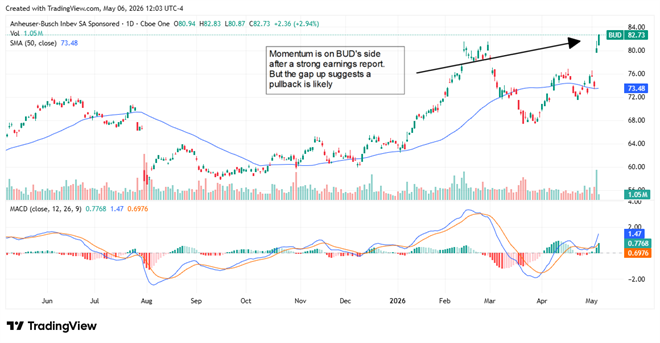
But would that be a dip worth buying? One reason to believe BUD may have catalysts ahead comes from the calendar. The World Cup begins in June and runs into July. This will be an international event attracting fans from all over the world, and it should particularly benefit the company's Mid-America segment.
There will also be many “America 250” celebrations throughout the country. Budweiser and Bud Light are likely to be key symbols of America at those events.
BUD Is a Mix of Hope and CautionSince the earnings report, several analysts have reiterated a rating of “Buy” or its equivalent. However, those ratings aren’t coming with an increase in their price targets. That’s something to be cautious about with BUD stock now sitting at a five-year high.
And that comes after the stock had a pandemic-fueled rally that broke it out of a sharp sell-off that began in 2019. It hasn’t been a party for shareholders. Competition and a shift away from alcohol have been a drag on BUD.
But the company’s data shows a significant addressable market for alcoholic beverages. And one of the company’s primary competitors, Molson Coors (NYSE: TAP) delivered earnings this week with a similar volume story.
That suggests the market is there, and the decline in volume may have been linked to inflation and not interest. It’s a thesis that will require more than one quarter to play out. But with forecasted earnings growth of 13% on a stock trading around 19x earnings, it could be time to revisit BUD on any pullback. | 