Dear Subscriber,
AI stocks are overhyped.
The data is telling us a crash is coming.
And this one stat confirms it.
Click here to find out what we recommend all investors do … right away.
3 European Bank Stocks Nearing New 52-Week Highs
Authored by Dan Schmidt. Published: 4/27/2026.

Key Points
- The outbreak of the Iran war caused a swift re-rating in some sectors, especially in Europe and Asia.
- UBS, Banco Santander, and Erste Group are three international banks recovering from war-driven drawdowns of 20% or more that are now approaching new 52-week highs.
- All three banks report Q1 2026 earnings on April 29, providing a near-term catalyst that could drive further price appreciation.
- Special Report: The Biggest IPO Ever: Claim Your Stake Today
Markets appear to be looking past the initial oil shock from the Iran war, and risk appetite has firmed even as crude remains volatile.
While many companies on U.S. exchanges have already made new highs, international stocks suffered larger drawdowns and therefore have more ground to recover. Foreign bank stocks—especially those in Europe—were attractive investments in 2025, and many remained at the top of analysts’ recommendation lists for 2026. Now that geopolitical shocks are (hopefully) behind us, these stocks once again have a chance to lead, and the three companies discussed below are quickly resuming their bullish marches.
The #1 stock to buy BEFORE the June S-1 filing (Ad)
When the SpaceX IPO launches, most retail investors will be locked out. The banks, funds, and insiders get in early - while everyone else waits on the sidelines.
But one small infrastructure supplier - a critical piece Musk can't scale the Colossus network without - is still trading well under institutional radar. A new briefing reveals the name and ticker at no cost.
Get the SpaceX infrastructure stock name and ticker hereDespite a very shaky ceasefire, these three international bank stocks are again moving toward new 52-week highs. The Iran war pushed many of these names down 20% (or more), so investors today have a good chance to buy quality companies on sale without changes to their long-term outlooks.
UBS Group: Pair of Upgrades and Easing Capital Requirements Provide Tailwinds Ahead of Q1 Earnings
After soaring nearly 40% in 2025, UBS Group AG (NYSE: UBS) was a top analyst pick to begin 2026. The integration of Credit Suisse was executed ahead of schedule, and the company now has a wealth management operation that rivals the largest U.S. investment banks.
UBS started the year strong with its Q4 2025 results, delivered on Feb. 3. The report showed revenue growth of more than 10% year over year (YOY) and plans for an additional 3 billion Swiss francs (CHF)—approximately $3.8 billion—in share buybacks in 2026.
UBS cut its annual dividend by nearly 40% this year, but a 14% Common Equity Tier One (CET1) ratio indicates it remains well-capitalized.
A downgrade from Goldman Sachs, followed by the outbreak of the Iran war, led to a swift re-rating of UBS shares.
The stock fell more than 20% before bottoming at the end of March. The Moving Average Convergence Divergence (MACD) indicator signaled slowing downward momentum well before the price began to recover.
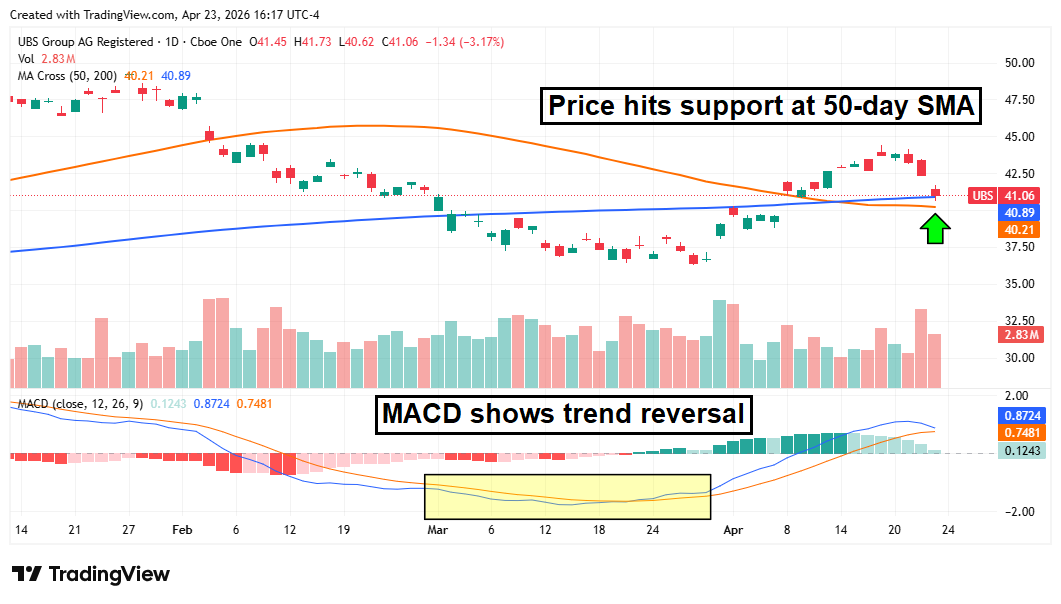
As the MACD flipped bullish, UBS shares rose back above the 50-day and 200-day moving averages on heavy volume. The stock is again testing the 50-day MA. UBS also received recent upgrades from Barclays and Weiss, positive commentary from the Swiss government on its capital requirements, and has an upcoming earnings catalyst on April 29.
Banco Santander: Bold Management Plans Present Growth Opportunity
Banco Santander, S.A. (NYSE: SAN) was another big 2025 winner, more than doubling on the year as the European banking sector took off.
The rally continued into 2026 until the Iran war, when SAN shares quickly dropped about 20%. Now that markets are shaking off the oil shock, investors have another chance to buy one of the most diversified European banks at roughly 10 times forward earnings and 1.39 times book value.
Management has outlined an ambitious framework for its 2028 goals, targeting Return On Tangible Equity (ROTE) above 20%, 20 billion euros (approximately $23.4 billion) in profits, and a doubling of the cash dividend.
Banco Santander has the lowest CET1 ratio among major Eurozone banks at 13.5%, but this remains well above the compliance level, giving the bank ample room to return capital to shareholders sustainably. The current dividend yield is about 1.6%, and the payout ratio is just 18.8%.
SAN shares rebounded quickly from the Iran oil shock, nearly making a new 52-week high in early April. Renewed tensions pushed the stock back to the 50-day moving average, which had previously served as support. If this level holds again, investors may have a favorable opportunity to open new positions before a bounce.
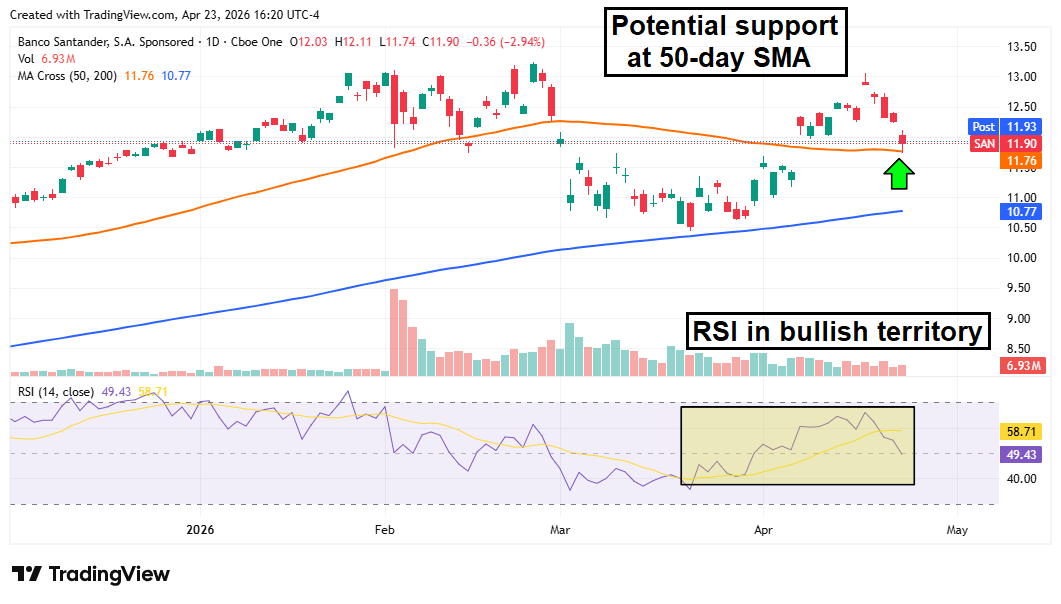
The Relative Strength Index (RSI) will be key: if it stays above the bullish threshold of 50, SAN shares are likely to bounce off the 50-day MA and resume their ascent. The company reports Q1 2026 earnings on April 29.
Erste Group: Acquisitions Boosting Key Banking Metrics
Erste Group Bank AG (OTCMKTS: EBKDY) is a $45 billion Austrian banking powerhouse that recently completed the acquisition of a 49% stake in Santander Bank Polska. The move makes Erste one of the largest asset holders in Poland and raises its profile in Eastern Europe.
Management expects the acquisition to boost EPS by 20% and raise 2026 ROTE to 19%. If Erste achieves those goals, the stock’s current valuation looks inexpensive at roughly 10 times forward earnings and 1.16 times book value.
The company reports Q1 2026 earnings on April 29, and investors will watch for any changes to the outlook following the acquisition's closing.
The stock peaked after the acquisition closed—a typical "sell the news" profit-taking reaction.
That reaction may have been an overreach, pushing the stock down toward the 200-day moving average. The 200-day MA then acted as a reversal zone, aided by a bullish MACD crossover.
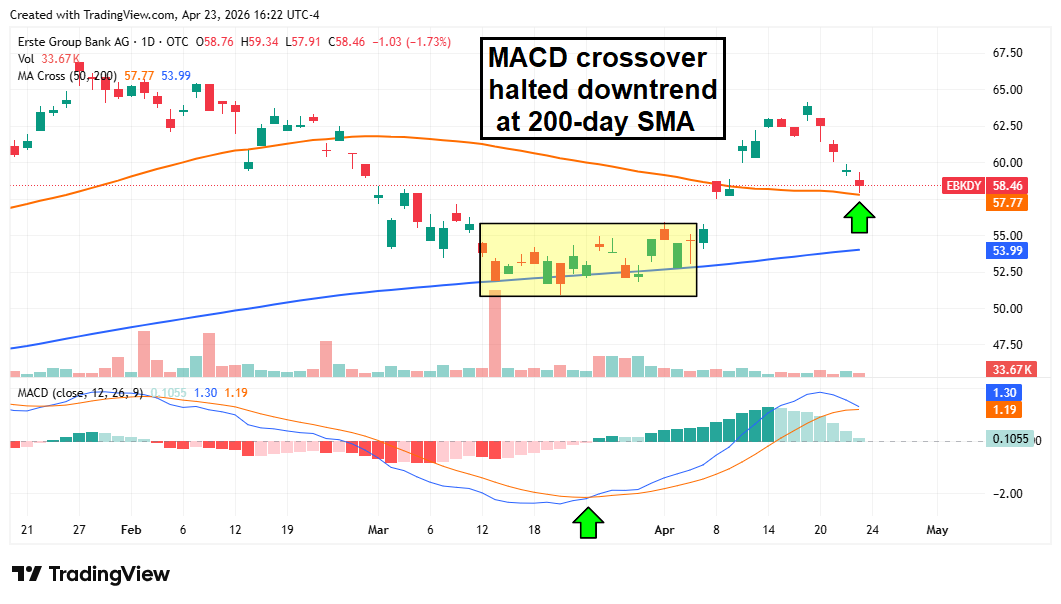
EBKDY shares have since pulled back to the 50-day MA ahead of earnings as investors digest geopolitical developments, but there remains significant upside potential if the Q1 2026 results and guidance meet or exceed expectations.
3 REITs to Watch as AI Data Center Spending Surpasses Office Construction
Authored by Jessica Mitacek. Published: 5/7/2026.

Key Points
- For the first time ever, spending on data center construction ($45 billion) has surpassed spending on office buildings ($44 billion), driven by the massive infrastructure demands of artificial intelligence.
- The global data center market is expected to more than double in value by 2033, growing from $384 billion to over $902 billion at a compound annual growth rate of 11.3%.
- Investors can gain exposure to this trend through three major Real Estate Investment Trusts—Iron Mountain, Digital Realty, and Equinix—which offer a combination of significant year-to-date stock gains and consistent dividend yields.
- Special Report: The Biggest IPO Ever: Claim Your Stake Today
The proliferation of artificial intelligence (AI) has created abundant market opportunities.
AI stocks — from NVIDIA (NASDAQ: NVDA) to Micron Technology (NASDAQ: MU) — haven’t just outperformed the market; they’ve done so by leaps and bounds.
The #1 stock to buy BEFORE the June S-1 filing (Ad)
When the SpaceX IPO launches, most retail investors will be locked out. The banks, funds, and insiders get in early - while everyone else waits on the sidelines.
But one small infrastructure supplier - a critical piece Musk can't scale the Colossus network without - is still trading well under institutional radar. A new briefing reveals the name and ticker at no cost.
Get the SpaceX infrastructure stock name and ticker hereBeyond the strong performance of pure-play AI companies and the Magnificent Seven’s record CapEx allocations, one development highlights just how transformative AI growth has become.
The AI-driven boom in data center construction has pushed spending above total office building construction. That shift creates a compelling opportunity for income investors seeking yield and AI exposure — an opportunity offered by each of the following three real estate investment trusts (REITs).
Data Center Spending Surges as Office Construction Lags
Fueled by AI and cloud demand, data center construction reached a record annualized rate of $45 billion in December 2025. For the first time, that figure exceeded private office construction, which fell to $44 billion.
That milestone was years in the making, and demand for data centers shows few signs of slowing. Industry consultant Grand View Research projects the global data center market — estimated at $383.82 billion in 2025 — will reach $902.19 billion by 2033, implying a compound annual growth rate (CAGR) of 11.3% from 2026 to 2033.
The North America data center segment alone, which represents more than 38% of the global addressable market, is projected to grow at a CAGR of 10.5% during the forecast period. By comparison, the office building construction market is expected to expand at a CAGR of about 8.5% through 2033, suggesting this gap may widen.
A Mountain of Potential From a Legacy Data Manager
Founded in 1951, Iron Mountain (NYSE: IRM) converted to a REIT in 2014.
As it evolved from a legacy records-management company into a colocation data center operator, the 75-year-old firm has amassed roughly 240,000 customers across 61 countries, including 95% of Fortune 1000 companies.
The REIT helps organizations unlock value through information management, digital transformation, information security, and data center/asset lifecycle services.
Iron Mountain illustrates how a data center REIT can deliver both dividends and growth. Over the past month, shares have climbed nearly 28%, contributing to a year-to-date (YTD) gain of more than 60%.
Meanwhile, the REIT’s dividend currently yields 2.67%, or $3.46 per share annually, with an annualized five-year growth rate of 5.45%.
Big Tech’s Big Data Center Partner
Digital Realty Trust (NYSE: DLR) owns, acquires, and operates carrier-neutral data centers, offering colocation and interconnection services.
It focuses on large-scale, mission-critical facilities that support the physical infrastructure needs of cloud providers, enterprises, network operators, and content companies.
That focus has led to partnerships with major tech firms, including NVIDIA, Oracle (NYSE: ORCL), Dell Technologies (NYSE: DELL), and Advanced Micro Devices (NASDAQ: AMD). Digital Realty has become known for wholesale data center space, turnkey facilities, and retail colocation suites.
The REIT hosts NVIDIA’s AI Factory Research Center in Northern Virginia and has partnered with AMD on the Digital Realty Data Center Innovation Lab — a hands-on facility where partners, enterprises, and customers can test and validate AI deployments in a real colocation environment, according to the company.
Shares of DLR have recorded a YTD gain of more than 29%, and its dividend currently yields 2.5%, or $4.88 per share annually.
The World’s Largest Data Center REIT
With a market cap approaching $108 billion, Equinix (NASDAQ: EQIX) is the world’s largest data center REIT.
After converting to a REIT on Jan. 1, 2015, Equinix expanded its focus on digital infrastructure and interconnection services, specializing in carrier-neutral data centers and colocation.
Like Digital Realty, Equinix operates a platform that enables enterprises, cloud and network service providers, and content companies to colocate IT infrastructure, interconnect directly with partners and providers, and access cloud on-ramps and network services in low-latency, secure environments.
The REIT now operates more than 280 data center locations across six continents, serving customers that range from large multinational enterprises to cloud providers and telecom operators. Equinix emphasizes interconnection density and ecosystem partnerships as differentiators for enabling digital transformation and low-latency connectivity.
Shares of EQIX are up more than 43% this year, and the REIT’s dividend currently yields 1.92%, or $20.64 per share annually. That yield is lower than the other two REITs on this list, but Equinix has increased its distribution for 10 consecutive years, and its annualized five-year growth rate of 12.01% surpasses both Iron Mountain and Digital Realty.
This email is a sponsored message sent on behalf of Weiss Ratings, a third-party advertiser of MarketBeat. Why was I sent this email content?.
11780 US Highway 1,
Palm Beach Gardens, FL 33408-3080
Would you like to edit your e-mail notification preferences or unsubscribe from our mailing list?
If you have questions about your subscription, please contact MarketBeat's U.S. based support team at [email protected].
If you would no longer like to receive promotional emails from MarketBeat advertisers, you can unsubscribe or manage your mailing preferences here.
© 2006-2026 MarketBeat Media, LLC. All rights protected.
345 N Reid Pl., Suite 620, Sioux Falls, South Dakota 57103. United States of America..