
| From | Alliance for Justice <[email protected]> |
| Subject | Supreme Court Puts the Dream of Multi-Racial Democracy on Life Support |
| Date | May 7, 2026 5:30 PM |
Links have been removed from this email. Learn more in the FAQ.
Links have been removed from this email. Learn more in the FAQ.
[[link removed]]
[[link removed]]
Judicial Nominees
Last week, the Senate Judiciary Committee held a hearing for federal judicial nominees Mike Hendershot [[link removed]] (District Court for the Northern District of Ohio), Jeffrey Kuntz [[link removed]] (District Court for the Southern District of Florida), John Marck [[link removed]] (District Court for the Southern District of Texas), and Arthur “Rob” Jones [[link removed]] (District Court for the Southern District of Texas). In a new low for Trump federal judge nominees, not a single nominee was willing to admit that the Constitution prevents President Trump from seeking a third term.
The stunning exchange [[link removed]] began when Senator Chris Coons (D-DE) asked Marck whether Trump is eligible to run for president in 2028. Marck responded [[link removed]] that he could not definitively answer the question without “considering all the facts.” Coons then asked if any of the other nominees were “brave enough” to apply the plain language of the Constitution and clearly state that Trump cannot seek another term. He was met with complete and utter silence. Alliance for Justice will continue to track this slate of nominees and any notable responses in their Senate questions for the record.
Next Thursday, the Senate Judiciary Committee will vote on the nominations of Justin Smith [[link removed]] (Court of Appeals for the Eighth Circuit), Tony Mattivi [[link removed]] (District Court for the District of Kansas), Tony Powell [[link removed]] (District Court for the District of Kansas), and Jeffrey Kuhlman [[link removed]] (District Court for the District of Kansas). Alliance for Justice and Alliance for Justice Action Campaign have put out a number of resources and links [[link removed]] that highlight Smith’s many efforts to undermine civil rights and voting rights [[link removed]] , attack LGBTQ+ rights [[link removed]] , and cut off access to reproductive care [[link removed]] . Smith serves as Trump’s personal attorney in his E. Jean Carroll sexual assault and defamation cases and played an integral role in Trump’s immunity case before the Supreme Court.
Just this week, he filed an appeal attempting to spare Trump from paying the $83 million defamation judgment awarded to E. Jean Carroll, arguing that Trump “will suffer irreparable harm” if forced to comply with the ruling.
[[link removed]]
Trump has also nominated Benjamin Flowers [[link removed]] (Court of Appeals for the Sixth Circuit) and Matthew Schwartz [[link removed]] (Court of Appeals for the Second Circuit), both of whom have demonstrated unfettered loyalty to Trump. Schwartz has represented Trump and his family members in a personal capacity and has consistently supported efforts to further billionaire special interests and Wall Street banks over everyday people, consumers, and borrowers. Flowers has actively supported anti-DEI efforts and has partnered with extremist organizations like America First and Independent Women’s Forum to attack LGBTQ+ communities and DEI programs. Their Senate Judiciary hearing is expected at the end of the month.
[[link removed]]
Last Wednesday, the Supreme Court continued its long crusade to dismantle the Voting Rights Act (“VRA”). Section 2(b) [[link removed]] of the VRA states that a violation occurs when “the political processes leading to nomination or election . . . are not equally open to participation by members” of a protected class of citizens “in that its members have less opportunity than other members of the electorate to participate in the political process and to elect representatives of their choice.” Congress amended this section of the VRA in 1982, specifically to override the Court’s ruling in City of Mobile v. Bolden [[link removed]] (1980) which held that Section 2 only prohibited intentional [[link removed]] discrimination against protected groups. The 1982 amendment instead prohibited the presence of discriminatory effects [[link removed]] , regardless of whether discriminatory intent could be proven. This expansive framework was instrumental in the creation of “majority-minority districts,” allowing the dream of multi-racial democracy in the South to be realized for the first time.
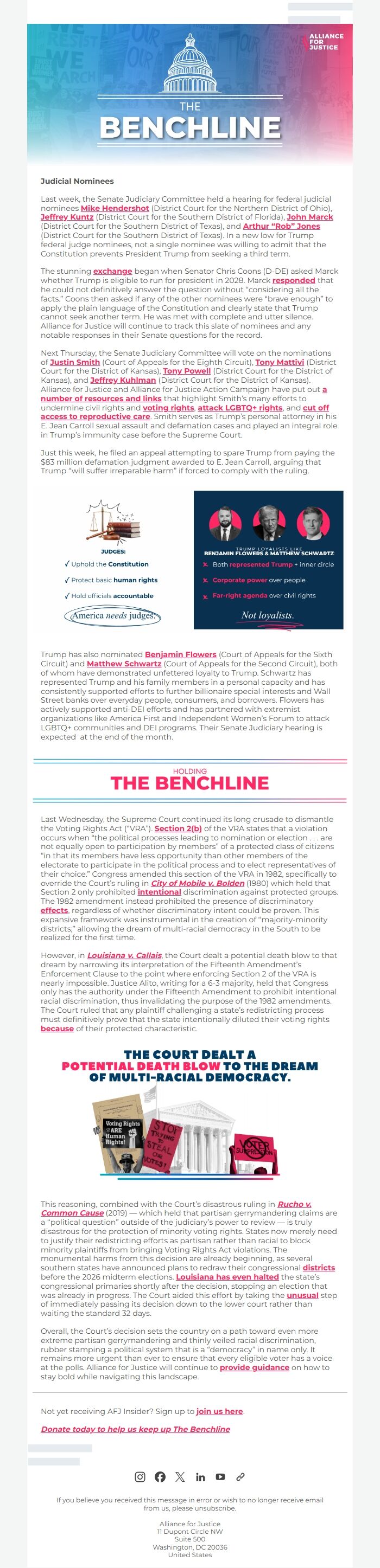
However, in Louisiana v. Callais [[link removed]] , the Court dealt a potential death blow to that dream by narrowing its interpretation of the Fifteenth Amendment’s Enforcement Clause to the point where enforcing Section 2 of the VRA is nearly impossible. Justice Alito, writing for a 6-3 majority, held that Congress only has the authority under the Fifteenth Amendment to prohibit intentional racial discrimination, thus invalidating the purpose of the 1982 amendments. The Court ruled that any plaintiff challenging a state’s redistricting process must definitively prove that the state intentionally diluted their voting rights because [[link removed]] of their protected characteristic.
[[link removed]]
This reasoning, combined with the Court’s disastrous ruling in Rucho v. Common Cause [[link removed]] (2019) — which held that partisan gerrymandering claims are a “political question” outside of the judiciary’s power to review — is truly disastrous for the protection of minority voting rights. States now merely need to justify their redistricting efforts as partisan rather than racial to block minority plaintiffs from bringing Voting Rights Act violations. The monumental harms from this decision are already beginning, as several southern states have announced plans to redraw their congressional districts [[link removed]] before the 2026 midterm elections. Louisiana has even halted [[link removed]] the state’s congressional primaries shortly after the decision, stopping an election that was already in progress. The Court aided this effort by taking the unusual [[link removed]] step of immediately passing its decision down to the lower court rather than waiting the standard 32 days.
Overall, the Court’s decision sets the country on a path toward even more extreme partisan gerrymandering and thinly veiled racial discrimination, rubber stamping a political system that is a “democracy” in name only. It remains more urgent than ever to ensure that every eligible voter has a voice at the polls. Alliance for Justice will continue to provide guidance [[link removed]] on how to stay bold while navigating this landscape.
Not yet receiving AFJ Insider? Sign up to join us here [[link removed]] .
Donate today to help us keep up The Benchline [[link removed]]
[[link removed]]
[link removed] [[link removed]] [link removed] [[link removed]] [link removed] [[link removed]] [link removed] [[link removed]] [link removed] [[link removed]] www.afj.org [www.afj.org]
If you believe you received this message in error or wish to no longer receive email from us, please unsubscribe: [link removed] .
Alliance for Justice
11 Dupont Circle NW
Suite 500
Washington, DC 20036
United States
[[link removed]]
Judicial Nominees
Last week, the Senate Judiciary Committee held a hearing for federal judicial nominees Mike Hendershot [[link removed]] (District Court for the Northern District of Ohio), Jeffrey Kuntz [[link removed]] (District Court for the Southern District of Florida), John Marck [[link removed]] (District Court for the Southern District of Texas), and Arthur “Rob” Jones [[link removed]] (District Court for the Southern District of Texas). In a new low for Trump federal judge nominees, not a single nominee was willing to admit that the Constitution prevents President Trump from seeking a third term.
The stunning exchange [[link removed]] began when Senator Chris Coons (D-DE) asked Marck whether Trump is eligible to run for president in 2028. Marck responded [[link removed]] that he could not definitively answer the question without “considering all the facts.” Coons then asked if any of the other nominees were “brave enough” to apply the plain language of the Constitution and clearly state that Trump cannot seek another term. He was met with complete and utter silence. Alliance for Justice will continue to track this slate of nominees and any notable responses in their Senate questions for the record.
Next Thursday, the Senate Judiciary Committee will vote on the nominations of Justin Smith [[link removed]] (Court of Appeals for the Eighth Circuit), Tony Mattivi [[link removed]] (District Court for the District of Kansas), Tony Powell [[link removed]] (District Court for the District of Kansas), and Jeffrey Kuhlman [[link removed]] (District Court for the District of Kansas). Alliance for Justice and Alliance for Justice Action Campaign have put out a number of resources and links [[link removed]] that highlight Smith’s many efforts to undermine civil rights and voting rights [[link removed]] , attack LGBTQ+ rights [[link removed]] , and cut off access to reproductive care [[link removed]] . Smith serves as Trump’s personal attorney in his E. Jean Carroll sexual assault and defamation cases and played an integral role in Trump’s immunity case before the Supreme Court.
Just this week, he filed an appeal attempting to spare Trump from paying the $83 million defamation judgment awarded to E. Jean Carroll, arguing that Trump “will suffer irreparable harm” if forced to comply with the ruling.
[[link removed]]
Trump has also nominated Benjamin Flowers [[link removed]] (Court of Appeals for the Sixth Circuit) and Matthew Schwartz [[link removed]] (Court of Appeals for the Second Circuit), both of whom have demonstrated unfettered loyalty to Trump. Schwartz has represented Trump and his family members in a personal capacity and has consistently supported efforts to further billionaire special interests and Wall Street banks over everyday people, consumers, and borrowers. Flowers has actively supported anti-DEI efforts and has partnered with extremist organizations like America First and Independent Women’s Forum to attack LGBTQ+ communities and DEI programs. Their Senate Judiciary hearing is expected at the end of the month.
[[link removed]]
Last Wednesday, the Supreme Court continued its long crusade to dismantle the Voting Rights Act (“VRA”). Section 2(b) [[link removed]] of the VRA states that a violation occurs when “the political processes leading to nomination or election . . . are not equally open to participation by members” of a protected class of citizens “in that its members have less opportunity than other members of the electorate to participate in the political process and to elect representatives of their choice.” Congress amended this section of the VRA in 1982, specifically to override the Court’s ruling in City of Mobile v. Bolden [[link removed]] (1980) which held that Section 2 only prohibited intentional [[link removed]] discrimination against protected groups. The 1982 amendment instead prohibited the presence of discriminatory effects [[link removed]] , regardless of whether discriminatory intent could be proven. This expansive framework was instrumental in the creation of “majority-minority districts,” allowing the dream of multi-racial democracy in the South to be realized for the first time.
However, in Louisiana v. Callais [[link removed]] , the Court dealt a potential death blow to that dream by narrowing its interpretation of the Fifteenth Amendment’s Enforcement Clause to the point where enforcing Section 2 of the VRA is nearly impossible. Justice Alito, writing for a 6-3 majority, held that Congress only has the authority under the Fifteenth Amendment to prohibit intentional racial discrimination, thus invalidating the purpose of the 1982 amendments. The Court ruled that any plaintiff challenging a state’s redistricting process must definitively prove that the state intentionally diluted their voting rights because [[link removed]] of their protected characteristic.
[[link removed]]
This reasoning, combined with the Court’s disastrous ruling in Rucho v. Common Cause [[link removed]] (2019) — which held that partisan gerrymandering claims are a “political question” outside of the judiciary’s power to review — is truly disastrous for the protection of minority voting rights. States now merely need to justify their redistricting efforts as partisan rather than racial to block minority plaintiffs from bringing Voting Rights Act violations. The monumental harms from this decision are already beginning, as several southern states have announced plans to redraw their congressional districts [[link removed]] before the 2026 midterm elections. Louisiana has even halted [[link removed]] the state’s congressional primaries shortly after the decision, stopping an election that was already in progress. The Court aided this effort by taking the unusual [[link removed]] step of immediately passing its decision down to the lower court rather than waiting the standard 32 days.
Overall, the Court’s decision sets the country on a path toward even more extreme partisan gerrymandering and thinly veiled racial discrimination, rubber stamping a political system that is a “democracy” in name only. It remains more urgent than ever to ensure that every eligible voter has a voice at the polls. Alliance for Justice will continue to provide guidance [[link removed]] on how to stay bold while navigating this landscape.
Not yet receiving AFJ Insider? Sign up to join us here [[link removed]] .
Donate today to help us keep up The Benchline [[link removed]]
[[link removed]]
[link removed] [[link removed]] [link removed] [[link removed]] [link removed] [[link removed]] [link removed] [[link removed]] [link removed] [[link removed]] www.afj.org [www.afj.org]
If you believe you received this message in error or wish to no longer receive email from us, please unsubscribe: [link removed] .
Alliance for Justice
11 Dupont Circle NW
Suite 500
Washington, DC 20036
United States
Message Analysis
- Sender: Alliance for Justice
- Political Party: n/a
- Country: United States
- State/Locality: n/a
- Office: n/a
-
Email Providers:
- EveryAction