
| From | Partnership to End Addiction <[email protected]> |
| Subject | Resources: Supporting Your Loved One's Mental Health |
| Date | May 6, 2026 4:33 PM |
Links have been removed from this email. Learn more in the FAQ.
Links have been removed from this email. Learn more in the FAQ.
Helping young people build coping skills and understanding mental health & substance use links.
NEWSLETTER
Resources to Help You Help Your Loved One
Supporting a young person's mental health is one of the most important ways to help them stay safe and healthy. In this issue, you’ll learn how mental health and substance use can be connected, and how to help a loved one build coping skills.
1. New Video: Co-Occurring Disorders Explained
If a teen or young adult you care about has been struggling lately, you may be asking yourself a difficult question: Is this just a phase or something more serious?
In our latest video, we take a closer look at co-occurring disorders, when mental health conditions like anxiety, depression, or ADHD overlap with substance use. This combination is more common than many families realize — and it can make it harder to know how to help.
This video shares:
-
What co-occurring disorders are
-
Why mental health and substance use often occur together
-
Key warning signs families should not ignore
-
How to start a supportive, productive conversation
-
What “integrated treatment” means and why it matters
Research shows that up to 50% of young people with mental health conditions also struggle with substance use. The encouraging news: healing is possible with the right support and treatment.
Watch this video at the button below and visit our Co-Occurring Disorders Resource Center ([link removed] ) to explore our resources on mental health and substance use.
Watch Video
([link removed] )
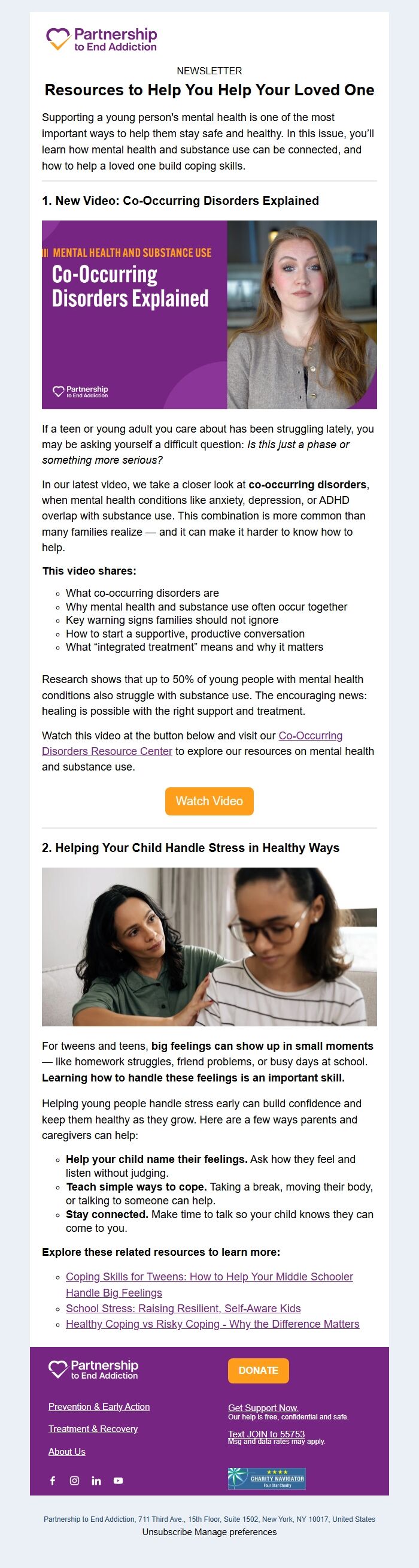
2. Helping Your Child Handle Stress in Healthy Ways
klebercordeiro_GettyImages-1492746026 ([link removed] )
For tweens and teens, big feelings can show up in small moments — like homework struggles, friend problems, or busy days at school. Learning how to handle these feelings is an important skill.
Helping young people handle stress early can build confidence and keep them healthy as they grow. Here are a few ways parents and caregivers can help:
-
Help your child name their feelings. Ask how they feel and listen without judging.
-
Teach simple ways to cope. Taking a break, moving their body, or talking to someone can help.
-
Stay connected. Make time to talk so your child knows they can come to you.
Explore these related resources to learn more:
-
Coping Skills for Tweens: How to Help Your Middle Schooler Handle Big Feelings ([link removed] )
-
School Stress: Raising Resilient, Self-Aware Kids ([link removed] )
-
Healthy Coping vs Risky Coping - Why the Difference Matters ([link removed] )
Prevention & Early Action ([link removed] )
Treatment & Recovery ([link removed] )
About Us ([link removed] )
DONATE
([link removed] )
Get Support Now. ([link removed] )
Our help is free, confidential and safe.
Text JOIN to 55753 ([link removed] )
Msg and data rates may apply.
Facebook ([link removed] )
Instagram ([link removed] )
LinkedIn ([link removed] )
YouTube ([link removed] )
Partnership to End Addiction, 711 Third Ave., 15th Floor, Suite 1502, New York, NY 10017, United States
Unsubscribe ([link removed] )
Manage preferences ([link removed] )
NEWSLETTER
Resources to Help You Help Your Loved One
Supporting a young person's mental health is one of the most important ways to help them stay safe and healthy. In this issue, you’ll learn how mental health and substance use can be connected, and how to help a loved one build coping skills.
1. New Video: Co-Occurring Disorders Explained
If a teen or young adult you care about has been struggling lately, you may be asking yourself a difficult question: Is this just a phase or something more serious?
In our latest video, we take a closer look at co-occurring disorders, when mental health conditions like anxiety, depression, or ADHD overlap with substance use. This combination is more common than many families realize — and it can make it harder to know how to help.
This video shares:
-
What co-occurring disorders are
-
Why mental health and substance use often occur together
-
Key warning signs families should not ignore
-
How to start a supportive, productive conversation
-
What “integrated treatment” means and why it matters
Research shows that up to 50% of young people with mental health conditions also struggle with substance use. The encouraging news: healing is possible with the right support and treatment.
Watch this video at the button below and visit our Co-Occurring Disorders Resource Center ([link removed] ) to explore our resources on mental health and substance use.
Watch Video
([link removed] )
2. Helping Your Child Handle Stress in Healthy Ways
klebercordeiro_GettyImages-1492746026 ([link removed] )
For tweens and teens, big feelings can show up in small moments — like homework struggles, friend problems, or busy days at school. Learning how to handle these feelings is an important skill.
Helping young people handle stress early can build confidence and keep them healthy as they grow. Here are a few ways parents and caregivers can help:
-
Help your child name their feelings. Ask how they feel and listen without judging.
-
Teach simple ways to cope. Taking a break, moving their body, or talking to someone can help.
-
Stay connected. Make time to talk so your child knows they can come to you.
Explore these related resources to learn more:
-
Coping Skills for Tweens: How to Help Your Middle Schooler Handle Big Feelings ([link removed] )
-
School Stress: Raising Resilient, Self-Aware Kids ([link removed] )
-
Healthy Coping vs Risky Coping - Why the Difference Matters ([link removed] )
Prevention & Early Action ([link removed] )
Treatment & Recovery ([link removed] )
About Us ([link removed] )
DONATE
([link removed] )
Get Support Now. ([link removed] )
Our help is free, confidential and safe.
Text JOIN to 55753 ([link removed] )
Msg and data rates may apply.
Facebook ([link removed] )
Instagram ([link removed] )
LinkedIn ([link removed] )
YouTube ([link removed] )
Partnership to End Addiction, 711 Third Ave., 15th Floor, Suite 1502, New York, NY 10017, United States
Unsubscribe ([link removed] )
Manage preferences ([link removed] )
Message Analysis
- Sender profile: Partnership to End Addiction
- Political Party: n/a
- Country: United States
- State/Locality: n/a
- Office: n/a
-
Email Providers:
- HubSpot