
'Israel, the Dreyfus of Nations': Interview with Joël Rubinfeld – Part 1
by Grégoire Canlorbe • May 5, 2026 at 5:00 am
We have been living through a kind of endless "Dreyfus trial," but with one major difference: the state has replaced the person. In the past, Dreyfus stood on trial; today, the Jewish state has taken his place.
The "prosecutors" in this permanent trial are UN agencies, "rapporteurs," Amnesty International, Human Rights Watch, Oxfam, the Human Rights League — which, ironically, was founded in 1901 in the wake of the Dreyfus Affair. There is also a whole ecosystem of organizations claiming to speak in the name of human rights, along with their relays in the newsrooms, in academia, in activist and cultural circles, and on the street.
When I see these so-called "pro-Palestinian" demonstrators, it seems as if many of them could not care less about the Palestinians. If they were truly pro-Palestinian, they would first call for the eradication of Hamas, which is the poison and the nightmare first of all of the Palestinian people. The poison, unfortunately, was widely embraced by Hamas's absolute majority (56%) in the last Palestinian legislative elections in 2006.
This fever in the streets weighs on political leaders. The great problem is that many of them think in purely arithmetical terms. They tend to hold a simplistic, and therefore racist, view of communities: "Jews" equals "Israel," and "Muslims" equals "Palestine." Once they do the math, skewed conclusions follow.
The votes are what make the situation almost irreversible. It has been called "Islam's Rule of Numbers": when you are in the minority, you keep relatively inconspicuous, but the larger one's percentage of the population becomes, the more assertive one gets.
Look at Nigeria, which is roughly half Muslim and half Christian. Since at least 2000, there has been an extremist Muslim genocide underway....
In Brussels, given its specific demographics, antisemitism has become an electoral asset.
[S]ome might hope, out of terror and a wish to survive, that if they are just nice to their tormentor, he will soon come around and see how "good" they are. They can even convince themselves that if they agree with their tormentor, he will appreciate and admire them –then they will no longer be in danger. They might even adopt his point of view, like a child whose parent is angry with him. It is easier for him to think that the parent is right and the problem must be with himself. It is an attempt to cope with, or somehow get through, a terrifying situation -- and it usually does not work. Tormentors torment; it is what they like to do. As the psychiatrist Dr. Kenneth Levin noted in his important book, The Oslo Syndrome: The Delusions of a People Under Siege, a child is dependent on his parent, and wants to feel safe. "If I just stop wetting my bed," the child might think, "then maybe he will like me." It is too terrifying to see that, say, the bed-wetting may not be the problem, just a pretext. We saw in World War II that people can rationalize anything.
Deep down, I think they know that this break amounts to a surrender: they leave Judaism to escape the pressure, to gain social respectability.... But from that point on, the Jews who remain — those who continue to embrace their identity despite the attacks—become an unbearable mirror for them.
Every Jew who stands firm reflects back an uncomfortable image to them. The one who has broken away sees himself as a coward... so now he turns against the Jews to show everyone else, "See? I am not like them. I am good! Now do you like me?"
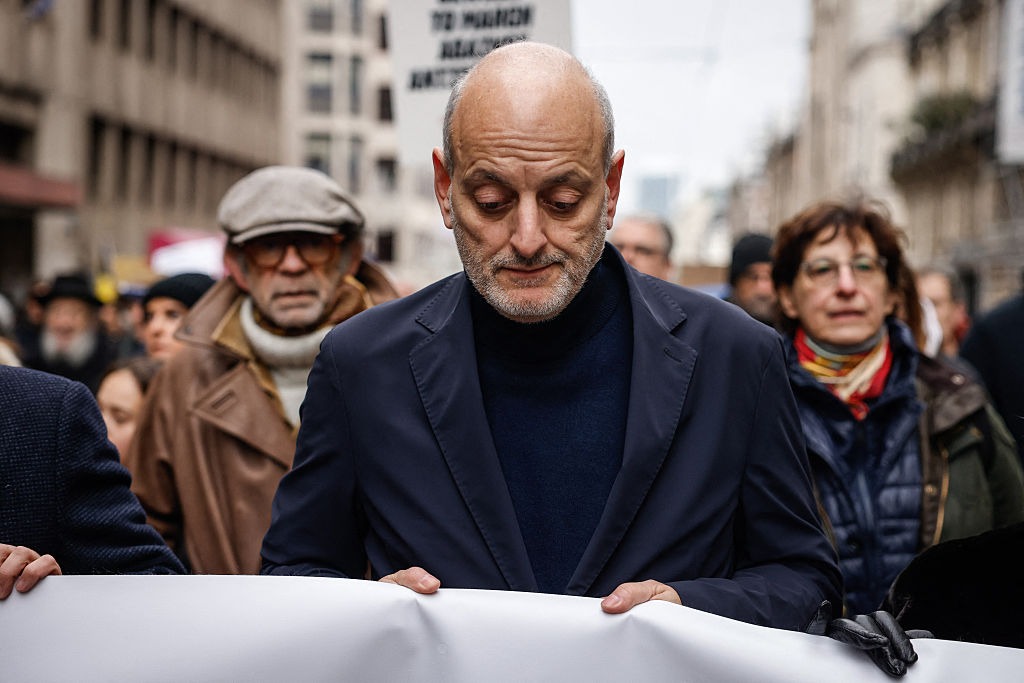
Joël Rubinfeld is a founding member and president of the Belgian League Against Antisemitism and president of the Jewish Coalition for Kurdistan. He was president of the Coordinating Committee of Jewish Organizations in Belgium, vice-president of the European Jewish Congress, and co-chairman of the European Jewish Parliament.
Canlorbe: You have described Israel as the "Dreyfus of nations." What does that mean?
Rubinfeld: Since October 7, 2023, we have been living through a kind of endless "Dreyfus trial," but with one major difference: the state has replaced the person. In the past, Dreyfus stood on trial; today, the Jewish state has taken his place.