Hello,
Thanks for signing up for MarketBeat Daily Ratings—we’re excited to have you on board.
Every weekday, you’ll get a curated summary of new “Buy” and “Sell” ratings from Wall Street’s top-rated analysts, the latest stock news, and bonus investing content—all delivered straight to your inbox.
You’re just two quick steps away from completing your sign-up:
1. Make sure our emails go to your inbox
Gmail users:
Mobile: Tap the three dots (…) in the top right and select Move to Inbox or Move to Primary
Desktop: Click the folder icon at the top and select Move to Inbox or Primary
Apple Mail users:
Tap our email address at the top (next to From: on mobile), then select Add to VIP
Other providers:
Reply to this message and add [email protected] to your contacts
2. Confirm your subscription
Click this link to confirm your subscription. This verifies your account and ensures you receive your newsletters without interruption instead of getting stuck in your spam filter.
Confirm your subscription here.
After you confirm, feel free to download our popular free report, "7 Stocks to Buy and Hold Forever" with this link.
Thanks again for subscribing—we look forward to being part of your investing journey.

Matthew Paulson
Founder and CEO, MarketBeat.
P.S. If you didn’t mean to subscribe, no problem—you can unsubscribe here.
Today's Bonus Story Uber’s AV Pivot: Growth Opportunity or Margin Risk?Written by Chris Markoch. Date Posted: 4/22/2026. 
Key Points- Uber is committing over $10 billion to autonomous vehicles, signaling a major shift away from its asset-light model.
- Rising labor costs and AV investments are expected to pressure earnings in the near term.
- Analysts remain bullish long term, but are lowering price targets as margin expansion timelines extend.
- Special Report: The Biggest IPO Ever: Claim Your Stake Today
Uber Technologies, Inc. (NYSE: UBER) has been taking the lead in autonomous vehicle (AV) adoption for several quarters. Recent announcements reveal the company has entered into deals with over a dozen automotive partners, including Baidu Inc. (NASDAQ: BIDU), Rivian Automotive Inc. (NASDAQ: RIVN), and Lucid Group (NASDAQ: LCID). In total, the deals mean Uber is committing over $10 billion to AV vehicles, equity stakes, and fleet purchases.
The deals further emphasize the company’s commitment to becoming the largest facilitator of AV trips in the world by 2029. However, they also move the company away from the asset-light business model that powered Uber’s growth over the last decade.
Most investors are reacting to the Iran strikes without understanding the underlying motive driving the decision.
Addison Wiggin, Founder of Grey Swan Investment Fraternity, says there is a hidden reason behind the bombing - and knowing it could change how you position your money right now. Discover the real reason behind the Iran strikes before markets react Uber's asset-light model — drivers owned the cars, not Uber — served it extraordinarily well. It allowed the company to scale globally with minimal capital expenditure and to focus on the platform and marketplace economics that investors favor. The question facing UBER, and more importantly its investors, is what it means when that model is replaced.
Gig Work Has Become Big Business
Autonomous vehicle technology may be inevitable. But this is a pivot Uber is being forced into, not one it chose lightly. The company’s ride-hailing model began with a simple premise: individuals would drive to supplement their income. That premise didn't fully anticipate a pandemic, a tight labor market, and a workforce that increasingly treats gig work as a primary livelihood rather than a side hustle.
That shift has made the “gig economy” mainstream and given drivers considerably more leverage. Recent legislation, like California’s Proposition 3, shows drivers want to be compensated as employees, with protections and benefits. Such changes would make the earnings math harder for Uber and, by extension, make UBER less attractive to investors.
In some ways, this mirrors the challenge Netflix (NASDAQ: NFLX) faced. Netflix created a category but eventually realized original content — not syndicated programming — was the real growth driver. Producing original content is expensive, which prompted a pivot to ad-supported models, moving away from the original premise of uninterrupted viewing. It was an uncomfortable concession that has since become one of the company’s fastest-growing segments.
Viewed through that lens, Uber’s pivot to AV follows similar logic. It’s abandoning the purity of its original model and absorbing near-term pain to reduce the risk of being disrupted.
The Earnings Math Is Getting Harder
Investors are already seeing short-term pain in the numbers. Analysts forecast Q1 2026 EPS of $0.71 per share on a diluted basis, down roughly 14.5% from $0.83 in the year-ago quarter. For the full fiscal year, analysts expect UBER to report EPS of $3.35, down 36.8% from $5.30 in fiscal 2025.
The decline reflects two pressures colliding at once: driver costs are rising as labor dynamics shift, and Uber is simultaneously investing heavily in the AV infrastructure it hopes will eventually replace those costs.
It's a race. The faster AV adoption scales, the more driver expenses can be reduced. But the runway is capital-intensive, and the transition won't happen overnight. The Uber analyst forecasts on MarketBeat show that analysts have noticed.
DA Davidson lowered its price target following Uber's Q4 2025 earnings, citing elevated investments. Stifel cut its price target on UBER to $94 from $105. Wells Fargo trimmed its target to $95 while maintaining an overweight rating.
In each case, analysts are signaling that the bull case remains intact, but the timeline for margin expansion is being pushed out.
The Trade-Off Investors Need to Understand
The $10 billion AV commitment isn't reckless; it is, arguably, inevitable. Waymo is already operating commercially in multiple U.S. cities, and Tesla (NASDAQ: TSLA) is clearly pursuing a robotaxi model. Uber's move to host AV fleets at scale is a necessary step to avoid being disintermediated by the very technology partners it once tried to remain neutral toward.
The Lucid partnership — a $500 million commitment for at least 35,000 vehicles — is the clearest signal that Uber intends to own this transition. Uber shares surged 6.8% when the AV fleet strategy was announced, suggesting the market is willing to reward ambition even if near-term earnings suffer.
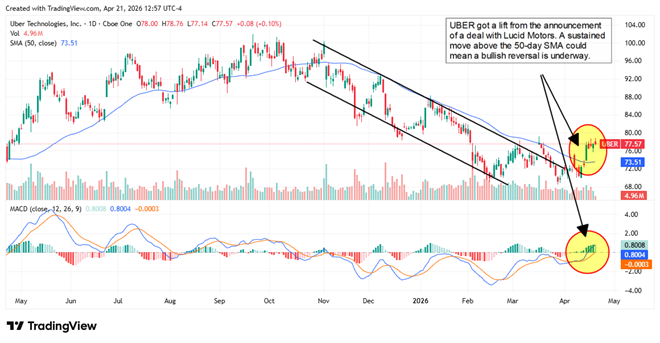
The central tension for investors is straightforward: Uber is spending its way out of one cost problem (gig labor) and into another (fleet capital). The bet is that AV unit economics will eventually be materially better than human-driver economics.
History suggests that bet is probably correct. The key questions are how long investors are willing to wait and how much earnings compression they're willing to tolerate in the meantime. |