Editor's Note: Louis Navellier, the quant legend who recommended Nvidia in 2005, just ran a live AI demo that left his research team stunned. Click here to watch it now or read more below.
Dear Reader, I put the paid version of ChatGPT head-to-head against the FREE version of Elon's Grok. It wasn't even close. Grok produced dozens of picture-perfect results while ChatGPT struggled to conjure even one. But what really floored me wasn't the demo itself. It's what's behind the technology. In just 19 days, Elon built a system that Oracle executives said was impossible. He connected 200,000 GPUs in a 114-acre facility on the Tennessee-Mississippi state line — and created what Nvidia's CEO calls "superhuman" AI. Competitors are literally flying spy planes overhead to figure out how he did it. Watch my live demo and see the stock at the center of Elon's AI breakthrough. And one tiny company's technology was central to the entire feat. And it's 49 times smaller than Tesla. The last time a tech shift this big created new supply chain winners, early investors had the chance to see extraordinary gains. Lithium Americas: 1,452%. NIO: 1,755%. Blink Charging: 3,648%. All in under two years. Click here to watch my live demo and get the full details in this free briefing — including the name and ticker of this stock. Regards, Louis Navellier Senior Investment Analyst, InvestorPlace P.S. The last time my system helped me identify a company this deeply embedded in a major tech buildout, early investors had a shot at 3X returns within 18 months. This one's even more deeply positioned. Watch the demo and get the ticker in this free briefing before this story breaks wide.
Friday's Bonus News STMicronelectronics Sends Industrial Chips Into OverdriveWritten by Thomas Hughes. Date Posted: 4/24/2026. 
Key Points- STMicronelectronics is well-positioned for a global semiconductor supercycle.
- Q1 results confirm that momentum is building and improving profitability is ahead.
- Analysts and institutions indicate accumulation and underpin a shifting market dynamic.
- Special Report: Your book is inside
Industrial chipmakers have been in rebound mode, with names like STMicroelectronics (NYSE: STM) leading the charge. The story in late April is that STMicroelectronics’ Q1 results not only affirm the rebound—centered on inventory normalization and improving demand—but also point to accelerating momentum. The net result is that its share price and those of its peers rocketed higher and are likely to continue rising over the long term. This is not merely normalization in play, but the acceleration of a multiyear semiconductor supercycle driven by demand across multiple segments. Simply put, AI is driving a systemic shift in technology, prompting major hardware upgrades across a wide range of products. Data centers need to be built, but so do the connectivity systems, the industrial infrastructure, and the end-point devices that AI will power — all of which require chips that STMicroelectronics is well positioned to provide. The chart action speaks for itself. The market underwent a sharp correction beginning in 2024 and has only recently recovered. Price action in April set a long-term high, breaking above a critical resistance level and signaling a shift in market dynamics. In this setup, STM could rebound by roughly the dollar amount of the prior correction—about $25—in the near-to-mid term, and by the equivalent percentage gain over the longer term. 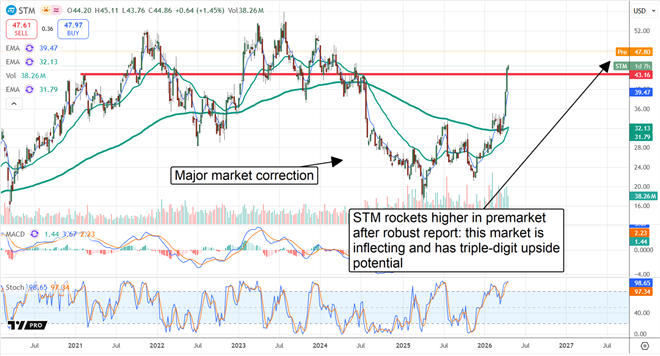
That implies potentially more than 100% upside, which could be reached within only a few quarters given the value presented. STM currently trades at a premium relative to the current-year forecast—around 40X earnings—but that multiple reflects a robust outlook and may understate future earnings. Longer-term forecasts also appear conservative: the stock trades at roughly 15X 2030 estimates, setting the stage for a greater-than-100% potential rally. STMicroelectronics: Looking Past Weak Earnings to a Strong FutureSTMicroelectronics delivered a mixed quarter: fiscal Q1 revenue beat MarketBeat’s reported consensus while earnings missed, but the growth story matters more because one-time items impacted EPS. Revenue rose 23% year-over-year to $3.1 billion, accelerating sequentially and reversing last year’s contraction. Strength came from OEM and distribution demand, with most underlying segments contributing to the top-line gain. The one area of weakness was the Power & Discrete business, which contracted by 1.8% but is expected to recover in coming quarters. Areas of strength included Analog, Embedded Processing, and RF/Optical — each grew by double digits, led by a 32% gain in RF, with Analog up 23% and Embedded Processing up 31.3%. Margin news was mixed. GAAP and adjusted results were affected by acquisition-related one-offs that also influenced cash flow metrics. After adjusting for inventory, working capital changes, and acquisition effects, margins improved: net cash flow rose by double digits and free cash flow remained sufficient to support financial health and capital returns. While adjusted earnings of $0.13 per share missed estimates by about $0.05, investors are focused on guidance, which calls for another quarter of acceleration and stronger margins. That said, Q2 guidance is likely to be cautiously framed. STMicroelectronics Builds Value and Pays You to Own ItSTMicroelectronics' balance sheet reflects the impact of the acquisition and capital returns: cash is down sequentially but the reductions are modest and offset by other improvements. The company remains well-capitalized with nearly $2 billion in cash, total assets up, total liabilities down year-over-year, and equity recently strengthened. Leverage is low: long-term debt is less than 0.35X liabilities, about 0.12X equity, and roughly equal to cash on hand. Looking ahead, STM can not only sustain the dividend and share buybacks, but is likely to increase capital returns as the semiconductor supercycle progresses. The dividend yield is modest at roughly 0.6%—not large, but enough to keep dividend-focused investors and funds engaged—while buybacks meaningfully reduce share count. Trailing 12-month buyback activity reduced the share count by approximately 2% year over year in Q1, and that pace is expected to continue. Analysts and Institutions Drive STM Price ActionMarketBeat tracks 14 analysts with current ratings on STM, and the trends are improving. Several price-target increases and upgrades were recorded around the report, firming the Moderate Buy rating and lifting consensus targets. The rise in the consensus price target is notable: it had been flat on a trailing-12-month basis but jumped about 20% following the results. While consensus still lags the market, the direction of analyst revisions supports the stock’s move toward the higher end of its range. Institutions, which collectively own roughly 60% of the company, have been ramping up buying activity in early 2026, further supporting the stock’s momentum. . |